


Why 2026 Will Be a Landmark Year for India’s Aditya-L1 Sun Mission
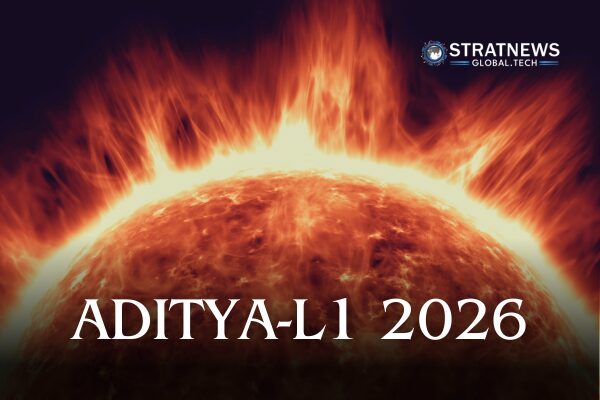
For India’s first solar observatory, Aditya-L1, the year 2026 will mark an extraordinary phase. It will be the first time the spacecraft observes the Sun during its peak activity cycle — a rare opportunity that occurs roughly every 11 years when the Sun’s magnetic poles reverse. This period, known as the solar maximum, transforms the Sun from calm to turbulent, creating powerful solar storms and vast coronal mass ejections (CMEs).
A Year of Intense Solar Activity
During this cycle, the Sun’s outer layer, or corona, releases massive bubbles of charged particles known as CMEs. These can weigh up to a trillion kilograms and travel as fast as 3,000 kilometres per second. At top speed, they can reach Earth in just 15 hours.
“In quieter periods, the Sun launches two or three CMEs daily,” explains Professor R. Ramesh of the Indian Institute of Astrophysics (IIA). “Next year, we expect 10 or more every day.”
Professor Ramesh leads the Visible Emission Line Coronagraph (Velc), the most vital of Aditya-L1’s seven instruments. His team monitors and analyses data from the mission to study CMEs — key to understanding the Sun and safeguarding technology on Earth.
Understanding and Preventing Space Disruptions
Although CMEs rarely pose direct harm to humans, they can trigger geomagnetic storms that disrupt satellites, power grids, and communication systems. There are nearly 11,000 satellites orbiting near Earth, including 136 from India, making early detection essential.
“The most beautiful effect of CMEs is the aurora,” says Professor Ramesh. “They show charged particles from the Sun reaching Earth. But the same activity can also damage satellite electronics and disrupt electricity networks.”
Historical records show the potential danger of such events. The 1859 Carrington Event disabled telegraph systems globally. In 1989, a solar storm left six million people in Quebec without power for nine hours. More recently, in 2022, a CME caused NASA to lose 38 satellites.
Aditya-L1’s Unique Edge
While other solar missions observe the Sun, Aditya-L1’s coronagraph provides a crucial advantage. It functions like an artificial Moon, blocking the Sun’s bright surface to give scientists a constant view of the corona — even during eclipses. This allows uninterrupted 24-hour observation, a capability unmatched by other missions.
Aditya-L1 can also observe eruptions in visible light, letting scientists measure a CME’s temperature and energy. This helps determine its strength and potential impact on Earth.
In September 2024, Aditya-L1 recorded one of its largest CMEs to date. The event, which began on 13 September at 00:30 GMT, had a mass of 270 million tonnes and a temperature of 1.8 million degrees Celsius. Its energy equalled 2.2 million megatons of TNT — yet it was only considered “medium-sized”.
As solar activity increases, scientists expect even larger and more energetic CMEs. The data gathered in 2026 will be vital for developing strategies to protect satellites and improve our understanding of near-Earth space.
with inputs from Reuters