


Close Menu
Stratnews GlobalStratnews Global
    Facebook X (Twitter) Instagram
    Trending
    • Starlink Keeps Citizens Online Amid Nationwide Internet Blackout In Iran
    • China: Are You Dead Is Not A Question, It’s An App Going Viral
    • ARI Pune Researchers Discover Clues to Healthy Ageing
    • India AI Impact Summit 2026 Set to Shape the Nation’s AI Future
    • BHASHINI Samudaye Unites India’s Language AI Ecosystem
    • Black Holes Found to Starve Galaxies to Death
    • Space Becomes the World’s Next Industrial Economy
    • White Dwarf Produces Dazzling Shockwave in the Milky Way
    Stratnews GlobalStratnews Global
    Write for Us
    Wednesday, January 14
    • Space
    • Science
    • AI and Robotics
    • Industry News
    Stratnews GlobalStratnews Global
    Home » Black Holes Found to Starve Galaxies to Death

    Black Holes Found to Starve Galaxies to Death

    Aditya LenkaBy Aditya LenkaJanuary 14, 2026 Space No Comments3 Mins Read
    Black Holes Starve Galaxies

    How Black Holes Slowly Starve Galaxies

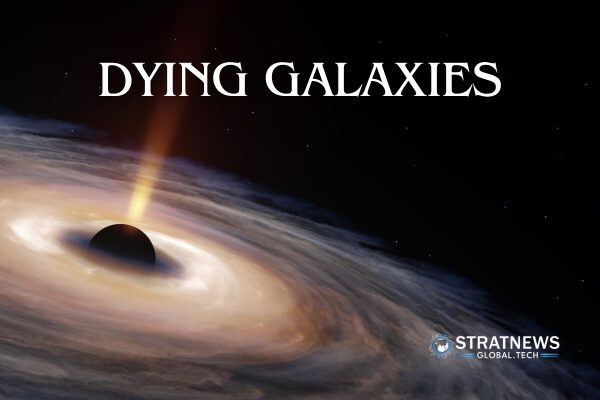
    Galaxies do not always die in violent bursts of energy. Some fade quietly, suffocated by the same black holes that once fuelled their brilliance. Astronomers using the James Webb Space Telescope (JWST) and the Atacama Large Millimetre Array (ALMA) have now witnessed this slow demise in action, observing a galaxy that appears to be dying not from collision or catastrophe, but from gradual starvation.

    A Galaxy Fading from Within

    The galaxy in question, formally designated GS-10578 and informally known as “Pablo’s Galaxy” after the astronomer who first analysed it, lies around 10.8 billion light years from Earth. During its prime, between 12.5 and 11.5 billion years ago, it produced stars at a remarkable rate, building a mass roughly 200 billion times that of the Sun within a single billion years. Then, quite suddenly, its star formation stopped.

    Researchers from the University of Cambridge suspected its central supermassive black hole might be responsible. When they used ALMA’s powerful radio array for seven hours to search for carbon monoxide—a tell-tale sign of cold hydrogen gas that fuels new stars—they found almost nothing. The galaxy appeared nearly empty of the material required for star formation.

    “What surprised us was how much you can learn by not seeing something. The absence of cold gas pointed toward slow starvation rather than a single dramatic event,” said Dr Jan Scholtz from Cambridge’s Cavendish Laboratory.

    Winds that Steal a Galaxy’s Breath

    JWST spectroscopy revealed the missing clue. Powerful winds were streaming from the galaxy’s central black hole at speeds of about 400 kilometres per second, expelling nearly 60 solar masses of gas every year. If that rate continues, the galaxy’s remaining star-forming fuel will disappear in as little as 16 million years, or at most 220 million—an astonishingly short period compared to the billion-year lifespans typical of similar systems.

    Yet Pablo’s Galaxy shows no sign of turmoil. Webb’s detailed images depict a calm, disc-like structure with no evidence of violent mergers or collisions. This ruled out external forces as the cause of its decline. Instead, astronomers concluded that the black hole’s repeated heating and expulsion of gas over time gradually choked off star formation. Each feedback episode prevented new material from cooling and settling into the galactic core, starving the system from within.

    A Quiet End in a Busy Universe

    This finding sheds light on a class of ancient, massive galaxies that JWST has recently uncovered in the early universe. These galaxies appear too old and inactive for their age, suggesting they burned through their gas supplies quickly before fading into dormancy. Slow, internal starvation by their central black holes could explain this pattern of rapid rise and quiet decline.

    By showing that galaxies can die gently rather than explosively, Pablo’s Galaxy offers a new perspective on how cosmic giants evolve. Even in the vastness of space, it seems, death can arrive not with a bang, but with a whisper.

    Author

    • Aditya Lenka
      Aditya Lenka

      A multi-faceted professional with a diverse range of skills and experiences. He currently works as a Producer, Digital Marketer, and Journalist for several well-known media outlets, namely StratNewsGlobal, BharatShakti, and Interstellar. With a passion for storytelling and a keen eye for detail, Aditya has covered a wide range of topics and events across India, bringing a unique perspective to his work.When he's not busy producing content, Aditya enjoys exploring new places and cuisines, having traveled extensively throughout India. He's also an avid writer and poet, often penning his thoughts and musings in his free time. And when he wants to unwind and relax, Aditya spends time with his two loyal companions, Zorro and Pablo, his beloved dogs.Aditya's dynamic personality and varied interests make him a unique individual, always eager to learn and experience new things.

      View all posts
    Featured
    Share. Facebook Twitter Pinterest LinkedIn Tumblr Email Reddit Telegram WhatsApp
    Aditya Lenka
    Aditya Lenka

      A multi-faceted professional with a diverse range of skills and experiences. He currently works as a Producer, Digital Marketer, and Journalist for several well-known media outlets, namely StratNewsGlobal, BharatShakti, and Interstellar. With a passion for storytelling and a keen eye for detail, Aditya has covered a wide range of topics and events across India, bringing a unique perspective to his work.When he's not busy producing content, Aditya enjoys exploring new places and cuisines, having traveled extensively throughout India. He's also an avid writer and poet, often penning his thoughts and musings in his free time. And when he wants to unwind and relax, Aditya spends time with his two loyal companions, Zorro and Pablo, his beloved dogs.Aditya's dynamic personality and varied interests make him a unique individual, always eager to learn and experience new things.

      Keep Reading

      Starlink Keeps Citizens Online Amid Nationwide Internet Blackout In Iran

      China: Are You Dead Is Not A Question, It’s An App Going Viral

      ARI Pune Researchers Discover Clues to Healthy Ageing

      India AI Impact Summit 2026 Set to Shape the Nation’s AI Future

      BHASHINI Samudaye Unites India’s Language AI Ecosystem

      Space Becomes the World’s Next Industrial Economy

      Add A Comment
      Leave A Reply Cancel Reply

      Anti Drone System (CUAS)
      Latest Posts

      Starlink Keeps Citizens Online Amid Nationwide Internet Blackout In Iran

      January 14, 2026

      China: Are You Dead Is Not A Question, It’s An App Going Viral

      January 14, 2026

      ARI Pune Researchers Discover Clues to Healthy Ageing

      January 14, 2026

      India AI Impact Summit 2026 Set to Shape the Nation’s AI Future

      January 14, 2026

      BHASHINI Samudaye Unites India’s Language AI Ecosystem

      January 14, 2026

      Black Holes Found to Starve Galaxies to Death

      January 14, 2026

      Space Becomes the World’s Next Industrial Economy

      January 14, 2026

      White Dwarf Produces Dazzling Shockwave in the Milky Way

      January 14, 2026

      TSMC profit to soar 27% on AI demand

      January 12, 2026

      Japan Begins Deep-Sea Mission to Extract Rare Earths near Minamitori Island

      January 12, 2026

      Subscribe to News

      Get the latest sports news from NewsSite about world, sports and politics.

      • Astronomical Events
      • Space Missions
      • Industry News
      • Science
      StratNewsGlobal Tech
      Facebook X (Twitter) Instagram LinkedIn YouTube
      © 2026 StratNews Global, A unit of BharatShakti Communications LLP
      • About Us
      • Contributors
      • Copyright
      • Contact
      • Write for Us

      Type above and press Enter to search. Press Esc to cancel.