


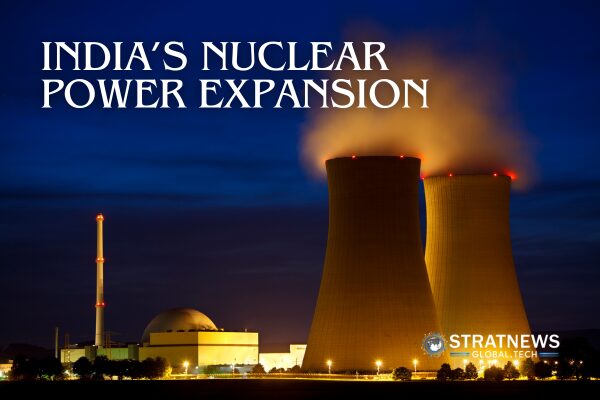
India’s nuclear energy programme is set for a significant scale-up, with the country’s India nuclear power capacity currently standing at 8,780 MW across 24 operational nuclear power plants, excluding the 100 MW Rajasthan Atomic Power Station-1.
In a written reply to the Rajya Sabha, Minister of State for Personnel, Public Grievances & Pensions and Prime Minister’s Office Dr Jitendra Singh said that 17 additional nuclear reactors, with a combined capacity of 13,100 MW, are under various stages of implementation and are expected to be completed progressively by 2031–32.
India Nuclear Power Capacity Expansion Underway
Of the 17 reactors, seven are under construction or commissioning, while ten are currently in pre-project activities. Major projects under construction include the 700 MW RAPP-8 unit at Rawatbhata in Rajasthan, which has achieved nearly 99% physical progress, and the Kudankulam Nuclear Power Project units 3 to 6 in Tamil Nadu.
Civil works are also progressing at the Gorakhpur Haryana Anu Vidyut Pariyojana units 1 and 2. Additional reactors planned at Kaiga, Gorakhpur, Chutka, and Mahi Banswara are in different stages of pre-project development.
Fast Breeder Reactor Programme at Kalpakkam
Parallel to the thermal reactor programme, BHAVINI is commissioning the 500 MWe Prototype Fast Breeder Reactor (PFBR) at Kalpakkam in Tamil Nadu. The government has approved pre-project activities for two additional 500 MWe Fast Breeder Reactors, FBR-1 and FBR-2, at the same site. Financial sanction for these twin units will be sought after PFBR achieves first criticality.
Safety Reviews and Environmental Clearances
Dr Singh said that safety and performance reviews of all reactors are conducted on an ongoing basis, with necessary upgrades implemented to meet state-of-the-art standards. Renovation and modernisation work is currently underway at four operating reactors.
All nuclear power projects undergo comprehensive Environment Impact Assessment studies in line with the Ministry of Environment, Forest and Climate Change’s approved Terms of Reference. Construction begins only after environmental clearance is granted.
With multiple reactors advancing simultaneously, the expansion marks a major step in strengthening India nuclear power capacity and enhancing long-term energy security.