


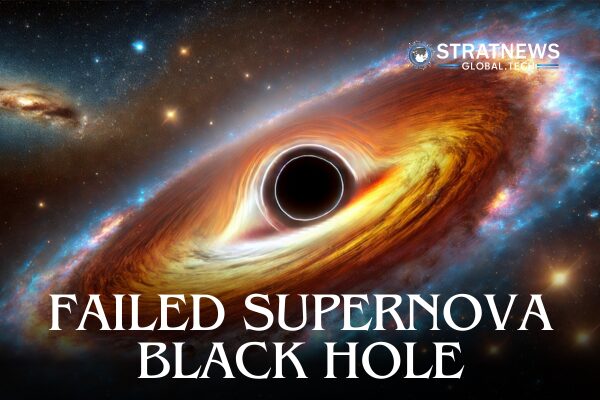
Failed Supernova Black Hole Formation Spotted in Real Time
Astronomers have documented compelling evidence of failed supernova black hole formation after tracking a massive star that vanished without exploding. The star, known as M31-2014-DS1, resided in the Andromeda Galaxy, roughly 2.5 million light-years from Earth. Instead of detonating in a brilliant supernova, the star appeared to collapse quietly, leaving behind only a faint infrared glow caused by gas and dust being pulled inward by a newly formed black hole.
Researchers observed that the star remained luminous for four decades before brightening in 2015 and then almost disappearing from view. The behaviour is consistent with failed supernova black hole formation, in which the collapse shockwave lacks sufficient energy to blow the star apart.
How a Star Collapses Without Exploding
Most massive stars end their lives in dramatic supernova explosions, leaving behind either neutron stars or black holes. In typical scenarios, the collapsing core generates a powerful shockwave that expels the outer layers. However, in a failed supernova black hole formation event, gravity overwhelms the shock.
Astrophysicist Kishalay De of the Flatiron Institute and Columbia University said the evidence suggests stars with masses as low as about 13 times that of the Sun can form black holes without exploding. Over its roughly 15-million-year lifetime, M31-2014-DS1 had already shed about 60% of its mass through stellar winds before its quiet demise.
A Gentler End Than Expected
Instead of a violent blast, the star’s outer envelope was gently ejected. As that material cooled and expanded, it created a temporary infrared brightening. Afterward, the star faded across wavelengths as its core collapsed into a black hole estimated to be about five times the Sun’s mass.
Scientists believe rotation may play a key role. A slower-spinning star allows most of its mass to fall straight inward, limiting the explosive energy released. The energy from this event was estimated to be roughly a thousand times weaker than a typical supernova.
The study, published in Science, provides rare real-time observational insight into how black holes can form. Researchers are now investigating how common failed supernova black hole formation might be, noting that theoretical uncertainties remain about what fraction of massive stars collapse in this quieter manner.
Author
 View all posts
A multi-faceted professional with a diverse range of skills and experiences. He currently works as a Producer, Digital Marketer, and Journalist for several well-known media outlets, namely StratNewsGlobal, BharatShakti, and Interstellar. With a passion for storytelling and a keen eye for detail, Aditya has covered a wide range of topics and events across India, bringing a unique perspective to his work.
When he's not busy producing content, Aditya enjoys exploring new places and cuisines, having traveled extensively throughout India. He's also an avid writer and poet, often penning his thoughts and musings in his free time. And when he wants to unwind and relax, Aditya spends time with his two loyal companions, Zorro and Pablo, his beloved dogs.
Aditya's dynamic personality and varied interests make him a unique individual, always eager to learn and experience new things.