


US Departments Transport Microreactor To Demonstrate Rapid Nuclear Deployment
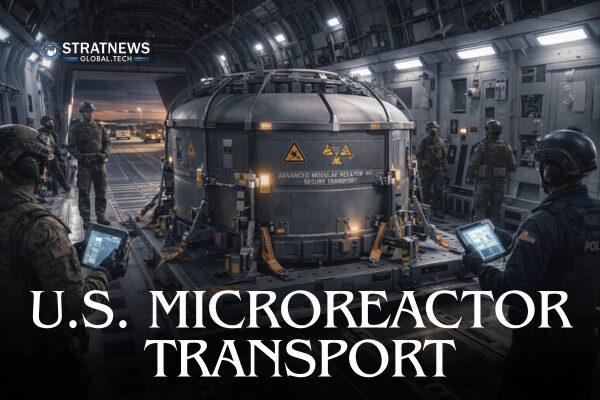
The US Departments of Energy and Defense transported a small nuclear reactor by cargo plane for the first time on Sunday, February 15. The agencies moved the unit from California to Utah to demonstrate how quickly nuclear power systems could deploy for military and civilian use.
Officials described the operation as a milestone for energy security and defence logistics. Moreover, they said the test highlights the growing role of compact nuclear technology in meeting strategic needs.
Microreactor Flown From California To Utah
The two departments partnered with California based Valar Atomics for the mission. They loaded one of the company’s Ward microreactors onto a C 17 military transport aircraft and flew it to Hill Air Force Base in Utah. Importantly, the reactor carried no nuclear fuel during the flight.
Energy Secretary Chris Wright and Under Secretary of Defense for Acquisition and Sustainment Michael Duffey travelled aboard the C 17 alongside the reactor and its components. After the flight, both officials praised the operation as a breakthrough for US nuclear capability.
They said the demonstration showed how rapidly authorities could transport advanced nuclear systems to remote or critical locations. As a result, military planners could consider microreactors as flexible energy sources for bases or emergency scenarios.
Push For Small Nuclear Reactors
President Donald Trump’s administration views small nuclear reactors as a key element in expanding domestic energy production. In May last year, Trump issued four executive orders designed to accelerate nuclear deployment across the United States.
The administration argues that the country must boost energy output to meet rising demand linked to national security requirements and competitive artificial intelligence development. Therefore, officials see compact reactors as part of a broader strategy to strengthen energy independence.
Small nuclear reactors offer potential advantages in mobility and scalability. Unlike traditional large scale plants, developers can transport and install them more quickly. Consequently, they may provide reliable power in areas where conventional infrastructure proves difficult to build.
Strategic And Civilian Implications
The successful airlift demonstrated the logistical feasibility of moving a reactor by military aircraft. Although the unit contained no fuel, the test still required careful coordination between energy and defence officials.
Supporters argue that such systems could supply power to military installations in remote regions. In addition, they believe the technology could support civilian communities facing energy shortages or natural disasters.
By showcasing the Ward microreactor’s mobility, the Departments of Energy and Defense signalled their intent to integrate advanced nuclear solutions into both defence planning and broader energy policy. The flight to Utah marked a symbolic and practical step in that direction.
With inputs from Reuters