


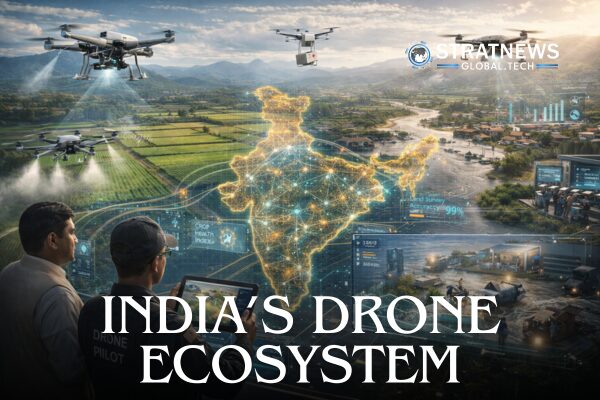
India’s drone ecosystem has evolved into a structured and regulated framework that now supports governance, development and national security. As of February 2026, more than 38,500 drones hold registered Unique Identification Numbers, while 39,890 remote pilots possess DGCA certification. In addition, 244 approved training organisations operate nationwide, reflecting strong institutional capacity.
Over the past two decades, drone technology has shifted from experimental use to mainstream deployment. Today, India applies drones across land surveys, agriculture, infrastructure inspection, disaster management, railway monitoring and defence. This expansion reflects coordinated policy reforms, simplified regulations and digital governance tools that have reduced barriers and encouraged innovation.
Drones Transform Public Service Delivery
Drone integration into flagship schemes has strengthened efficiency and transparency. Under the SVAMITVA Scheme, authorities have surveyed 3.28 lakh villages using drone technology. Consequently, officials have prepared 2.76 crore property cards for 1.82 lakh villages across 31 states and Union Territories. The programme aims to settle land disputes and improve access to bank credit in rural areas.
Similarly, drone deployment under the Pradhan Mantri Fasal Bima Yojana has improved crop assessment and insurance processes. Meanwhile, the National Highways Authority of India mandates monthly drone video recordings for highway projects. Contractors upload footage for digital review, and project directors cross verify it during inspections. Therefore, drone data now strengthens oversight and dispute resolution.
The Ministry of Railways has also directed zones to deploy drones for infrastructure monitoring. Railway Protection Force units use drones for surveillance, crowd management and anti trespass operations. In disaster management, specialised drone systems provide real time visuals during floods and landslides, enabling faster and more coordinated rescue efforts.
Agriculture And Women’s Empowerment
The Namo Drone Didi initiative, launched in November 2023, has reshaped agricultural practices. So far, 1,094 drones have been distributed to women Self Help Groups, including more than 500 under the core initiative. These drones support precision spraying and modern farming techniques.
As a result, women farmers have improved productivity, reduced input costs and created new livelihood opportunities. The shift from manual labour to technology driven agriculture marks a significant structural change in rural economies.
Policy Reforms Accelerate Adoption
The Drone Rules 2021 and subsequent amendments in 2022 and 2023 have liberalised operations. Authorities reduced forms from 25 to five and lowered approval requirements from 72 to four. Furthermore, officials declared nearly 90 percent of airspace as a Green Zone for operations up to 400 feet. They also replaced traditional pilot licences with Remote Pilot Certificates and simplified identification requirements.
The Production Linked Incentive scheme, with an outlay of ₹120 crore, promotes domestic manufacturing. Additionally, the government reduced GST on drones to five percent in September 2025. This measure lowered costs and encouraged wider adoption.
Digital platforms have also strengthened governance. As of February 2026, 38,575 drones hold registration on the Digital Sky system, and nearly 40,000 Remote Pilot Certificates have been issued. Capacity building programmes, innovation challenges and national expos further support start ups and research institutions.
India’s drone ecosystem now combines policy reform, skill development and financial incentives. Together, these measures have embedded drone technology into agriculture, infrastructure, disaster response and defence. As expansion continues, India positions itself as a future ready and self reliant leader in unmanned aerial systems.