


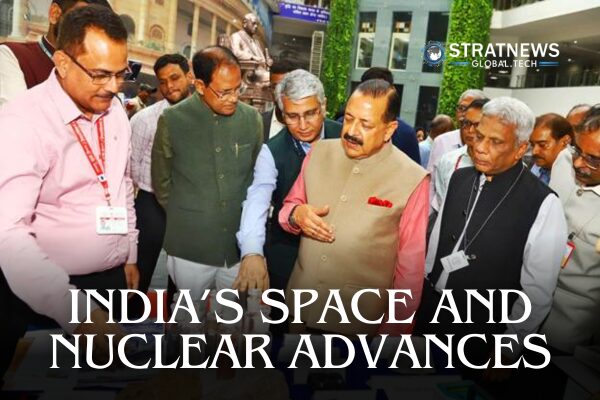
Union Minister of State for Science and Technology Dr Jitendra Singh said exhibitions highlighting India’s scientific achievements can inspire young people to explore careers in science and technology. He made the remarks during a visit to an exhibition showcasing India’s advances in space technology, nuclear energy and strategic mineral exploration.
The exhibition was organised at the Dr Ambedkar International Centre in New Delhi. It presented key developments in India’s scientific and technological capabilities across multiple sectors.
Inspiring students through science exhibitions
Dr Jitendra Singh said showcasing India’s achievements in space and nuclear science can ignite students’ curiosity and help them discover their natural talents. Therefore, he encouraged organisers to expand outreach to young people.
He advised organisers to arrange guided visits for school and college students. Such visits, he said, would allow students to directly engage with scientific concepts and national technological achievements.
In addition, he suggested creating short social media versions of the exhibits. These digital formats could help reach a wider audience and encourage greater interest in science among young people.
Highlights of India’s space programme
The exhibition presented information about India’s expanding space capabilities. It highlighted the country’s launch vehicle fleet, including the Polar Satellite Launch Vehicle, the Geosynchronous Satellite Launch Vehicle and the LVM3 heavy lift rocket.
These launch systems support India’s satellite deployment and human spaceflight ambitions. India has conducted more than one hundred launch missions and deployed hundreds of satellites supporting communication, navigation, earth observation and scientific research.
The exhibition also outlined India’s long term space roadmap. Plans include the development of human spaceflight systems with crew and service modules. It also presented the concept of an Indian space station, known as the Bharatiya Antariksh Station.
This proposed station aims to support sustained human presence in low Earth orbit and enable research in microgravity conditions. Future missions related to lunar exploration, deep space studies and expanded satellite services were also highlighted.
Nuclear energy and strategic mineral resources
Alongside space technology, the exhibition also focused on India’s nuclear energy strategy. Displays explained the country’s three stage nuclear power programme designed to maximise domestic resources.
The first stage uses pressurised heavy water reactors operating on natural uranium fuel. The second stage focuses on fast breeder reactors that generate more fissile material than they consume. The final stage aims to deploy advanced reactor systems capable of using thorium based fuel cycles.
Information at the exhibition also mapped uranium bearing geological formations across several Indian states. These include Jharkhand, Rajasthan, Andhra Pradesh, Telangana and Karnataka, along with parts of the Himalayan region.
The exhibition further highlighted India’s coastal mineral resources. Heavy minerals such as ilmenite, rutile, zircon, monazite, garnet and sillimanite occur in coastal placer deposits along the country’s extensive coastline.
The Atomic Minerals Directorate for Exploration and Research conducts exploration and assessment of these deposits to determine their industrial and strategic potential.
India’s space and nuclear programmes remain central to the country’s scientific development. While the space sector continues to expand its role in communication and navigation services, the nuclear energy programme supports long term electricity generation and strengthens low carbon energy capacity.
With inputs from Reuters