


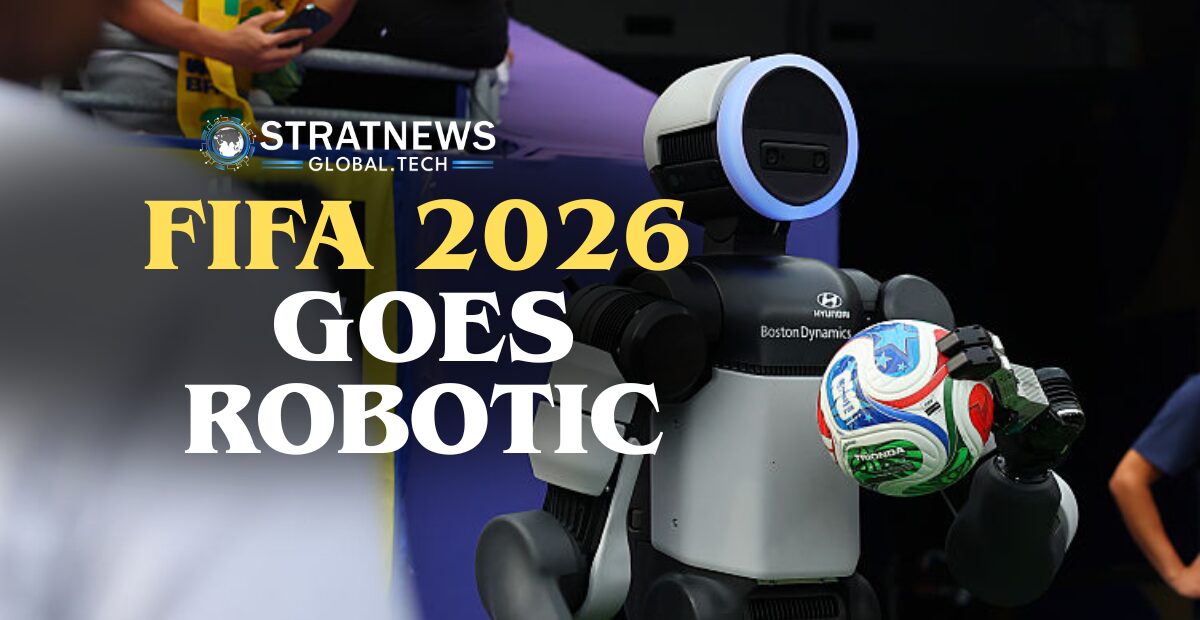
The FIFA World Cup witnessed a historic first when Atlas, the advanced humanoid robot developed by Boston Dynamics, walked onto the pitch to deliver the match ball during half-time of Brazil’s Round of 16 clash against Norway at New York New Jersey Stadium.
Presented by tournament sponsor Hyundai Motor, Atlas became the first humanoid robot to feature in an official World Cup ceremony. Before handing over the ball to the referee, the robot entertained fans by recreating several iconic football celebrations, including Norwegian striker Erling Haaland’s trademark meditation pose.
“We’ve always looked at human skill as something that motivates and challenges us to push forward what robots can do,” said Alberto Rodriguez, Director of Robot Behaviour at Boston Dynamics.
Built For The World’s Biggest Stage
While Atlas has previously demonstrated its capabilities through dancing, parkour and other complex movements, operating inside a packed World Cup stadium posed entirely new technical challenges.
With tens of thousands of spectators carrying mobile phones, conventional Wi-Fi communication was considered unreliable. Engineers instead developed a dedicated radio communication system mounted on the robot’s back to ensure uninterrupted control.
The natural grass surface also required significant adjustments.
“Grass has its own peculiarity,” Rodriguez explained. “We had to change the way Atlas learns to walk, jump and run so that it’s much more robust.”
Hyundai’s Robot Ambitions
The appearance also highlighted Hyundai’s growing investment in humanoid robotics.
Earlier this year, the company announced plans to begin deploying Atlas robots at its manufacturing facility in Georgia, United States, from 2028. The robots are expected to automate repetitive, hazardous and physically demanding industrial tasks.
Atlas’ World Cup appearance offered a glimpse of how advanced robotics is moving beyond factories and laboratories into some of the world’s biggest public events, bringing artificial intelligence directly onto football’s grandest stage.
(with inputs from Reuters)