


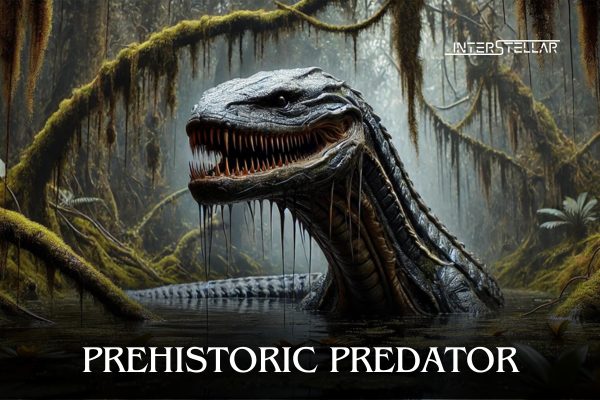
Meet Gaiasia jennyae: The Prehistoric ‘Swamp Thing’ of Namibia
About 280 million years ago, a formidable creature prowled the swamps and lakes of what is now Namibia. This creature, ‘swamp thing’ resembling a salamander but with fearsome fangs, was a top predator in a chilly ecosystem long before the age of dinosaurs.
Discovery of Gaiasia jennyae
Named Gaiasia jennyae, this ancient predator lived during the Permian Period and measured at least 8 feet (2.5 meters) long, potentially reaching up to 13 feet (4 meters). Its large, round, flat skull measured over 2 feet (60 cm) long and featured interlocking fangs at the front of its mouth.
Jason Pardo, a paleontology postdoctoral fellow at the Field Museum in Chicago, described the creature’s unique feeding strategy. “Wide flat heads in modern animals usually generate strong suction to ambush prey by suddenly sucking it into their mouths. Gaiasia combines that with huge fangs for grabbing and killing large prey,” he said. Pardo led the research published in the journal Nature.
The Habitat and Evolutionary Context
The fossils of Gaiasia were found in Namibia, a country in southwest Africa. During the Permian Period, this region was located much further south, nearly aligned with Antarctica’s current northernmost point, due to the gradual movement of Earth’s crustal plates, a process known as plate tectonics. The waters Gaiasia inhabited were likely surrounded by ice and glaciers.
“In the far south, where Gaiasia lived, an ice age was ending, and it was still quite cold, with large glaciers even at low altitudes,” Pardo explained.
About 100 million years before Gaiasia’s existence, the first land vertebrates evolved from fish with fleshy fins, known as stem tetrapods. These creatures, although amphibious, were not true amphibians. Stem tetrapods are the ancestors of all land vertebrates, including amphibians, reptiles, and mammals.
Despite the emergence of new competitors, some stem tetrapods, like Gaiasia, persisted, particularly in remote areas such as ancient Namibia. This challenges previous assumptions about the habitats and evolutionary paths of early tetrapods.
“Most of what we know of terrestrial life at this time comes from the ancient equator, preserved in rocks from Europe and North America,” Pardo said. “We thought early tetrapods were confined to the tropics by their physiology. Gaiasia shows clearly that this is not correct. Stem tetrapods were thriving at high latitudes in very cold environments, dominated by unexpectedly primitive animals.”
Evolutionary Insights and Ecosystem Dynamics
Gaiasia represents a stubborn holdover from a bygone era. “Gaiasia is very different from anything else we’ve seen, so it could be a lone survivor, but it could also be part of a vibrant ecosystem of similarly strange animals,” Pardo noted.
During the Permian, evolutionary developments were rapid. Forerunners of mammals, such as Dimetrodon, and early reptiles were diversifying in ways that mirrored modern lizards. The first true amphibians also emerged during this period.
The Permian Period ended about 252 million years ago with Earth’s most severe mass extinction event. The first dinosaurs appeared roughly 230 million years ago during the Triassic Period.
Honouring a Paleontological Pioneer
The name Gaiasia jennyae honours both the Gai-as rock formation in Namibia where the fossils were discovered and the late British paleontologist Jenny Clack, who studied early tetrapods. And for a catchy nickname? “‘Swamp thing’ is excellent,” Pardo said.

