


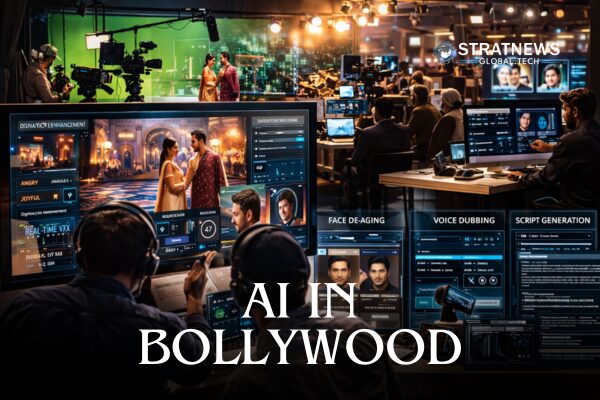
AI Reshapes India’s Film Industry Economics
India’s film industry is undergoing a transformation as artificial intelligence replaces traditional filmmaking processes. Studios now operate in environments where coding tools and digital systems take precedence over cameras and physical sets.
The Collective Artists Network, known for managing top Bollywood talent, has moved into creating digital characters and AI driven content. In its Bengaluru facility, filmmakers produce scenes inspired by Hindu mythology. These include visuals of Hanuman carrying a mountain and Gandhari blindfolding herself, drawn from well known epics.
Changing Audience Trends And Industry Pressures
India remains the world’s most prolific film producer. However, audience habits have shifted significantly. Streaming platforms have reduced cinema attendance, which fell from 1.03 billion in 2019 to 832 million in 2025. Although box office revenue reached a record level last year, earnings remain uneven and depend heavily on a few successful releases.
As a result, studios have embraced AI to cut costs and speed up production. AI tools now create full films, enable multilingual dubbing, and even alter endings of older movies. Production costs have dropped sharply, while timelines have reduced to a fraction of traditional schedules.
AI Adoption And Creative Debate
Studios in India are deploying AI more aggressively than counterparts elsewhere. While other industries proceed cautiously, Indian filmmakers experiment with large scale AI generated projects. Some companies are reviewing entire film libraries to identify titles suitable for AI adaptation.
However, audience reactions remain mixed. For instance, an AI altered version of a past hit replaced its tragic ending with a happier one. Although the release attracted viewers, critics argued that the change compromised the original story.
Similarly, an AI generated series based on an ancient epic has drawn both attention and criticism. While it achieved millions of views, reviewers highlighted issues such as unnatural visuals and lack of authenticity.
AI Dubbing And Expanding Reach
Dubbing presents a more widely accepted use of AI. India’s linguistic diversity requires films to adapt across multiple languages. AI now improves lip synchronisation and preserves performance quality while changing dialogue.
This technology enables faster and more accurate localisation, making films accessible to broader audiences. Consequently, studios see dubbing as a practical and scalable application of AI.
Global Tech Collaboration And Future Direction
Technology companies have partnered with Indian studios to support AI filmmaking. These collaborations provide tools, computing power, and resources to accelerate production. Additionally, hybrid techniques combining motion capture and digital animation enhance character realism.
Film festivals dedicated to AI generated content have also emerged, reflecting growing interest in this new form of storytelling. Despite concerns from some filmmakers about artistic integrity, the economic advantages continue to drive adoption.
Industry leaders acknowledge both the opportunities and risks. While AI offers efficiency and cost savings, it also raises questions about creativity and authenticity. Nevertheless, studios continue to expand their use of AI as they adapt to changing market conditions.
With inputs from Reuters

