


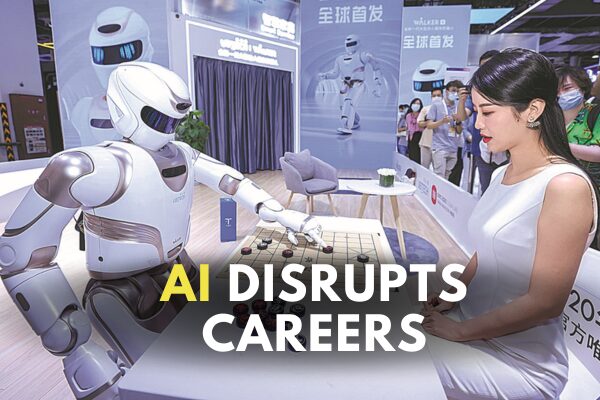
The South China Morning Post reports that the eve of Lunar New Year, usually one of the most joyful days of the year for Chinese workers, carried an unexpected undercurrent of unease this year.
During China Central Television’s annual Spring Festival Gala, widely regarded as the world’s most-watched television programme, humanoid robots took centre stage, performing break-dance routines, sword displays and comedy sketches.
The spectacle, watched by roughly 677 million viewers, was meant to celebrate technological progress. Instead, it left many reflecting on their own job security. Domestic artificial intelligence firms dominated premium advertising slots during the broadcast, reinforcing the sense that rapid automation is no longer a distant possibility but a present reality.
According to the South China Morning Post, social media was flooded with anxious reactions. Some viewers openly worried that their roles could soon disappear, while others feared creative professions such as dancing and performance might also be affected.
Concerns were not confined to China. A report by US-based Citrini Research warning of mass white-collar displacement due to AI triggered volatility on Wall Street shortly after the gala. The study suggested that companies might replace skilled workers with AI to protect profit margins, reinvesting savings into further automation.
Within China’s technology sector, pressure is already being felt. Experienced software engineers report that AI tools now complete a significant share of coding tasks in hours rather than days. While productivity has risen, so too has workload intensity, fuelling fears that even those who adapt may only be postponing redundancy.
However, the impact is uneven. Public sector roles often described as “iron rice bowl” jobs remain relatively insulated, particularly where work involves sensitive data that cannot be uploaded to external systems. Adoption of AI in banking and government institutions has been slower due to regulatory and security constraints.
Economists cited by the South China Morning Post argue that entry-level white-collar workers and fresh graduates are most vulnerable, especially as youth unemployment remains elevated. At the same time, demand for specialised AI talent is surging, creating sharp contrasts within the labour market.
Beijing has acknowledged the risks. Policymakers are reportedly preparing measures to strengthen employment support, expand AI skills training and enhance social protection. Analysts suggest that while automation may cause short-term disruption, long-term outcomes will depend on how effectively China balances innovation with workforce protection.
For now, AI adoption in China has largely enhanced productivity rather than triggered mass lay-offs. Yet as one observer noted, whether artificial intelligence becomes a trusted assistant or a destabilising force will depend on how workers, employers and the state adapt to this profound technological shift.

