


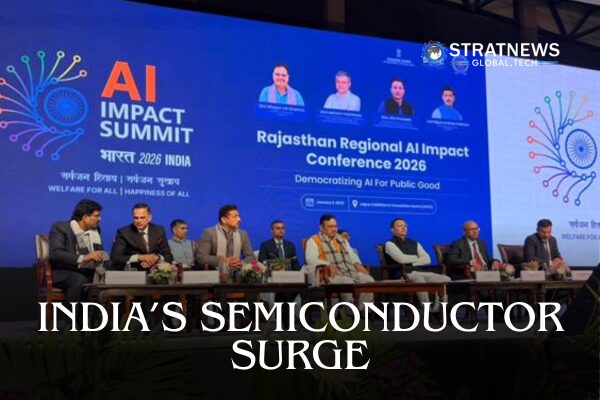
India’s rapid expansion across multiple technology sectors was highlighted at a session during the just concluded AI Impact Summit in New Delhi, where industry leaders and policymakers discussed the country’s semiconductor ambitions against the backdrop of recent data.
In 2015, India did not feature among the top 100 countries globally in digital payments, and had just two space technology startups.
In 2026, India leads the world in the number of digital payments, has around 300 space tech startups, and has grown from zero semiconductor startups in 2020 to 24.
“These figures are a testament to the fact that India can do whatever it sets out to do,” said Ranjan Anandan, Managing Director at Peak XV, speaking at the session with industry experts and startup founders on how to position India as a global semiconductor leader.
Dheemanth Nagaraj, CEO and co-founder of Agrani Labs, said building a GPU was not unfamiliar territory. “We’ve been doing it for 30 years. We have been doing it in hardware and software – at Intel and IBM, and so on. Now we just have to go and replicate it.” Noting that his firm’s team includes veterans with over two decades of experience building multiple generations of data centres, CPUs and GPUs, he said India has both the talent concentration and a clear mission.
However, India’s semiconductor success depends on sustained investment in foundational research, argued Naveen Bishnoi, Country Head of Marvell India. “When we build 10 plants in India, all the technology for it is coming from outside. Investing in an R&D ecosystem where we have industry-driven research on the next generation device, materials, circuits, architectures, packaging, thermal power, means we will be ready when these 10 projects need the next generation IP.” Such an ecosystem would enable India to move faster, rather than relying on buying commodity technologies.
Preetam Tadeparthy, Founder and CTO of C2I Semiconductors, said talent alone was not sufficient. “I think encouraging talent within organisations or outside through startups like C2I will be the way to go forward,” he said, stressing the need for technology leadership to guide priorities.
Noting that Rome was not built in a day, Amitesh Kumar Sinha, Additional Secretary at MeitY and CEO of the India Semiconductor Mission, said the programme was a long-term effort.
“The India Semiconductor Mission (ISM) is not a 100-metre race. It’s a marathon,” he said, pointing out that countries with fully developed semiconductor industries took decades to reach their current scale. “We have 10 ongoing projects right now. By 2030, all of them will be fully functional,” he said.

