


Close Menu
Stratnews GlobalStratnews Global
    Facebook X (Twitter) Instagram
    Trending
    • AI Takes Center Stage in India’s Space Sector Ahead of AI Summit
    • Railways Strengthens Cybersecurity, Ensuring Smooth Tatkal Booking
    • National Biodiversity Authority Secures ₹2.40 Crore Through ABS Contributions
    • Failed Supernova Black Hole Formation Observed in Andromeda
    • Eutelsat, Starlink Rival Revenue Beats Forecasts
    • Mexico World Cup Counter-Drone Systems Unveiled for 2026 Tournament
    • Ariane 6 Amazon Satellite Launch Deploys 32 Spacecraft
    • GE Aerospace Singapore Automation Targets Repair Bottlenecks
    Stratnews GlobalStratnews Global
    Write for Us
    Monday, February 16
    • Space
    • Science
    • AI and Robotics
    • Industry News
    Stratnews GlobalStratnews Global
    Home » 2026: A Landmark Year for India’s Aditya-L1 Sun Mission

    2026: A Landmark Year for India’s Aditya-L1 Sun Mission

    Aditya LenkaBy Aditya LenkaDecember 1, 2025 Space No Comments3 Mins Read
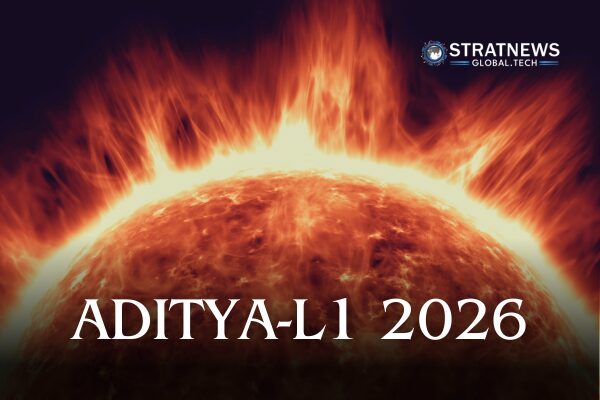
    Aditya-L1 2026

    Why 2026 Will Be a Landmark Year for India’s Aditya-L1 Sun Mission

    For India’s first solar observatory, Aditya-L1, the year 2026 will mark an extraordinary phase. It will be the first time the spacecraft observes the Sun during its peak activity cycle — a rare opportunity that occurs roughly every 11 years when the Sun’s magnetic poles reverse. This period, known as the solar maximum, transforms the Sun from calm to turbulent, creating powerful solar storms and vast coronal mass ejections (CMEs).

    A Year of Intense Solar Activity

    During this cycle, the Sun’s outer layer, or corona, releases massive bubbles of charged particles known as CMEs. These can weigh up to a trillion kilograms and travel as fast as 3,000 kilometres per second. At top speed, they can reach Earth in just 15 hours.

    “In quieter periods, the Sun launches two or three CMEs daily,” explains Professor R. Ramesh of the Indian Institute of Astrophysics (IIA). “Next year, we expect 10 or more every day.”

    Professor Ramesh leads the Visible Emission Line Coronagraph (Velc), the most vital of Aditya-L1’s seven instruments. His team monitors and analyses data from the mission to study CMEs — key to understanding the Sun and safeguarding technology on Earth.

    Understanding and Preventing Space Disruptions

    Although CMEs rarely pose direct harm to humans, they can trigger geomagnetic storms that disrupt satellites, power grids, and communication systems. There are nearly 11,000 satellites orbiting near Earth, including 136 from India, making early detection essential.

    “The most beautiful effect of CMEs is the aurora,” says Professor Ramesh. “They show charged particles from the Sun reaching Earth. But the same activity can also damage satellite electronics and disrupt electricity networks.”

    Historical records show the potential danger of such events. The 1859 Carrington Event disabled telegraph systems globally. In 1989, a solar storm left six million people in Quebec without power for nine hours. More recently, in 2022, a CME caused NASA to lose 38 satellites.

    Aditya-L1’s Unique Edge

    While other solar missions observe the Sun, Aditya-L1’s coronagraph provides a crucial advantage. It functions like an artificial Moon, blocking the Sun’s bright surface to give scientists a constant view of the corona — even during eclipses. This allows uninterrupted 24-hour observation, a capability unmatched by other missions.

    Aditya-L1 can also observe eruptions in visible light, letting scientists measure a CME’s temperature and energy. This helps determine its strength and potential impact on Earth.

    In September 2024, Aditya-L1 recorded one of its largest CMEs to date. The event, which began on 13 September at 00:30 GMT, had a mass of 270 million tonnes and a temperature of 1.8 million degrees Celsius. Its energy equalled 2.2 million megatons of TNT — yet it was only considered “medium-sized”.

    As solar activity increases, scientists expect even larger and more energetic CMEs. The data gathered in 2026 will be vital for developing strategies to protect satellites and improve our understanding of near-Earth space.

    with inputs from Reuters

    Author

    • Aditya Lenka
      Aditya Lenka

      A multi-faceted professional with a diverse range of skills and experiences. He currently works as a Producer, Digital Marketer, and Journalist for several well-known media outlets, namely StratNewsGlobal, BharatShakti, and Interstellar. With a passion for storytelling and a keen eye for detail, Aditya has covered a wide range of topics and events across India, bringing a unique perspective to his work.When he's not busy producing content, Aditya enjoys exploring new places and cuisines, having traveled extensively throughout India. He's also an avid writer and poet, often penning his thoughts and musings in his free time. And when he wants to unwind and relax, Aditya spends time with his two loyal companions, Zorro and Pablo, his beloved dogs.Aditya's dynamic personality and varied interests make him a unique individual, always eager to learn and experience new things.

      View all posts
    Featured
    Share. Facebook Twitter Pinterest LinkedIn Tumblr Email Reddit Telegram WhatsApp
    Aditya Lenka
    Aditya Lenka

      A multi-faceted professional with a diverse range of skills and experiences. He currently works as a Producer, Digital Marketer, and Journalist for several well-known media outlets, namely StratNewsGlobal, BharatShakti, and Interstellar. With a passion for storytelling and a keen eye for detail, Aditya has covered a wide range of topics and events across India, bringing a unique perspective to his work.When he's not busy producing content, Aditya enjoys exploring new places and cuisines, having traveled extensively throughout India. He's also an avid writer and poet, often penning his thoughts and musings in his free time. And when he wants to unwind and relax, Aditya spends time with his two loyal companions, Zorro and Pablo, his beloved dogs.Aditya's dynamic personality and varied interests make him a unique individual, always eager to learn and experience new things.

      Keep Reading

      AI Takes Center Stage in India’s Space Sector Ahead of AI Summit

      Railways Strengthens Cybersecurity, Ensuring Smooth Tatkal Booking

      National Biodiversity Authority Secures ₹2.40 Crore Through ABS Contributions

      Failed Supernova Black Hole Formation Observed in Andromeda

      Eutelsat, Starlink Rival Revenue Beats Forecasts

      Mexico World Cup Counter-Drone Systems Unveiled for 2026 Tournament

      Add A Comment
      Leave A Reply Cancel Reply

      Anti Drone System (CUAS)
      Latest Posts

      AI Takes Center Stage in India’s Space Sector Ahead of AI Summit

      February 15, 2026

      Railways Strengthens Cybersecurity, Ensuring Smooth Tatkal Booking

      February 13, 2026

      National Biodiversity Authority Secures ₹2.40 Crore Through ABS Contributions

      February 13, 2026

      Failed Supernova Black Hole Formation Observed in Andromeda

      February 13, 2026

      Eutelsat, Starlink Rival Revenue Beats Forecasts

      February 13, 2026

      Mexico World Cup Counter-Drone Systems Unveiled for 2026 Tournament

      February 13, 2026

      Ariane 6 Amazon Satellite Launch Deploys 32 Spacecraft

      February 13, 2026

      GE Aerospace Singapore Automation Targets Repair Bottlenecks

      February 13, 2026

      Why Nirmala Sitharaman’s 9th Budget Is A Turning Point

      February 12, 2026

      Iron Mountain AI Data Center Revenue Forecast Beats Estimates

      February 12, 2026

      Subscribe to News

      Get the latest sports news from NewsSite about world, sports and politics.

      • Astronomical Events
      • Space Missions
      • Industry News
      • Science
      StratNewsGlobal Tech
      Facebook X (Twitter) Instagram LinkedIn YouTube
      © 2026 StratNews Global, A unit of BharatShakti Communications LLP
      • About Us
      • Contributors
      • Copyright
      • Contact
      • Write for Us

      Type above and press Enter to search. Press Esc to cancel.