


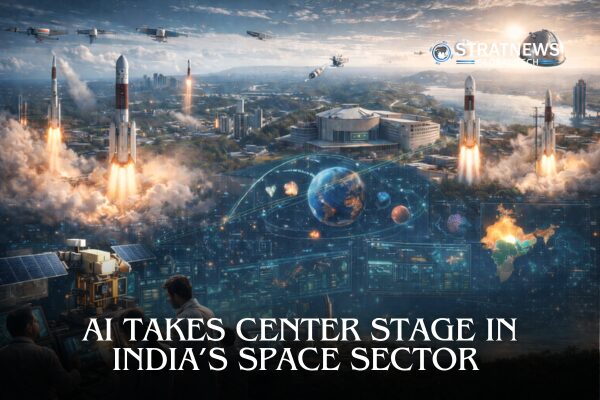
As New Delhi prepares to host the AI Summit next week, India’s space industry is positioning artificial intelligence as a key driver of innovation, safety, and competitiveness. Industry leaders say AI is no longer an optional tool, it has become the “operating layer” of the country’s growing space economy.
AI Reshapes The Space Value Chain
Lt. Gen. AK Bhatt (Retd.), Director General of the Indian Space Association, highlighted how AI is transforming the entire value chain. He explained that Indian companies are increasingly using AI for everything from onboard satellite processing and automated image interpretation to predictive satellite health monitoring and space traffic management.
“Across the value chain, Indian companies are applying AI for onboard/edge processing, automated image interpretation, predictive satellite health and anomaly detection, space traffic management and collision-risk assessment, and building analysis-ready geospatial services for agriculture, urban planning, disaster response, climate monitoring, and national security,” Bhatt said.
He noted that India’s upcoming 12-satellite Earth observation constellation marks a shift from one-off imagery to continuous, AI-driven monitoring, while growing orbital congestion makes trustworthy AI a safety imperative. “Our industry priority should be to scale these capabilities responsibly, grounded in safety, talent, and secure data ecosystems, so India becomes globally competitive in AI-native spacetech,” he added.
Geospatial Intelligence Gains Momentum
Geospatial intelligence is also seeing rapid AI adoption. Agendra Kumar, Managing Director of Esri India, said the country’s AI ambition in the space sector depends heavily on accessible, high-quality data.
“At Esri India, we are integrating AI into GIS applications to empower customers to extract richer insights from complex geospatial data, automate routine workflows, and make faster, more informed decisions,” Kumar said, citing the company’s new INR 150 crore GIS and AI Competency Centre in Noida, which brings together AI specialists, data scientists, and GIS experts.
Satellite Communications Enters An AI Era
The satellite communications sector is undergoing a parallel transformation. Gautam Sharma, Managing Director of Viasat India, described how AI is enabling networks to “learn” from telemetry, predict congestion, and automate troubleshooting, while improving operational safety at remote sites.
Rupesh Kumar, CTO and Co-Founder of Suhora Technologies, highlighted that AI helps organizations convert terabytes of data into actionable intelligence for applications such as disaster response, agriculture monitoring, and national security.
“Our algorithms automate imagery classification, filter low-quality data, and detect subtle changes in terrain or infrastructure over time. We are building predictive models that help users anticipate trends and guide future action, not just understand what has already happened,” Kumar said.
The AI Summit will host representatives from more than 50 countries, including the US, France, Brazil, Japan, UK, Russia, China, Bolivia, Germany, Costa Rica, Croatia, Denmark, Egypt, Estonia and Finland among others.
For India’s space industry, the event offers a stage to demonstrate how AI is not only boosting efficiency but also ensuring safer, smarter, and globally competitive space operations.