


How Black Holes Slowly Starve Galaxies
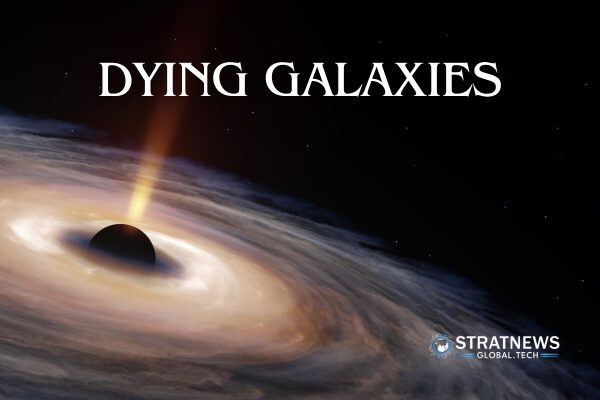
Galaxies do not always die in violent bursts of energy. Some fade quietly, suffocated by the same black holes that once fuelled their brilliance. Astronomers using the James Webb Space Telescope (JWST) and the Atacama Large Millimetre Array (ALMA) have now witnessed this slow demise in action, observing a galaxy that appears to be dying not from collision or catastrophe, but from gradual starvation.
A Galaxy Fading from Within
The galaxy in question, formally designated GS-10578 and informally known as “Pablo’s Galaxy” after the astronomer who first analysed it, lies around 10.8 billion light years from Earth. During its prime, between 12.5 and 11.5 billion years ago, it produced stars at a remarkable rate, building a mass roughly 200 billion times that of the Sun within a single billion years. Then, quite suddenly, its star formation stopped.
Researchers from the University of Cambridge suspected its central supermassive black hole might be responsible. When they used ALMA’s powerful radio array for seven hours to search for carbon monoxide—a tell-tale sign of cold hydrogen gas that fuels new stars—they found almost nothing. The galaxy appeared nearly empty of the material required for star formation.
“What surprised us was how much you can learn by not seeing something. The absence of cold gas pointed toward slow starvation rather than a single dramatic event,” said Dr Jan Scholtz from Cambridge’s Cavendish Laboratory.
Winds that Steal a Galaxy’s Breath
JWST spectroscopy revealed the missing clue. Powerful winds were streaming from the galaxy’s central black hole at speeds of about 400 kilometres per second, expelling nearly 60 solar masses of gas every year. If that rate continues, the galaxy’s remaining star-forming fuel will disappear in as little as 16 million years, or at most 220 million—an astonishingly short period compared to the billion-year lifespans typical of similar systems.
Yet Pablo’s Galaxy shows no sign of turmoil. Webb’s detailed images depict a calm, disc-like structure with no evidence of violent mergers or collisions. This ruled out external forces as the cause of its decline. Instead, astronomers concluded that the black hole’s repeated heating and expulsion of gas over time gradually choked off star formation. Each feedback episode prevented new material from cooling and settling into the galactic core, starving the system from within.
A Quiet End in a Busy Universe
This finding sheds light on a class of ancient, massive galaxies that JWST has recently uncovered in the early universe. These galaxies appear too old and inactive for their age, suggesting they burned through their gas supplies quickly before fading into dormancy. Slow, internal starvation by their central black holes could explain this pattern of rapid rise and quiet decline.
By showing that galaxies can die gently rather than explosively, Pablo’s Galaxy offers a new perspective on how cosmic giants evolve. Even in the vastness of space, it seems, death can arrive not with a bang, but with a whisper.