


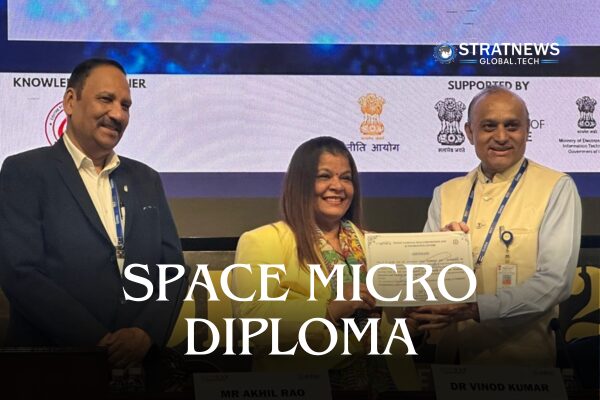
India has taken a significant step toward formalising space education at the school level with the unveiling of “CubeSat 101: Inception to Operations” at DefSat 2026 in Delhi. Described as the world’s first high school curriculum book dedicated to satellite development, the programme introduces structured, end-to-end CubeSat training for students.
Developed by Chennai-based Space Kidz India, the curriculum is set to become India’s first space-focused Micro Diploma programme. The book was formally released by Dr. Vinod Kumar, Director, Promotion Directorate at the Indian National Space Promotion and Authorization Centre (IN-SPACe). A certification was presented to Dr. Srimathy Kesan, Founder and CEO of Space Kidz India, recognising the curriculum’s academic depth, technical robustness and national relevance.
Validation by IN-SPACe marks a milestone in aligning school-level satellite education with India’s expanding private space ecosystem.
According to Dr. Kesan, the curriculum goes beyond introductory STEM modules and offers a comprehensive framework guiding learners through the complete lifecycle of a small satellite mission — from conceptualisation to post-launch operations. It covers mission planning and systems engineering; subsystem design and payload integration; regulatory processes and compliance; environmental testing and launch campaigns; and in-orbit mission operations. The programme aims to bridge theory with real-world satellite execution, equipping students with both practical readiness and conceptual understanding.
In a major development, the curriculum will soon be uploaded to a Government of India portal under the Ministry of Skill Development and Entrepreneurship, where it will be formally recognised as a certified Micro Diploma programme. Once notified, it will become India’s first government-recognised Micro Diploma focused exclusively on CubeSat technology, creating structured pathways for students, academic institutions, start-ups and aspiring satellite engineers.
The ceremony was attended by Anil Prakash, Director General of the Satcom Industry Association, reflecting industry-academia collaboration. Space Kidz India also acknowledged the support of IN-SPACe Chairman Dr. Pawan Goenka.
The curriculum underwent detailed review by former ISRO directors Dr. Prakash Rao PJVKS, Dr. Surendra Pal and Dr. Alok Srivastava. Academic and technical contributors include Dr. Kshitij Mall of the University of South Alabama, engineers from Aathmanirbar Trust, Ambassador ShakthiSAT from Argentina, and multiple domain experts. Hexaware Technologies supported the initiative.
Founded to empower students — especially young girls — through hands-on space programmes, Space Kidz India has facilitated multiple student satellite launches and trained thousands in space sciences. With CubeSat 101, it shifts from project-based exposure to a scalable national curriculum framework.
The unveiling signals a broader shift in India’s space ecosystem: as defence and commercial capabilities expand, building a trained talent pipeline is emerging as a parallel strategic priority.