


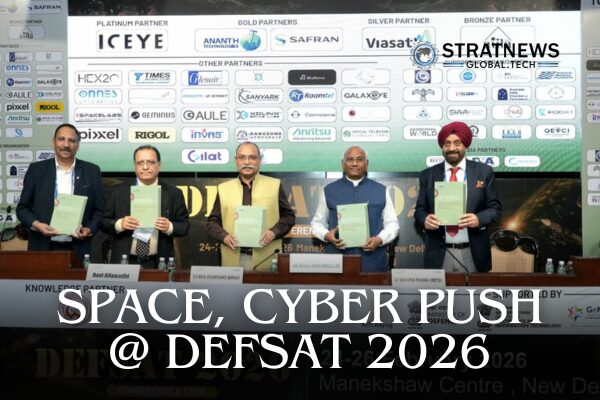
The final day of DefSat 2026 included the release of a dedicated cybersecurity framework for the space and satellite communications sector.
It also featured strategic deliberations by the newly formed Space Strategic Group (SSG) and the fourth edition of the IndSpaceX Wargame.
A key development during the three-day event which ended February 26 was the unveiling of Cyber Security Guidelines for space systems by CERT-In in collaboration with SIA-India. The framework spans satellites, ground infrastructure, communication networks, supply chains and user interfaces, and calls for the integration of cyber safeguards at the mission design stage.
Dr Sanjay Bahl, Director General, CERT-In, said, “CERT-In remains steadfast in strengthening the cyber resilience of all sectors across Bharat. Recognizing the strategic importance of space systems, including satellite communication networks, to India’s technological sovereignty and future growth, these comprehensive guidelines establish a unified and forward-looking framework by considering defence in depth, breadth and height to safeguard satellite networks, ground infrastructure, space related supply chains and space assets against the rapidly evolving and increasingly sophisticated cyber threat landscape.”
The formation and progress of the Space Strategic Group featured prominently during the concluding session. The Group, spearheaded by SIA-India in collaboration with the Centre for Land Warfare Studies and the MERI Group of Institutions, has been established as a continuing platform to align policy, operational requirements, technological development and industry capability in the space sector.
Lt Gen (Dr) PJS Pannu (Retd), Chairman of the Space Strategic Group and conductor of IndSpaceX 4.0, observed, “As satellite constellations expand across LEO, space is no longer a benign global commons; it is congested, contested, and increasingly conflict-prone. With superpowers declaring space a warfighting domain, India must align spectrum strategy, cyber resilience, ISR autonomy, and legal preparedness. Deploying fast, securing frequencies early, and integrating space with cyber command structures will determine whether we deter, deny, or are disrupted in orbit.”
Lt Gen Dushyant Singh (Retd), Director General, CLAWS, underscored the need for institutional evolution, saying, “India cannot afford to repeat the jet engine story in space; starting strong, pausing, and losing decades. We were pioneers in the 1960s, yet slow to militarise and operationalise space power. With adversaries fielding integrated constellations and space stations, incrementalism is no longer viable. The moment demands a transition from a Defence Space Agency to a fully operational Space Command with autonomous ISR, PNT, and secure communications.”
The fourth edition of the IndSpaceX Wargame formed the operational core of the final day, placing participants in simulated contested-space scenarios to test coordination and response mechanisms.
Dr Subba Rao Pavuluri, President, SIA-India, said, “The strong participation over the past three days, particularly from industry, academia, and a young cohort of innovators aged 30 to 40, demonstrates that India possesses the technological depth required for defence space autonomy. What we now need is policy acceleration. With DefSat evolving from concept to platform, today’s war-gaming simulations will translate capability into doctrine and operational readiness.”
Summing up the event, Anil Prakash, Director General, SIA-India, said, “DefSat has firmly established itself as more than a conference, it is a strategic movement. The clarity of thought and actionable outcomes witnessed over the past three days reflect a maturing ecosystem that recognises both the urgency and the responsibility of securing India’s space future.”
The three-day event, attended by over 600 delegates from government, the armed forces, industry, academia and start-ups, concluded with a focus on operational preparedness and institutional coordination in the space domain.