


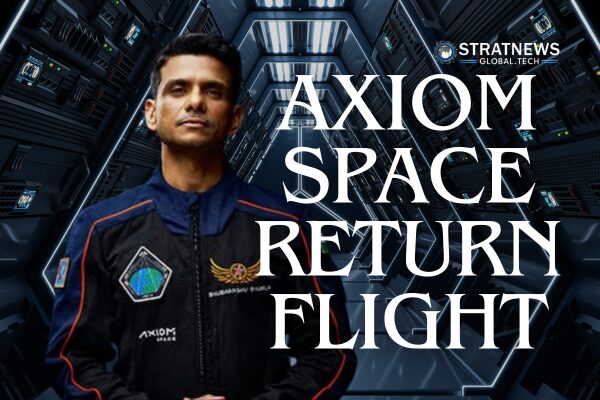
India Welcomes Shubhanshu Shukla, India’s first astronaut in over four decades, as he returned safely to Earth on Tuesday after completing a successful 18-day mission aboard the International Space Station (ISS). His return marks a watershed moment in India’s human spaceflight journey and a major step forward in its growing space-tech ecosystem.
Launched on June 27 as part of the Axiom Mission 4 (Ax-4), a private crewed spaceflight organized by Axiom Space, Shukla joined NASA astronaut Peggy Whitson and European astronauts Slawosz Uznanski-Wisniewski and Tibor Kapu on board the orbiting laboratory. Their SpaceX Dragon capsule undocked from the ISS on Monday and safely splashed down off the coast of California around 1:30 PM GST.
A Landmark Mission for India
Shukla, a decorated fighter pilot in the Indian Air Force, is the first Indian to fly to space since Rakesh Sharma’s historic 1984 mission aboard the Soviet Soyuz. While India’s space agency ISRO continues to develop its indigenous Gaganyaan mission, Shukla’s participation in Ax-4 allowed India to accelerate its human spaceflight learning curve through international collaboration.
Shukla’s time aboard the ISS was focused on conducting seven Indian scientific experiments in microgravity, spanning biological and agricultural studies—ranging from muscle cell growth to the behaviour of cyanobacteria and sprouting of Indian crop seeds.
Scientific Milestone and National Pride
Reacting to the successful completion of the mission, Dr. Subba Rao Pavuluri, CMD of Ananth Technologies, praised Shukla’s contribution and emphasized its significance for India’s scientific ambitions: “It is a great day for Bharat as we welcome Group Capt Shubhanshu Shukla back to Bharat. While on board the ISS, he successfully completed all seven microgravity experiments sent by India—tardigrades, myogenesis, methi and moong seed sprouting, cyanobacteria, microalgae, crop seeds, and the Voyager display—all achieved as planned. This mission is a precursor to our own ‘Gaganyaan Mission’, where Indian astronauts will conduct experiments in space. While our ancestors explored planets with intuition, we now do so with science. Shukla’s mission is the first step in realizing ‘Bharat’s space ambitions’ during Viksit Bharat.”
Space Biotech and Private Sector Power
Echoing the transformative nature of the mission, Anil Prakash, Director General of the Satellite Industry Association (SIA)-India, highlighted its role in integrating biotech with space exploration, “Group Captain Shubhanshu Shukla’s 18-day mission aboard the ISS isn’t just a milestone—it heralds India’s leap into the space-biotech frontier. He spearheaded seven ISRO-backed microgravity experiments—cultivating methi, moong, microalgae, cyanobacteria, tardigrades, and human muscle cells—laying the groundwork for orbit-based, self-sustaining life-support systems. This mission, enabled through strategic private-sector engagement via Axiom Space, SpaceX, Skyroot Aerospace, and India’s space-tech startups, exemplifies public–private collaboration, positioning India at the forefront of space-driven biotech innovation.”
Future Missions: Gaganyaan and Beyond
Looking ahead, Lt. Gen. AK Bhatt (Retd.), Director General of the Indian Space Association (ISpA), underscored the mission’s importance as a stepping stone for India’s long-term space vision,
“We congratulate Axiom and Group Captain Shubhanshu Shukla on completing a successful mission. This achievement is a stepping stone for India’s future crewed space journeys, including the Gaganyaan mission and our ambitious goal of landing an Indian on the Moon by 2040 in an Indian spacecraft. It will not only support ISRO but also give impetus to both global and Indian private space industries. This success marks a significant stride towards realizing India’s vision for outer space exploration.”
From Earth to Orbit and Back
Shukla’s mission not only reestablishes India’s human presence in space but also validates the country’s growing capacity to contribute to cutting-edge scientific research and next-generation space innovation. As the country prepares for its first indigenous human spaceflight under Gaganyaan, the return of Group Captain Shukla serves as both a symbol of progress and a launchpad for the future of Indian space exploration.