


Close Menu
Stratnews GlobalStratnews Global
    Facebook X (Twitter) Instagram
    Trending
    • Ford Records $19.5 Billion Charge as It Retreats from Electric Vehicle Plans
    • Italian Scientists Create 3D-Printed Snacks from Lab-Grown Plant Cells
    • Korea Zinc to Build $7.4 Billion U.S.-Backed Smelter in Tennessee
    • Tesla Directors Earn $3 Billion from Stock Options, Raising Governance Concerns
    • Lawmaker Seeks Details on Trump’s Approval of Nvidia H200 Exports
    • Google to Lay Australia-Funded Subsea Cables in Papua New Guinea
    • Protesters in Tomsk Rally Against Russia’s Roblox Ban
    • NTT Chief Urges Japan to Focus on Niche Semiconductor Strategy
    Stratnews GlobalStratnews Global
    Write for Us
    Tuesday, December 16
    • Space
    • Science
    • AI and Robotics
    • Industry News
    Stratnews GlobalStratnews Global
    Home » ISRO Delays SpaDeX Docking Due to Unexpected Satellite Drift

    ISRO Delays SpaDeX Docking Due to Unexpected Satellite Drift

    Kanika SharmaBy Kanika SharmaJanuary 9, 2025 Space No Comments2 Mins Read
    ISRO Delays SpaDeX

    ISRO Delays SpaDeX Docking: Latest Updates

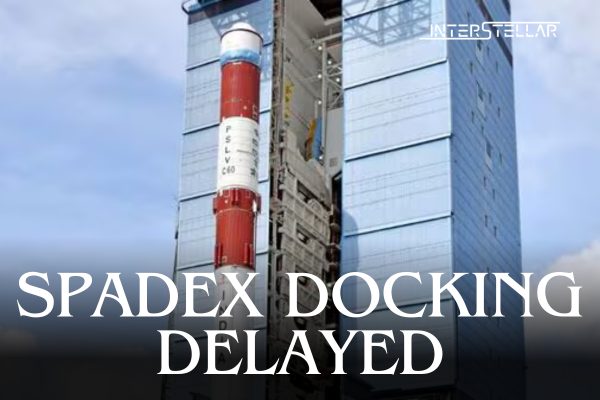
    ISRO delays SpaDeX Docking experiment, which was originally set to begin at 8:00 AM on January 9, 2025. The decision follows a slight deviation in the planned satellite manoeuvre, delaying the event to an unspecified time.

    ISRO explained that Spacecraft A began drifting closer to its target, reducing the distance from 500 metres to 225 metres. However, after the non-visibility period, the drift exceeded expectations, prompting the delay. In a post on X (formerly Twitter), ISRO confirmed the safety of the satellites and assured that further updates would follow.

    This marks the second postponement of the docking experiment, which was initially scheduled for January 7. The earlier delay was caused by the identification of an abort scenario. To ensure the mission’s success, ISRO conducted additional ground simulations before rescheduling to January 9.

    Why SpaDeX Docking Matters for India

    SpaDeX is a critical milestone in India’s space ambitions. Docking technology enables larger space structures, satellite refuelling, long-term maintenance, and sustainable exploration. It also supports sample return missions and reduces space debris, making space operations safer and more efficient.

    For India, mastering docking technology will pave the way for advanced projects like Chandrayaan-4, the Bharatiya Antariksh Station, and Gaganyaan. These missions rely on autonomous docking capabilities for success. SpaDeX’s achievements will directly contribute to developing the Bharatiya Antariksh Station and advancing India’s human spaceflight programme.

    The Impact of SpaDeX on Future Missions

    SpaDeX aims to validate autonomous in-space docking technology, which is vital for long-term satellite servicing. This capability extends the operational life of satellites and minimises the growing issue of space debris. It also enables complex manoeuvres like crew transfers and assembly of space infrastructure.

    By mastering docking, India can establish the Bharatiya Antariksh Station, join the elite club of advanced space-faring nations, and significantly enhance lunar exploration and interplanetary missions. Furthermore, docking technology will ensure safer human spaceflights, expand satellite servicing capabilities, and boost sustainable exploration initiatives.

    In short, SpaDeX represents a leap forward for India’s space exploration capabilities, equipping ISRO with cutting-edge tools to achieve its ambitious goals.

    with inputs from Reuters

    Author

    • Kanika Sharma
      Kanika Sharma

      View all posts
    Featured
    Share. Facebook Twitter Pinterest LinkedIn Tumblr Email Reddit Telegram WhatsApp
    Kanika Sharma
    Kanika Sharma

      Keep Reading

      Ford Records $19.5 Billion Charge as It Retreats from Electric Vehicle Plans

      Italian Scientists Create 3D-Printed Snacks from Lab-Grown Plant Cells

      Korea Zinc to Build $7.4 Billion U.S.-Backed Smelter in Tennessee

      Tesla Directors Earn $3 Billion from Stock Options, Raising Governance Concerns

      Lawmaker Seeks Details on Trump’s Approval of Nvidia H200 Exports

      Google to Lay Australia-Funded Subsea Cables in Papua New Guinea

      Add A Comment
      Leave A Reply Cancel Reply

      Anti Drone System (CUAS)
      Latest Posts

      Ford Records $19.5 Billion Charge as It Retreats from Electric Vehicle Plans

      December 16, 2025

      Italian Scientists Create 3D-Printed Snacks from Lab-Grown Plant Cells

      December 15, 2025

      Korea Zinc to Build $7.4 Billion U.S.-Backed Smelter in Tennessee

      December 15, 2025

      Tesla Directors Earn $3 Billion from Stock Options, Raising Governance Concerns

      December 15, 2025

      Lawmaker Seeks Details on Trump’s Approval of Nvidia H200 Exports

      December 15, 2025

      Google to Lay Australia-Funded Subsea Cables in Papua New Guinea

      December 15, 2025

      Protesters in Tomsk Rally Against Russia’s Roblox Ban

      December 15, 2025

      NTT Chief Urges Japan to Focus on Niche Semiconductor Strategy

      December 15, 2025

      EU set to roll back 2035 ban on petrol and diesel cars amid automaker pressure

      December 15, 2025

      U.S. Bill Targets Chinese Lidar Sensors Over Fear of Space Hack

      December 15, 2025

      Subscribe to News

      Get the latest sports news from NewsSite about world, sports and politics.

      • Astronomical Events
      • Space Missions
      • Industry News
      • Science
      StratNewsGlobal Tech
      Facebook X (Twitter) Instagram LinkedIn YouTube
      © 2025 StratNews Global, A unit of BharatShakti Communications LLP
      • About Us
      • Contributors
      • Copyright
      • Contact
      • Write for Us

      Type above and press Enter to search. Press Esc to cancel.