


Juno Delivers Most Precise Measurements Yet
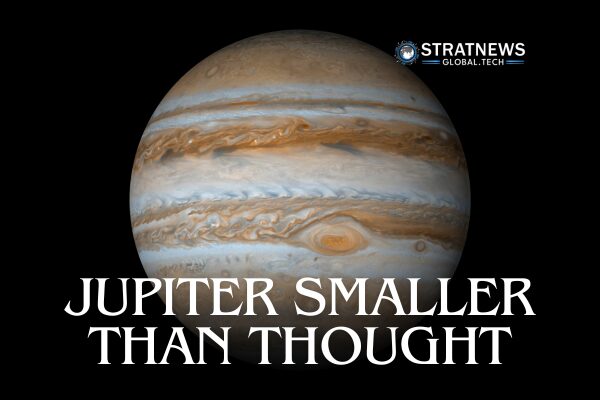
Jupiter, the largest planet in the solar system, is marginally smaller than scientists had long believed, according to new measurements from NASA’s Juno spacecraft. Using advanced radio-science data, researchers have produced the most accurate assessment yet of Jupiter’s size and shape, refining figures that had stood for more than four decades.
The findings show that Jupiter’s equatorial diameter measures 88,841 miles (142,976 kilometres), around 5 miles smaller than earlier estimates. Its polar diameter — from north pole to south pole — is now measured at 83,067 miles (133,684 kilometres), approximately 15 miles less than previously calculated. These revisions may seem minor, but they are significant for planetary science.
A More Flattened Gas Giant
The updated measurements confirm that Jupiter is more flattened than once thought. The planet’s equator is about 7% wider than its polar diameter, a stark contrast to Earth, where the difference is only 0.33%. This pronounced bulge is driven by Jupiter’s rapid rotation and gaseous composition.
Earlier estimates were based on data from NASA’s Pioneer and Voyager missions in the late 1970s. Juno, which has been orbiting Jupiter since 2016, provided a unique opportunity to improve accuracy when its radio signal passed behind the planet from Earth’s viewpoint. Changes in the signal as it travelled through Jupiter’s atmosphere allowed scientists to analyse the planet’s density, temperature and atmospheric structure in exceptional detail.
Why Jupiter’s Size Matters
Accurate measurements of Jupiter’s size and shape are crucial for modelling its interior, magnetic field and atmospheric dynamics. Jupiter’s radius is a key reference point for understanding how the planet formed and how it influenced the evolution of the solar system.
Jupiter is composed mainly of hydrogen and helium and is so massive that all the other planets could fit inside it. Scientists believe it formed early in the solar system’s history and played a decisive role in shaping planetary orbits and delivering volatile substances — such as water and carbon dioxide — to the inner solar system, including Earth.
With NASA extending Juno’s mission, researchers expect further refinements that will deepen understanding of Jupiter’s internal structure and its lasting influence on planetary evolution.