


Close Menu
Stratnews GlobalStratnews Global
    Facebook X (Twitter) Instagram
    Trending
    • Railways Strengthens Cybersecurity, Ensuring Smooth Tatkal Booking
    • National Biodiversity Authority Secures ₹2.40 Crore Through ABS Contributions
    • Failed Supernova Black Hole Formation Observed in Andromeda
    • Eutelsat, Starlink Rival Revenue Beats Forecasts
    • Mexico World Cup Counter-Drone Systems Unveiled for 2026 Tournament
    • Ariane 6 Amazon Satellite Launch Deploys 32 Spacecraft
    • GE Aerospace Singapore Automation Targets Repair Bottlenecks
    • Why Nirmala Sitharaman’s 9th Budget Is A Turning Point
    Stratnews GlobalStratnews Global
    Write for Us
    Sunday, February 15
    • Space
    • Science
    • AI and Robotics
    • Industry News
    Stratnews GlobalStratnews Global
    Home » Mercury’s Hidden Diamond Mantle: New Research Reveals Planet’s Sparkling Secret

    Mercury’s Hidden Diamond Mantle: New Research Reveals Planet’s Sparkling Secret

    Kanika SharmaBy Kanika SharmaJuly 24, 2024 Space No Comments3 Mins Read
    Mercury's Hidden Diamond

    Mercury’s Hidden Diamond Mantle: A New Discovery

    Unveiling Mercury’s Diamond Mantle

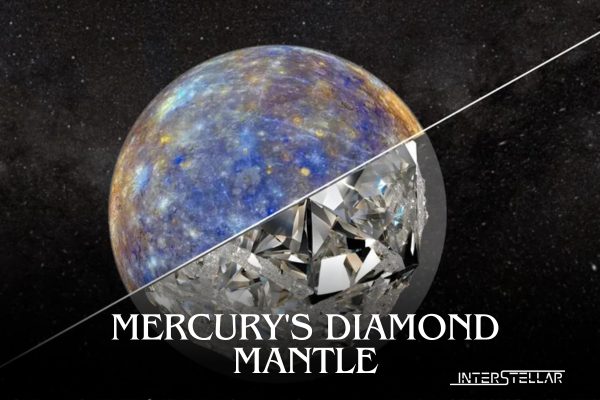
    Scientists have uncovered a stunning secret about Mercury, the smallest planet in our solar system. Data from NASA’s MESSENGER spacecraft suggest that a 10-mile-thick diamond mantle might lie beneath Mercury’s crust. This discovery sheds light on Mercury’s unique characteristics, including its dark surface and dense core.

    Carbon-Rich Beginnings

    Mercury has long puzzled scientists due to its unusual qualities, such as its premature volcanic end and the presence of graphite patches on its surface. These patches led scientists to hypothesise that Mercury once had a carbon-rich magma ocean. This ocean likely floated to the surface, creating graphite and giving Mercury its dark hue.

    Researchers now believe that this process also formed a carbon-rich mantle beneath Mercury’s surface. Unlike previously thought, this mantle is likely composed of diamond rather than graphite.

    Research and Findings

    Olivier Namur, an associate professor at KU Leuven, explained that the new pressure estimates at Mercury’s mantle-core boundary support the formation of diamond over graphite. Namur’s team used data from NASA’s MESSENGER spacecraft to conduct their study. They simulated Mercury’s interior conditions on Earth, using a large-volume press to replicate the immense pressures and high temperatures found inside the planet. This allowed them to observe how minerals similar to those in Mercury’s mantle would behave.

    The team discovered Mercury’s hidden diamond mantle could form through two processes. Firstly, the crystallisation of the magma ocean might have created a thin diamond layer at the core-mantle boundary. Secondly, the crystallisation of Mercury’s initially liquid core over time likely contributed to the formation of a thicker diamond layer.

    Implications for Understanding Mercury

    When Mercury formed around 4.5 billion years ago, its liquid core began to crystallise, enriching the remaining melt with carbon. Eventually, this led to diamond formation. Since diamond is less dense than metal, it floated to the top of the core, creating a diamond layer approximately 0.62 miles (1 km) thick.

    This discovery highlights significant differences between Mercury and other rocky planets like Venus, Earth, and Mars. Mercury’s proximity to the sun meant it formed from a carbon-rich dust cloud, resulting in more carbon and less oxygen compared to other planets. This unique composition led to the formation of a diamond mantle on Mercury.

    Namur hopes this finding will help solve other mysteries about Mercury, such as why its volcanic activity ceased around 3.5 billion years ago. This research provides a fresh perspective on the planet’s history and composition, contributing to our understanding of the diverse processes that shape our solar system.

    Author

    • Kanika Sharma
      Kanika Sharma

      View all posts
    Featured
    Share. Facebook Twitter Pinterest LinkedIn Tumblr Email Reddit Telegram WhatsApp
    Kanika Sharma
    Kanika Sharma

      Keep Reading

      Railways Strengthens Cybersecurity, Ensuring Smooth Tatkal Booking

      National Biodiversity Authority Secures ₹2.40 Crore Through ABS Contributions

      Failed Supernova Black Hole Formation Observed in Andromeda

      Eutelsat, Starlink Rival Revenue Beats Forecasts

      Mexico World Cup Counter-Drone Systems Unveiled for 2026 Tournament

      Ariane 6 Amazon Satellite Launch Deploys 32 Spacecraft

      Add A Comment
      Leave A Reply Cancel Reply

      Anti Drone System (CUAS)
      Latest Posts

      Railways Strengthens Cybersecurity, Ensuring Smooth Tatkal Booking

      February 13, 2026

      National Biodiversity Authority Secures ₹2.40 Crore Through ABS Contributions

      February 13, 2026

      Failed Supernova Black Hole Formation Observed in Andromeda

      February 13, 2026

      Eutelsat, Starlink Rival Revenue Beats Forecasts

      February 13, 2026

      Mexico World Cup Counter-Drone Systems Unveiled for 2026 Tournament

      February 13, 2026

      Ariane 6 Amazon Satellite Launch Deploys 32 Spacecraft

      February 13, 2026

      GE Aerospace Singapore Automation Targets Repair Bottlenecks

      February 13, 2026

      Why Nirmala Sitharaman’s 9th Budget Is A Turning Point

      February 12, 2026

      Iron Mountain AI Data Center Revenue Forecast Beats Estimates

      February 12, 2026

      China EV Tariff Talks Open After Volkswagen Deal

      February 12, 2026

      Subscribe to News

      Get the latest sports news from NewsSite about world, sports and politics.

      • Astronomical Events
      • Space Missions
      • Industry News
      • Science
      StratNewsGlobal Tech
      Facebook X (Twitter) Instagram LinkedIn YouTube
      © 2026 StratNews Global, A unit of BharatShakti Communications LLP
      • About Us
      • Contributors
      • Copyright
      • Contact
      • Write for Us

      Type above and press Enter to search. Press Esc to cancel.