


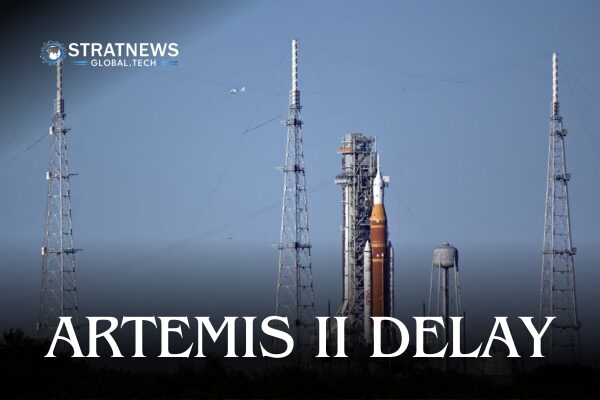
NASA is preparing to roll back the Artemis II rocket and Orion spacecraft to the Vehicle Assembly Building after detecting an interrupted flow of helium. The agency said the issue will almost certainly affect the planned March launch window.
Helium Flow Disruption Triggers Review
Engineers observed the disruption overnight in the Space Launch System rocket’s interim cryogenic propulsion stage. Helium plays a critical role in the launch process, and a stable flow remains essential for flight readiness.
As a result, NASA is taking precautionary steps to move the rocket and spacecraft back to the Vehicle Assembly Building at the Kennedy Space Center. The rollback will allow technicians to inspect and address the issue under controlled conditions.
The agency acknowledged that this development will almost assuredly affect the March launch schedule. Previously, NASA had targeted March 6 for liftoff.
Crewed Mission Around The Moon
Artemis II will carry four astronauts on a journey around the moon and back to Earth. The planned crew includes Reid Wiseman, Victor Glover and Christina Koch from the United States, along with Canadian astronaut Jeremy Hansen.
The mission aims to become the farthest human spaceflight ever undertaken. Moreover, it will mark the first crewed lunar mission since the Apollo era more than 50 years ago.
NASA views Artemis II as a crucial test flight. Therefore, ensuring the rocket and spacecraft meet strict safety standards remains a top priority.
Path Toward Future Lunar Landing
Artemis II serves as a precursor to Artemis III, which NASA has scheduled for 2028. Artemis III aims to return astronauts to the lunar surface.
Consequently, any technical issue requires careful evaluation before launch. By conducting a rollback and further inspections, NASA seeks to protect both crew and mission objectives.
For now, engineers will assess the helium flow problem and determine the necessary corrective actions. Further updates on the revised launch timeline are expected once the review concludes.
Inputs from Reuters.

