


Space is no longer merely an enabler but has become the central pillar of military power, the Director General of Military Intelligence Lt Gen RS Raman said on Tuesday.
Delivering the keynote address on “Decoding Adversarial Military Space Domain” at the DefSat Conference organised by the Satcom Industry Association-India (SIA-India), he said military competition has decisively expanded beyond terrestrial boundaries, creating an urgent need for sovereign capabilities and strategic clarity in orbit.
The session was introduced by Lt Gen Rakesh Kapoor (Retd), former Deputy Chief of Army Staff.
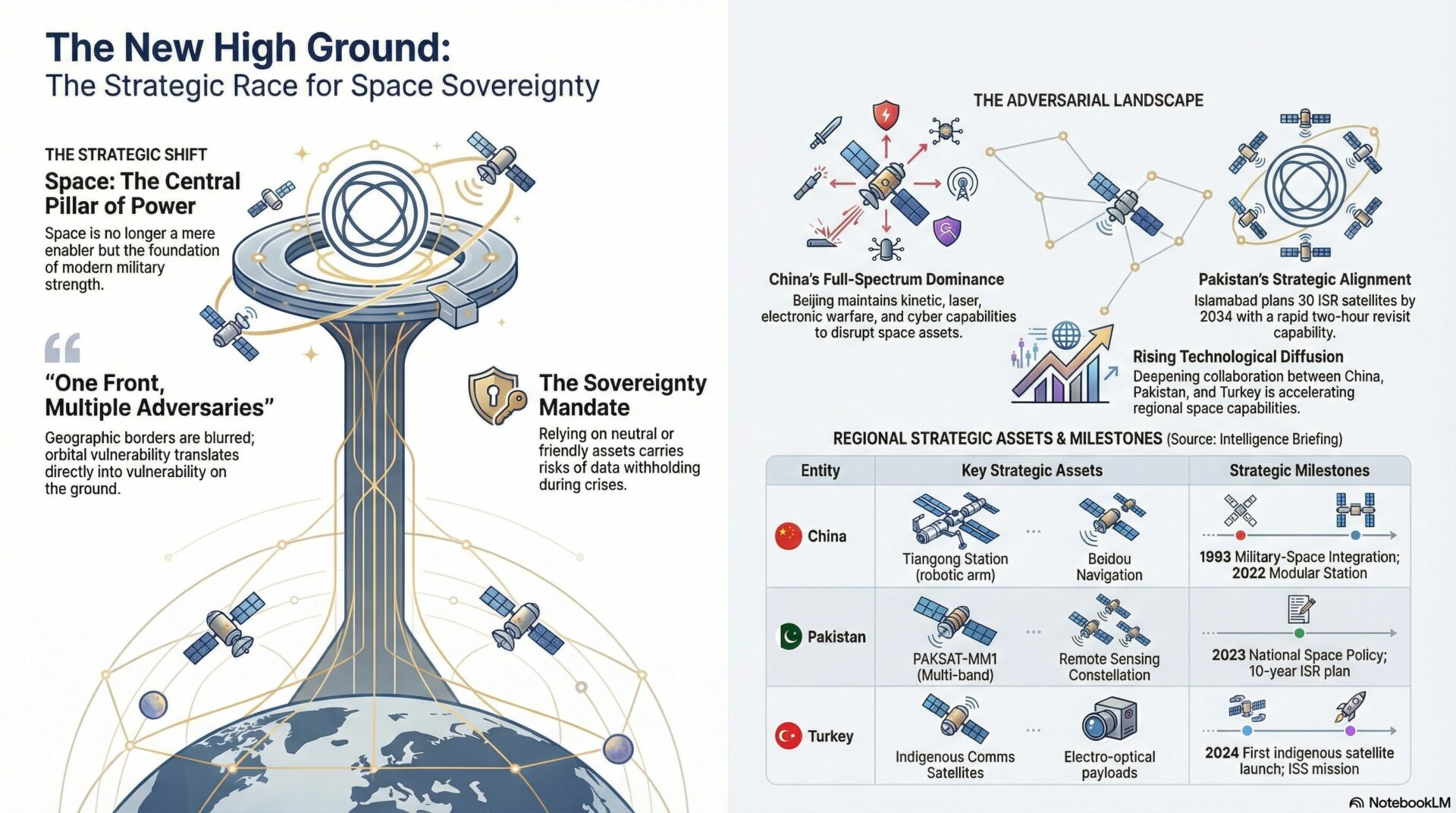
Lt Gen Raman outlined four categories of space actors: a nation’s own assets, those of a known terrestrial adversary, satellites of neutral countries, and assets belonging to friendly nations driven by national interests. He pointed to the ambiguity that arises when neutral satellites provide information to an adversary or when friendly nations withhold critical data at decisive moments.
While he did not offer definitive answers, he said such uncertainty underlines the need for sovereign space assets under national control, even as nations bridge capability gaps through partnerships while building safeguards and redundancy.
He described China’s space programme as deeply integrated into its ambitions for global influence, noting that following the establishment of the China National Space Administration in 1993, Beijing sharply accelerated military–space integration.
The expansion of the Long March launch vehicle programme, human spaceflight missions, Chang’e lunar exploration initiatives and Tianwen Mars missions, he said, reflects sustained state-driven growth. The operationalisation of the Tiangong Space Station since 2022, which is fully modular and permanently crewed, was identified as a major milestone, with the station expected to outlast the International Space Station scheduled to retire around 2030.
Lt Gen Raman highlighted the strategic relevance of Tiangong’s robotic arm, which can capture, reposition and assemble satellites in orbit, enabling servicing missions and potential life extension of space assets with clear dual-use implications.
He said China’s determination to dominate the space domain was shaped by the 1991 Gulf War, which demonstrated the role of space-enabled warfare, and the 1995–96 Taiwan Strait crisis, when vulnerabilities during missile tests reportedly exposed the risks of reliance on foreign space systems.
According to him, China today possesses a full spectrum of counter-space capabilities, including kinetic anti-satellite weapons, co-orbital systems, directed-energy weapons, electronic warfare tools and cyber operations.
Open-source reports, he noted, have referred to temporary laser dazzling of foreign satellites as calibrated and reversible actions that signal capability without overt escalation. China’s expanding satellite constellations, including the BeiDou navigation system and low-Earth orbit communication networks intended to rival commercial mega-constellations, further underscore its pursuit of strategic autonomy, even where projected satellite numbers appear ambitious.
Turning to Pakistan, Lt Gen Raman said its space efforts, though smaller in scale, show increasing policy coherence and strategic alignment. He noted that Pakistan approved its National Space Policy in December 2023, setting out institutional responsibilities for satellite development, national registry management and programme execution.
Islamabad has articulated plans to deploy 30 intelligence, surveillance and reconnaissance satellites over the next decade with a two-hour revisit capability, with parts of its remote sensing constellation already operational.
He said Pakistan launched PAKSAT-MM1 in May 2024, providing Ku-, Ka- and X-band communications, which, while presented as a civilian platform, enhances secure communications for the armed forces. Additional communication and earth observation satellites are planned before 2027.
Lt Gen Raman also pointed to deepening collaboration with China, including access to commercial imagery constellations, integrated satellite systems involving micro-satellites, assembly and integration facilities, astronaut training for missions aboard the Tiangong station, and interest in future lunar robotic missions under Chinese frameworks.
On Turkey, he said Ankara operates communication and high-resolution earth observation satellites for military and civilian use, successfully launched its first indigenously developed communication satellite in 2024, and sent its first astronaut to the International Space Station the same year. He noted Turkey’s export of electro-optical payload technologies and cooperation with Pakistan in satellite assembly and integration as signals of technological diffusion in the region.
Lt Gen Raman said traditional geographical distinctions are increasingly blurred in the space age. “There are no more northern borders or western borders,” he said. “It is one front and multiple adversaries.” Space-based assets, he added, operate across theatres simultaneously, enabling collusive support and coordinated strategic signalling, where vulnerability in orbit translates directly into vulnerability on the ground.
A neutral satellite may not remain neutral in effect, and a friendly nation’s assets may not always align with immediate operational needs, he said, warning that dependence carries inherent risk. The imperative, Lt Gen Raman stressed, is sovereign capability backed by redundancy, resilience and strategic foresight.