


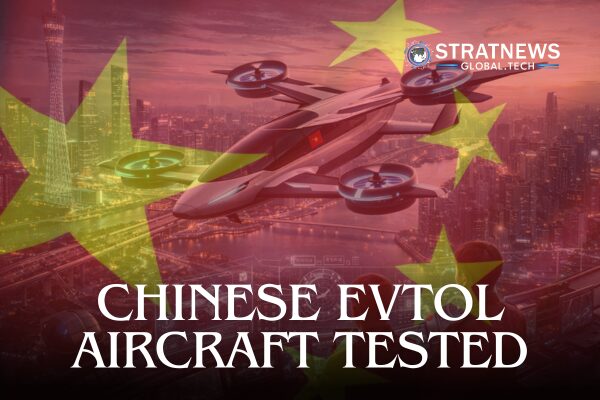
An electric vertical takeoff and landing vehicle developed by the Ninth Academy of the China Aerospace Science and Technology Corporation has successfully completed its maiden flight in southwest China’s Chongqing Municipality, its developer said on Friday.
The successful test marks an important step in China’s efforts to expand its low-altitude aviation ecosystem and develop next-generation transport technologies. According to the developer, the aircraft completed all scheduled performance verification tasks during the flight, confirming the stability and reliability of its design.
The China eVTOL aircraft features a novel configuration that blends aviation engineering with automobile design principles, allowing it to operate seamlessly in both air and ground modes. The vehicle is built around three main structural elements — wings, a passenger cabin and a chassis — and is divided into two primary modules.
China eVTOL Aircraft Combines Road and Air Mobility
The airborne module is designed to carry two passengers and can reach speeds of up to 150 kilometres per hour while flying at altitudes below 3,000 metres. This module can detach from the road-going platform, enabling vertical takeoff and landing without the need for conventional runways.
The road-going module features a fully electric intelligent chassis and provides a driving range of more than 300 kilometres. This design allows the aircraft to function as a ground vehicle when not in flight, offering flexibility for urban and regional travel.
Applications in Transport, Logistics and Emergencies
As a multipurpose low-altitude platform, the aircraft is expected to be used across a range of sectors, including passenger transportation, logistics delivery and emergency support operations. Developers say such platforms could help reduce traffic congestion in major cities while improving access to remote or hard-to-reach areas.
China’s Push Into Low-Altitude Aviation
China has been accelerating investment and research into low-altitude aviation technologies, including drones, air taxis and eVTOL platforms. Reusable, electric and modular designs are viewed as critical to lowering operational costs and increasing flight frequency in the future.
The successful maiden flight of the China eVTOL aircraft highlights the country’s broader ambitions to commercialise advanced aerial mobility solutions and integrate them into everyday transport networks.

