


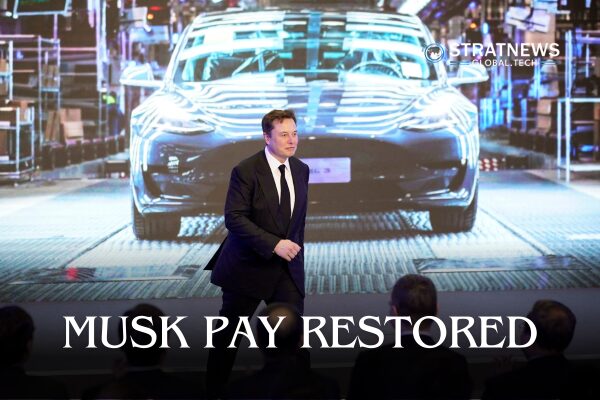
Delaware Supreme Court Restores Elon Musk’s $56 Billion Tesla Pay Deal
Elon Musk has scored a major legal victory after the Delaware Supreme Court reinstated his 2018 Tesla compensation package, once valued at $56 billion. The ruling, issued on Friday, overturns a lower court decision that had struck down the record-breaking pay plan as “unfathomable” and ensures Musk retains stronger control over the electric car maker.
Landmark Ruling Reverses Earlier Decision
In a 49-page opinion, the state’s highest court said the 2024 ruling that rescinded Musk’s pay package was “improper and inequitable,” as it left the Tesla chief “uncompensated for his time and efforts over a period of six years.” The decision reverses a verdict that had not only angered Musk but also sparked debate over Delaware’s business-friendly image.
At Friday’s closing stock price, the 2018 pay deal is now worth about $139 billion. Following the announcement, Tesla’s shares rose slightly in after-hours trading. Musk, who posted on X that he felt “vindicated,” now stands to increase his ownership in Tesla from roughly 12.4% to 18.1% if he exercises all the stock options tied to the package.
Background: From Court Challenge to Corporate Migration
The pay plan, the largest in corporate history until Tesla shareholders approved an even bigger one this year, granted Musk the right to buy around 304 million Tesla shares at a steep discount if the company hit specific performance goals. All of those milestones were achieved.
However, the plan was challenged in court by investor Richard Tornetta, who held just nine Tesla shares. In 2024, Delaware Judge Kathaleen McCormick sided with Tornetta, finding that Tesla’s directors were conflicted and had failed to disclose key details before the shareholder vote. The ruling voided Musk’s award and prompted him to criticise Delaware’s judiciary, accusing it of being “anti-founder.”
Musk’s frustration with Delaware’s ruling led Tesla and several other major companies — including Roblox, Dropbox, and Coinbase — to reincorporate in states such as Texas and Nevada, which are seen as more management-friendly. Despite these moves, Delaware remains the preferred legal home for most U.S. public corporations.
Shareholder Support and New Safeguards
Analysts suggest the Supreme Court’s reversal reflects judicial reluctance to override shareholder decisions. “There’s some belief that courts shouldn’t interfere with what shareholders have approved,” said Brian Dunn of Cornell University’s Institute for Compensation Studies.
Tesla shareholders overwhelmingly backed both the original 2018 pay plan and a new 2025 compensation package approved in November. The company’s board had warned that Musk — who also leads SpaceX and AI startup xAI — might reduce his involvement or leave Tesla entirely without suitable incentives.
The automaker, now incorporated in Texas, has introduced new measures to shield itself from future shareholder lawsuits. Under Texas law, investors must own at least 3% of the company to bring a corporate governance claim — a stake currently valued at around $30 billion, a threshold only Musk himself meets.
with inputs from Reuters