



India has emerged as a global reference point for inclusive artificial intelligence, particularly for countries in the Global South seeking to align innovation with development goals, believes Paula Bogantes Zamora, Costa Rica’s Minister of Science, Innovation, Technology and Telecommunications.
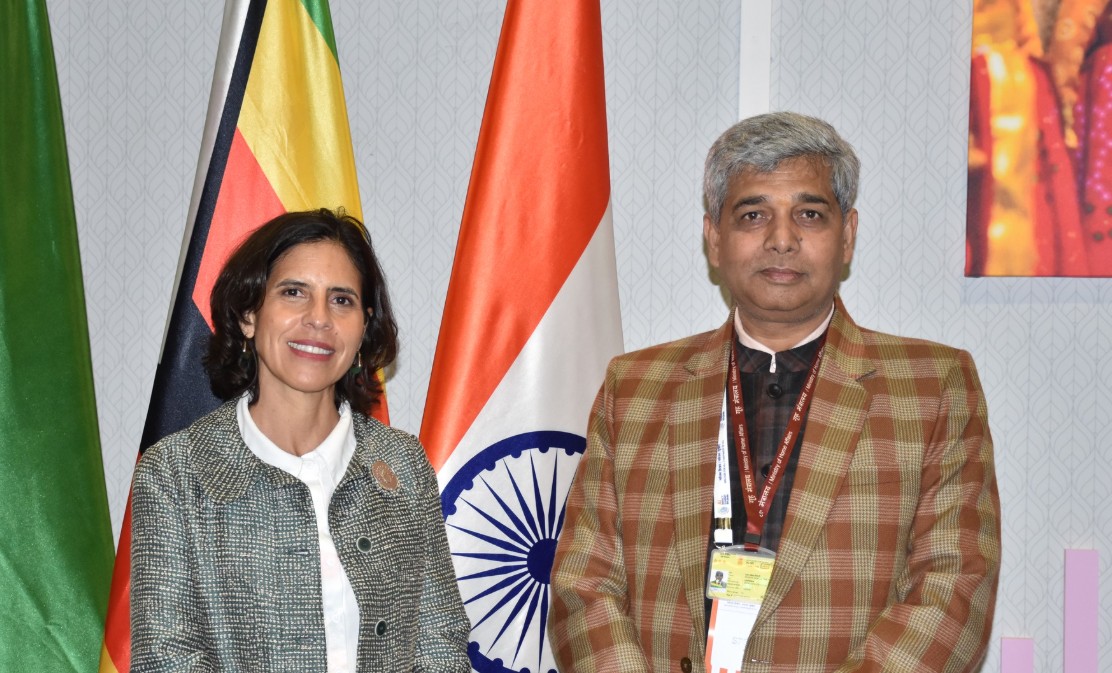
In an exclusive interaction with StratNewsGlobal Tech on the sidelines of the Global AI summit in New Delhi, she said at a time when governments are rethinking economic strategies around emerging technologies, the message of inclusive AI, championed at the highest political level, is resonating far beyond national borders.
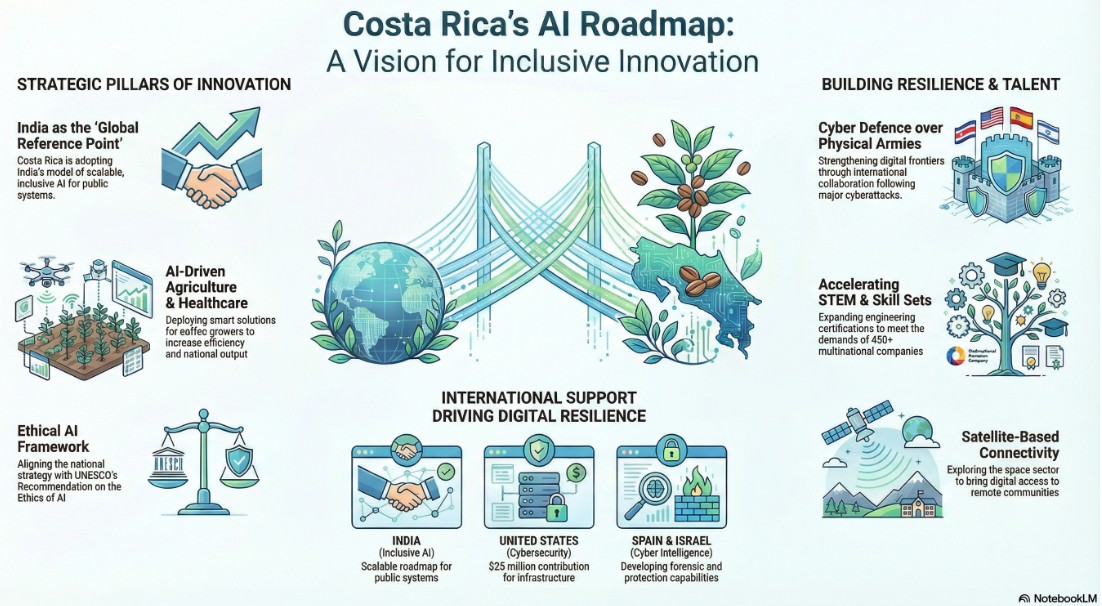
Describing India as a “point of reference” across sectors ranging from education and healthcare to digital transformation, she said that for smaller economies, the scale and speed of India’s AI implementation offer both inspiration and a practical roadmap.
Costa Rica, in particular, is looking closely at India’s experience as it sharpens its own AI ambitions.
“AI needs to be an element that every government must consider when discussing economic development,” she said. “This is the first time such a significant AI conversation is taking place in a Global South country, and what better example than India?”
The Minister’s visit comes at a pivotal moment for Costa Rica’s digital journey. In 2023, an action plan was agreed for the country to develop a national Artificial Intelligence strategy aligned with the “Recommendation on the Ethics of Artificial Intelligence” by UNESCO, with support from Andean Development Corporation (CAF).
Once finalised, Costa Rica will become the first country in Central America to adopt a comprehensive national AI strategy, a move that underscores its ambition to position itself as a regional digital leader.
According to the visiting Minister, participation in India’s AI dialogue has provided valuable insights into how large-scale public systems can integrate AI responsibly and inclusively. “We came here to learn how AI can help improve our education system. India is a reference in that. In health, India is a reference. In digital transformation, again, India,” she said. “For small economies like Costa Rica, seeing implementation at this scale is extraordinary.”
Agriculture remains one of Costa Rica’s primary economic activities, and AI-driven solutions are already being deployed to improve productivity, particularly among coffee growers. “Technology can help our farmers increase efficiency and output,” she said. “We know India has strong practices in agriculture technology, and this is an area where we can learn and adapt.”
For Global South nations, food security and climate resilience remain pressing concerns, and the Minister sees AI as a tool to strengthen both.
Costa Rica has long invested in education and healthcare as pillars of national development. However, the Minister acknowledged that the AI era demands faster adaptation. “Unless we use AI to become more efficient, to train more engineers, to expand STEM careers, to create more certifications, we won’t meet global demand,” she said.
Costa Rica currently hosts over 450 multinational companies operating in the country, reflecting its success in attracting foreign direct investment. As India’s global technology companies expand their footprint, she signalled openness to deeper bilateral engagement.
“Let’s talk about the skill sets you need,” she said. “If we don’t have them, how can we quickly adjust our systems to provide them?”
On the emerging space sector, she described it as a field with untapped potential for Costa Rica and the wider Central American region. Satellite-based connectivity, in particular, is seen as critical for reaching remote communities. “Space is an area with potential, especially for connectivity,” she noted, adding that further research is required to define Costa Rica’s strategic approach.
Costa Rica abolished its army in 1948, a decision that remains a source of national pride. But as the Minister pointed out, modern threats are increasingly digital. Four years ago, the country faced a major cyberattack, prompting international collaboration to strengthen its cyber defence infrastructure. Support from the United States, Spain and Israel has been central to building capacity, including a $25 million contribution from the United States.
“Wars today are not only fought on the ground but also in cyberspace,” she said. “With AI, we need to continue strengthening our knowledge, protection techniques and resilience.” Costa Rica is also working with Spain to develop cyber intelligence and cyber forensic capabilities, areas still underdeveloped in much of Latin America.
For Costa Rica, India’s leadership in digital public infrastructure and inclusive AI offers a template for scalable, people-centric innovation. “This has been a spectacular event for us,” the Minister said. “We’ve learned so much, and we hope to continue strengthening the relationship between our governments.”
As Costa Rica moves toward becoming Central America’s first nation with a formal AI strategy, collaboration with partners across the Global South, particularly India, could prove instrumental in shaping a model of ethical, inclusive and development-driven artificial intelligence.