


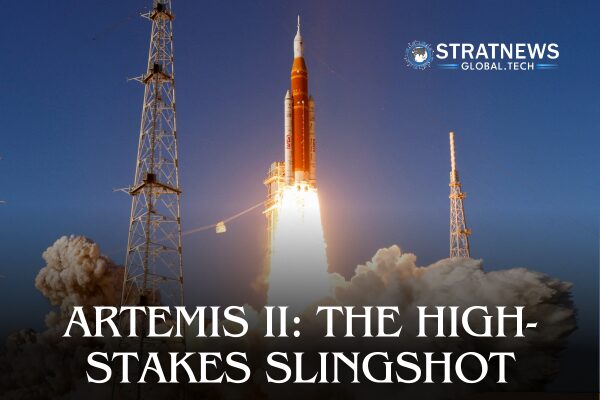
Artemis II Mission Enters Critical Phase of Free Return Trajectory
With NASA’s Artemis II now underway following its April 1 launch, the mission has moved from theory into active execution. Every burn, correction, and trajectory adjustment now unfolds in real time. What was once a carefully modelled path has become a live demonstration of the free return trajectory, one of spaceflight’s most refined concepts.
The Journey So Far: Committed to the Loop
After liftoff aboard the Space Launch System, the Orion spacecraft performed the crucial Trans-Lunar Injection burn. This manoeuvre committed the crew to a long arc towards the Moon. At this stage, conventional return is no longer an option. Instead, the spacecraft follows a pre-determined path designed to bring it back naturally.
This trajectory carries Orion far beyond Earth’s dominant gravitational pull. It then loops around the far side of the Moon before guiding the spacecraft back towards Earth. Rather than travelling in a straight line, Orion follows a vast curved path extending hundreds of thousands of kilometres into space.
The Gravitational Slingshot in Motion
The free return trajectory now actively shapes the mission. As Orion nears the Moon, lunar gravity bends its path with extreme precision. Each variation in distance plays a critical role.
If the spacecraft moves too close, the trajectory tightens and increases re-entry risks. If it remains too far, the return path loses accuracy. However, when aligned correctly, the result is a smooth arc back to Earth.
This process does not rely on propulsion during the loop. Instead, the spacecraft moves within a gravitational corridor defined by Earth and the Moon. The motion resembles a slingshot effect, although the key function is redirection rather than acceleration.
Managing Risk Through Precision
Although the situation carries high stakes, it does not imply unnecessary danger. Several factors ensure a strong margin of safety throughout the mission.
First, the Trans-Lunar Injection burn established the foundation of the trajectory. Early data indicates that this burn achieved the required precision, placing Orion on a stable return path.
Second, mission control continues to implement small mid-course corrections. These adjustments refine the trajectory and maintain alignment with the planned lunar flyby and Earth return.
Third, the underlying physics has already proven reliable. The same principle once enabled a safe return under extreme conditions, and it now serves as a primary mission design feature.
The Challenge of Earth Re-Entry
The most demanding phase still lies ahead. As Orion returns from the Moon, it will reach speeds near 39,000 kilometres per hour. At that point, the spacecraft must enter Earth’s atmosphere within a narrow corridor.
A steep entry angle would cause excessive heating and structural stress. Conversely, a shallow approach could result in the spacecraft skipping back into space. Therefore, the trajectory must guide Orion with exact precision to ensure a safe descent.
Gravity as the Guiding Force
At this stage, gravity governs nearly every aspect of the mission. Earth’s pull extends outward and then draws the spacecraft back, while the Moon reshapes its path during the flyby. This interaction forms a delicate balance of forces.
Rather than active steering, the mission depends on placing the spacecraft within this dynamic system. The motion resembles an object moving through a current, guided by natural forces rather than continuous control.
A Mission Defined by Precision and Trust
With Artemis II in flight, the mission now depends on execution rather than planning. The free return trajectory reflects a system that relies on accuracy from the outset rather than constant intervention.
If all elements remain aligned, the spacecraft will return to Earth as intended. The path home, once established, unfolds through the combined influence of gravity and precise initial conditions.