


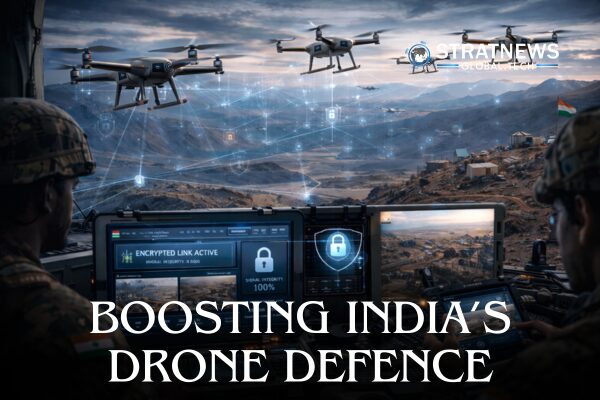
As unmanned systems rapidly redefine modern warfare, the focus is shifting from capability to survivability—and increasingly, to cybersecurity built into systems from the ground up. In this evolving battlespace, drones are no longer just surveillance tools; they are high-value assets vulnerable to hacking, spoofing, and electronic disruption.
Against this backdrop, ZUPPA Geo Navigation Technologies has delivered over 500 cyber-secure drones to the Indian Army in just three months, signalling a decisive move towards “secure-by-design” unmanned platforms in active deployment.
The company’s ‘Ajeet’ series drones have cleared the government’s Standardization Testing and Quality Certification (STQC) framework after undergoing detailed evaluation of their cybersecurity, reliability, and operational resilience. The certification process mirrors protocols used for surveillance systems like CCTV networks, highlighting growing concerns around vulnerabilities in connected defence technology.
The development comes as military planners globally confront a new reality: drones are now integral to combat operations, electronic warfare environments, and precision missions—making them prime cyber targets.
“As drones become integral to modern defence strategies, cybersecurity is no longer optional, it is mission-critical,” said Sai Pattabiram, Founder and MD of ZUPPA Geo Navigation Technologies. “With the increasing weaponization of drones, ensuring cyber-secure unmanned systems is essential for safeguarding operations. Our focus has been on building indigenous platforms that are not only high-performing but also resilient, secure, and trusted for deployment in contested EW saturated operational environments.”
Unlike earlier generations of unmanned systems that prioritised performance and range, newer platforms are being designed with embedded safeguards to counter threats such as hacking, signal spoofing, and data interception—risks that have been exposed in recent conflicts and breaches involving connected systems.
The Ajeet drones are designed and manufactured in India, with a focus on ease of deployment in field conditions. Officials say personnel have been trained to operate the systems independently as well as in coordinated swarm formations using indigenous software.
The push reflects a broader shift in India’s defence posture, where indigenisation is being paired with secure architecture to reduce dependence on foreign systems that may carry embedded risks.
ZUPPA says its manufacturing and quality processes are aligned with global aerospace benchmarks, including AS9100 standards, allowing for scalability and rapid deployment as operational demand grows.
The message is clear: future combat readiness will depend not just on deploying more drones, but on ensuring they can operate securely in contested, electronically saturated environments—where disruption is as likely to come from code as from conventional firepower.