


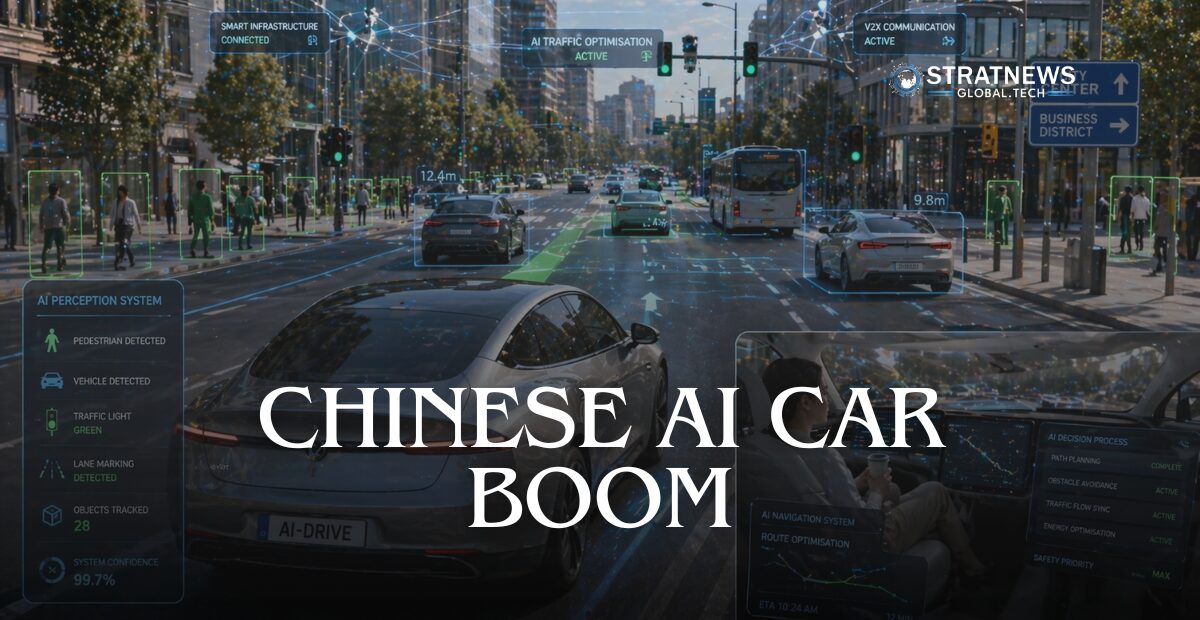
China’s Automotive Industry Accelerates Towards AI Integration
China took a quarter of a century to establish dominance in the electric vehicle sector. Now, however, its automotive industry is rapidly advancing towards a new transformation centred on artificial intelligence. This shift aims to create vehicles that are not only connected but capable of reasoning independently, powered by domestically developed chips and software.
Earlier this year, China introduced its latest five-year plan, outlining a national strategy known as “AI Plus”. This initiative seeks to integrate artificial intelligence across industries, including manufacturing and healthcare. At the same time, it reflects a clear ambition to reduce reliance on foreign semiconductor technologies, particularly those controlled by external markets.
Blurring Lines Between Technology And Automobiles
Industry leaders increasingly recognise that the boundary between technology firms and car manufacturers has effectively disappeared. AI-driven vehicle development is progressing at a faster pace in China than in many other regions. As a result, the country is positioning itself at the forefront of innovation in next-generation mobility.
In recent days, automakers and suppliers have announced a wave of investments and unveiled new AI-powered systems. Although some applications appear incremental in the short term, analysts emphasise that the long-term implications are substantial. China’s automotive capabilities have reached a level where they are reshaping the global industry landscape, signalling not a gradual transition but a profound transformation.
Vehicles Evolve Into Intelligent Agents
Car manufacturers are introducing systems that significantly enhance user interaction. For instance, updated AI models now allow drivers to issue natural language commands, such as requesting parking near a specific location. These systems can rely on camera-based navigation without requiring predefined maps or coordinates.
Meanwhile, new operating systems are enabling vehicles to perform complex tasks. Drivers can instruct their cars to manage schedules, place orders, and organise information while travelling. Additionally, these systems can monitor driver behaviour and adjust in-car environments accordingly, improving comfort and safety.
Investment And Strategic Alignment Drive Growth
Technology companies are making substantial investments to strengthen computing capabilities for smart driving. Although automotive revenue remains a smaller portion of their overall business, it represents one of the fastest-growing segments. This highlights the increasing importance of intelligent vehicles within the broader technology ecosystem.
Chipmakers are also advancing rapidly, introducing processors that combine cockpit and driving functions while supporting multiple displays within a vehicle. At the same time, traditional automakers are aligning closely with national priorities, adopting advanced AI technologies and forming strategic partnerships to remain competitive.
China’s coordinated approach, supported by policy direction and industrial collaboration, is accelerating the development of AI-powered vehicles. This momentum indicates a decisive shift towards a future where cars function as intelligent, responsive agents rather than conventional modes of transport.
With inputs from Reuters

