


The Chinese Navy has deployed a new underwater drone in the South China Sea: the soft-body bionic manta ray. These are underwater drones that immitate movement of manta rays and will be used for a wide range of applications like armed reconnaissance missions in the future. It has also unveiled robotic fish submersibles the NH-1, NH-2, and NH-3.
The Defence Mirror reported that these submersibles have been created to match the swimming mechanics of manta rays, or devil fish. They were developed by a team at Northwestern Polytechnical University of China with complete intellectual property rights. They are equipped with optical cameras, sonar systems, a positioning system and a satellite navigation system.
A NPJ Robotics review, authored by a team led by Junzhi Yu, a leading Chinese roboticist at Peking University’s Institute of Automation, highlights that modern bionic fish robots can adapt their gait, speed, and trajectory in real time. They can make these adjustments in response to changing currents, obstacles, or detection threats — making them credible for autonomous surveillance or mine-countermeasure missions.
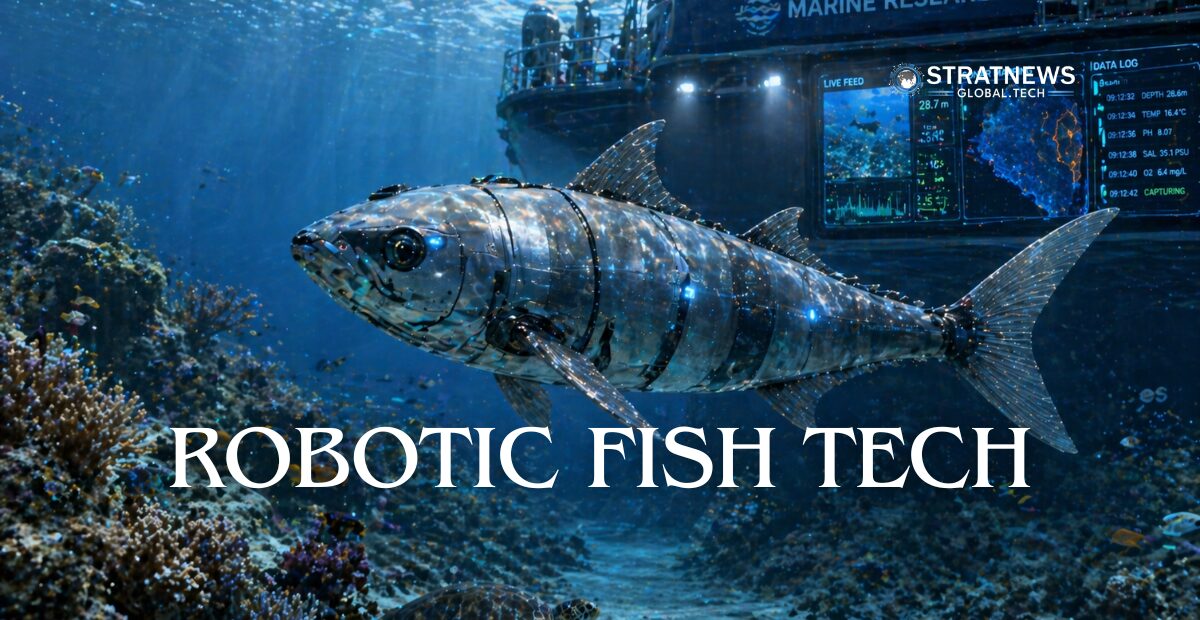
The United States too has been developing such robotic fish for military and commercial purposes. The U.S.Navy’s spy robotic fish, Silent NEMO, bears a resemblance to tuna. It evades sonar tracking more effectively because it operates more quietly than miniature submarines and can remove obstacles such as mines in environments with low visibility, ensuring safe passage, as published in a A National Library Of Medicine journal.
Robotic fish can also be used for fault detection in commercial spaces and aversion of disasters, offering crucial support for ensuring industrial safety and enhancing production efficiency. In America, Michigan State University developed GRACE, a robotic fish equipped with multiple sensors, positioning devices, and wireless communication equipment, to continuously monitor and track oil spills in key Gulf areas.
The Polytechnic University of Madrid and the University of Florence utilized these equipment to track pH levels in aquaculture environments. These systems, although unique, come with challenges, in terms of detection accuracy and equipment maintenance. However, with further enhancements, more application is warranted through the use of AI and data analytics.

