


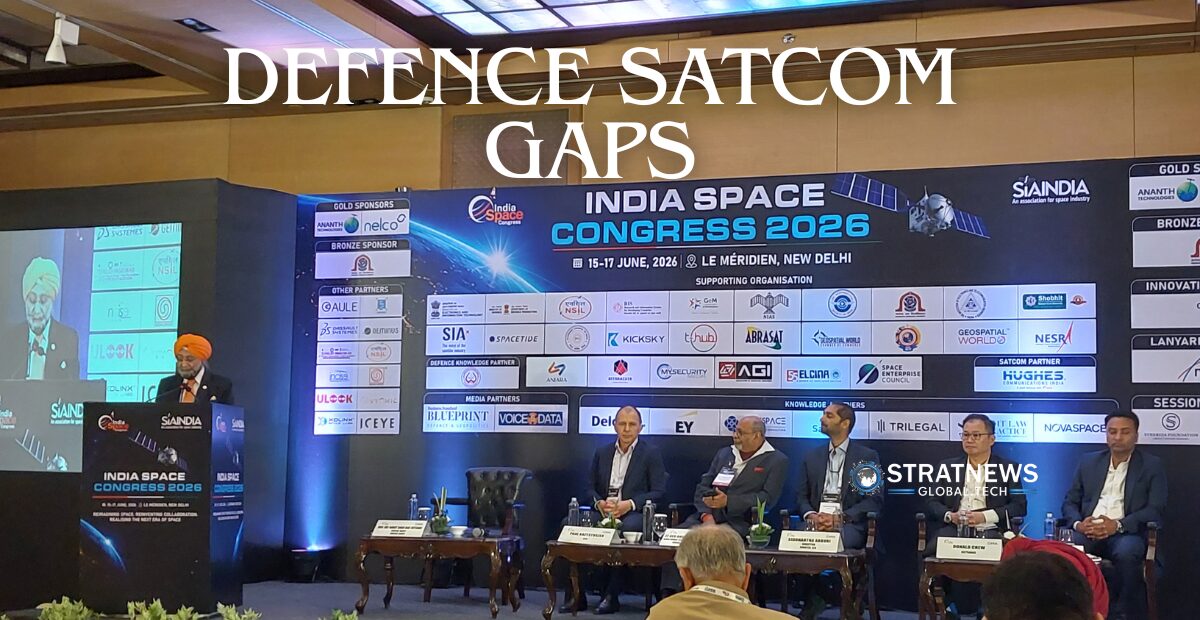
At the India Space Congress 2026, hosted by SIA-India at Le Meridien, New Delhi, a session, conducted on June 17th, on “Secure SATCOM for Air, Naval and Tactical Operations” was one of the more candid conversations at the event. Six speakers, a mix of veterans and executives, laid out where Indian satellite communications actually stand, and the gap between ambition and reality was clear.
Lt Gen Anil Kapoor (Retd), who chaired the session, set the tone. As India’s former Director General of Information Systems, he said the gap he tried to close within the Army two decades ago still exists, except it now spans three services under Theaterisation. He broke the problem down using his own acronym, SATCOM: skilled manpower, deep tech, cyber resilience, orbital congestion and manufacturing, returning to NavIC’s troubles and India’s continuing reliance on others’ GPS, a dependency that has worked against India before.
Brigadier (Dr) Navjot Singh Bedi, who has worked with the Integrated Defence Staff on jointness, made the most grounded point of the session. Satcom will be jammed or knocked out in any real conflict, he said, so it must be built to degrade gracefully. Losing the link to headquarters should not mean losing the fight on the ground. With Operation Sindoor as his example of multi-domain operations, and terrain ranging from the Himalayas to a coastline thousands of kilometres long, he called satcom not a luxury but often the only option.
Siddhartha Abburi of Avantel gave the clearest status check on where India stands. The skillset and manufacturing exist, he said, pointing to Avantel’s own work with ISRO, the Navy, BEL and DRDO on satcom terminals and software-defined radios. The problem is what’s already in service: most Indian military satellites are older, receive-only geostationary systems, pushing data in bits per second when a drone feed needs megabytes or gigabytes. This was less a pitch than an admission. India can build the boxes, but the satellites carrying them haven’t caught up.
Then came two pitches dressed up as principles. Paul Krzystoszek of SES argued real resilience now means multi-orbit, multi-band satellites and terminals that can switch orbit and band on the fly. Donald Chew of Astranis went further, selling his company’s micro-GEO satellites: smaller, cheaper, built and launched in 14 to 18 months instead of the years a traditional GEO bird takes, and less likely to go obsolete before reaching orbit.
Both reflect a genuine industry shift, away from one giant satellite covering a continent for twenty years, toward smaller, layered networks. But both men were also plainly selling capacity India doesn’t build itself. Neither company manufactures here, and the pitch, technically sound as it is, underlines that India’s own ISRO-built fleet has no real multi-orbit or micro-GEO answer yet. The need is real. So is the sale. But as Brig. Bedi said in his closing remarks: Indigenisation is the solution.
The most consequential warning came from Suhas Gopinath of Globals, whose company already runs cyber-defence for Indian Navy satcom terminals and carries CERT-In empanelment, proof India has genuine capability here. Anything with an IP address can be hacked, he said, recalling how his team found an unpatched maritime satcom terminal and used it to take over a merchant ship’s data and controls. A compromised ground terminal, he warned, can sit dormant for months harvesting data before being triggered for physical damage, the digital equivalent of an invisible, non-human sleeper cell. Unlike the orbit pitches, this read less like sales talk and more like a warning that India’s wider terminal base is still catching up.
The closing remarks returned to the same themes: multi-orbit and multi-band architecture, AI-driven spectrum management, and tighter cyber hygiene for every terminal in service. For India, the session was less a showcase of new technology than an honest reckoning with where it still falls short: manpower, an ageing satellite fleet, and unpatched ground systems, even as foreign vendors queue up with a fix. The real question for Indian planners is whether to keep buying that fix, keep calling screwdrivergiri ‘Make in India’ or finally build it at home.
This article is written by KOUSTUBH GHORMADE currently interning with StratNewsGlobal.

