


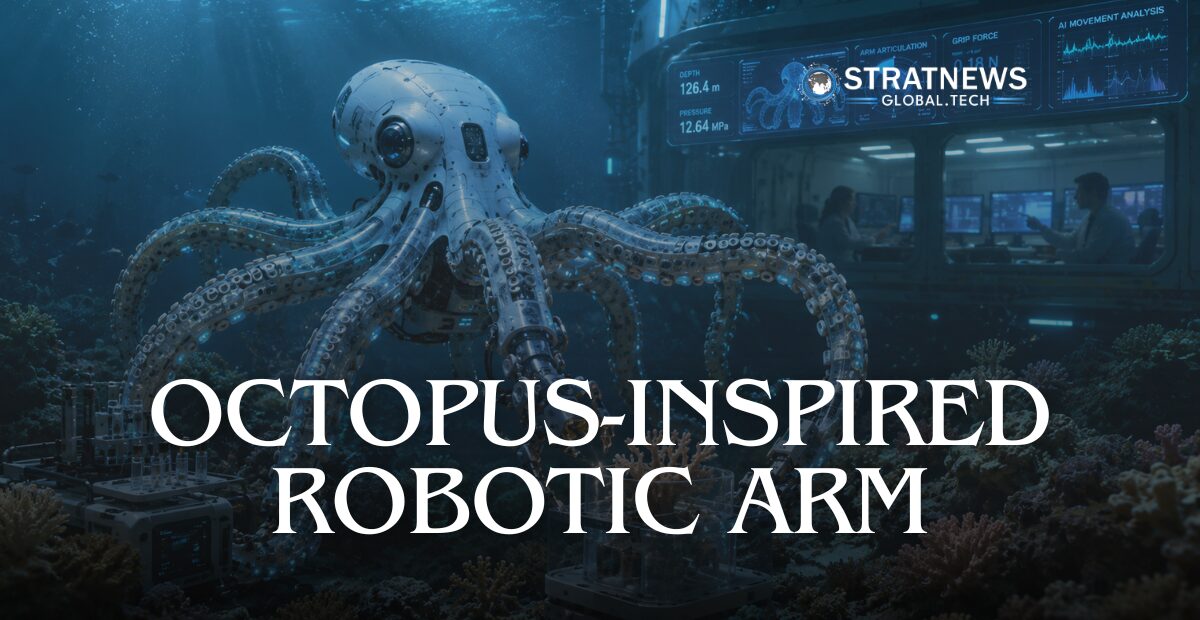
Octopus-Inspired Robotic Arm Uses Artificial Suction Cups To Sense And Grasp Objects
Researchers in Italy have developed an octopus-inspired robotic arm that can feel its surroundings through artificial suction cups, enabling it to grasp objects both underwater and on land. The innovation could provide a softer and more adaptable alternative to conventional rigid robotic systems in complex environments.
Inspired By Nature’s Master Of Flexibility
The prototype was created by scientists at the Istituto Italiano di Tecnologia (IIT) in Genoa. Designed to mimic the remarkable capabilities of octopus arms, the robotic system combines flexibility with advanced touch sensing.
Unlike traditional robotic arms, which often rely on rigid structures and centralised control systems, the new device distributes sensing capabilities along its length. This approach allows the arm to interact more naturally with objects and navigate confined or cluttered spaces.
“We have proposed a new version of a continuous soft robotic arm, which is inspired by octopus,” said Barbara Mazzolai, Associate Director for Robotics at IIT.
According to Mazzolai, the research drew particular inspiration from an octopus’s ability to explore and understand its environment through highly sensitive suckers.
How The Artificial Suction Cups Work
The robotic arm is equipped with silicone suction cups containing miniaturised optoelectronic sensors. When a suction cup makes contact with an object, its shape changes slightly.
This deformation alters the way light from tiny internal LEDs is reflected and detected by integrated sensors. By analysing these changes, the system can determine both the strength and direction of contact.
“Each sucker can detect contact, the direction, the contact and even forces,” Mazzolai explained, noting that the sensing technology is embedded within miniature electronic boards.
As a result, the arm can identify subtle touch signals and respond accordingly, improving its ability to handle objects with precision.
Soft Robotics For Challenging Environments
Octopuses have long served as a source of inspiration for roboticists because their arms contain no skeleton. Instead, they can bend, twist and wrap around objects while simultaneously sensing and gripping them through their suckers.
The IIT team adopted these principles to create a robotic arm that is highly adaptable and capable of conforming to different shapes.
“The robot, in fact, is so soft, so adaptable, like the natural system,” Mazzolai said.
The researchers demonstrated that the arm can operate effectively both underwater and in air. Furthermore, its modular structure allows engineers to adjust the number and placement of suction cups to suit specific applications.
This flexibility enables the system to retrieve objects of varying sizes, shapes and weights, even in constrained spaces where conventional robotic arms may struggle.
Future Applications And Development
The research, published in Nature Machine Intelligence, highlights the potential of soft robotics for underwater exploration, industrial inspection and other tasks requiring delicate manipulation.
Because the arm can sense contact directly through its suction cups, it may prove particularly useful in environments where visibility is limited or where fragile objects must be handled carefully.
Looking ahead, the team plans to expand the range of objects the robotic arm can grasp and manipulate.
Mazzolai also suggested that the technology could eventually be integrated into humanoid robots.
“In theory we could also think to combine such features in a humanoid,” she said, pointing to the possibility of using octopus-inspired suction systems to improve gripping performance in wet or slippery conditions.
As soft robotics continues to evolve, biologically inspired designs such as this one could help create machines that interact with the world more safely, efficiently and naturally than traditional rigid robots.
With inputs from Reuters