


Chinese Team Develops SkyX Vehicle for Underwater and Aerial Missions
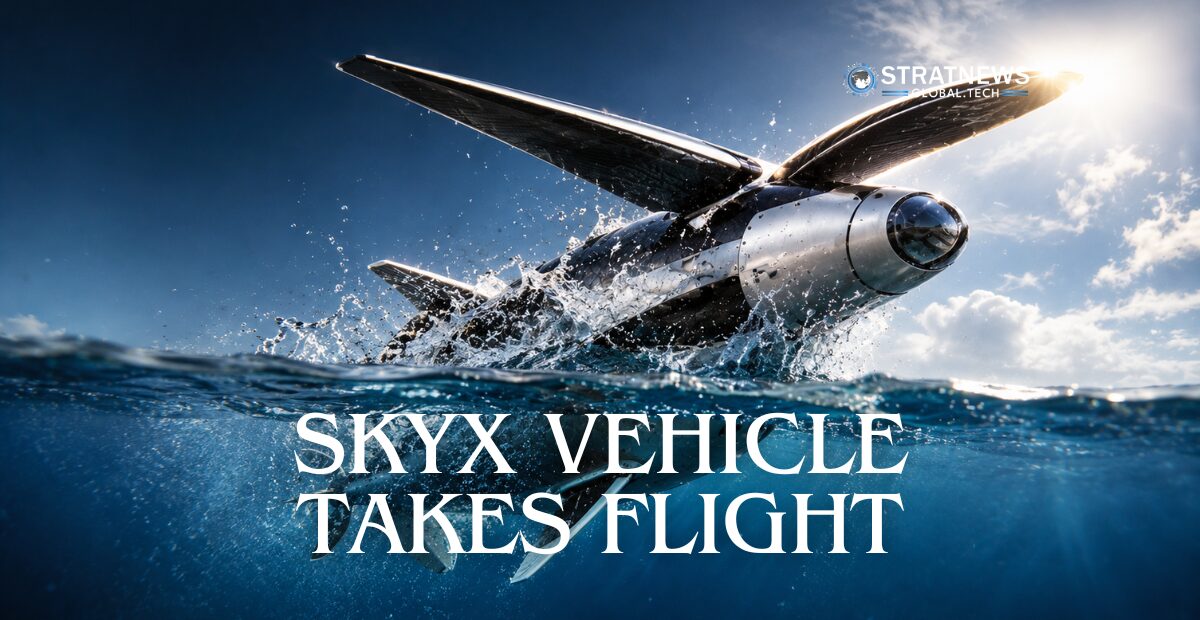
Inspired by flying fish in nature, a young Chinese team in Changsha, central China’s Hunan Province, has developed SkyX, a bionic cross-domain vehicle designed to move between underwater navigation and aerial flight.
The team developed the vehicle at the Lugu Science and Innovation Park. Unlike conventional aerial and underwater vehicles, which typically operate in a single environment, SkyX is designed to handle both domains with one device.
Foldable Wings Enable Cross-Domain Movement
SkyX uses a foldable fixed-wing configuration to adapt between underwater and aerial operations.
When the vehicle submerges, its wings fold inward to reduce drag. Then, when it reaches the surface, the wings spread out automatically to prepare the vehicle for take-off.
The design draws inspiration from flying fish, allowing the vehicle to transition between water and air while using a single platform.
The team has developed five generations of prototypes so far. Meanwhile, a sixth-generation version is undergoing testing.
Young Team Develops Multiple Prototypes
The development team is made up of young researchers and engineers. Its oldest member is 27, while its youngest member is 23 and recently graduated from college.
Founder Qu Guangxi said the team has worked with laboratories at the National University of Defense Technology and secured multiple core patents during the development process.
After five generations of prototype development, the team has completed engineering prototype verification.
“If progress continues smoothly, the product is expected to reach the market within six months,” Qu said.
The ongoing sixth-generation testing will therefore be an important stage before the vehicle moves towards potential commercial use.
SkyX Targets Multiple Applications
SkyX is expected to have applications in several areas where both aerial and underwater operations are required.
Potential uses include emergency water rescue, ecological monitoring of rivers and lakes, water conservancy inspections and maritime security.
A single vehicle could perform both aerial and underwater missions. As a result, the system could avoid some of the costs and operational separation associated with deploying two separate vehicles for different environments.
The development reflects the team’s effort to combine aerial and underwater capabilities within one bionic platform.
With inputs from Reuters