


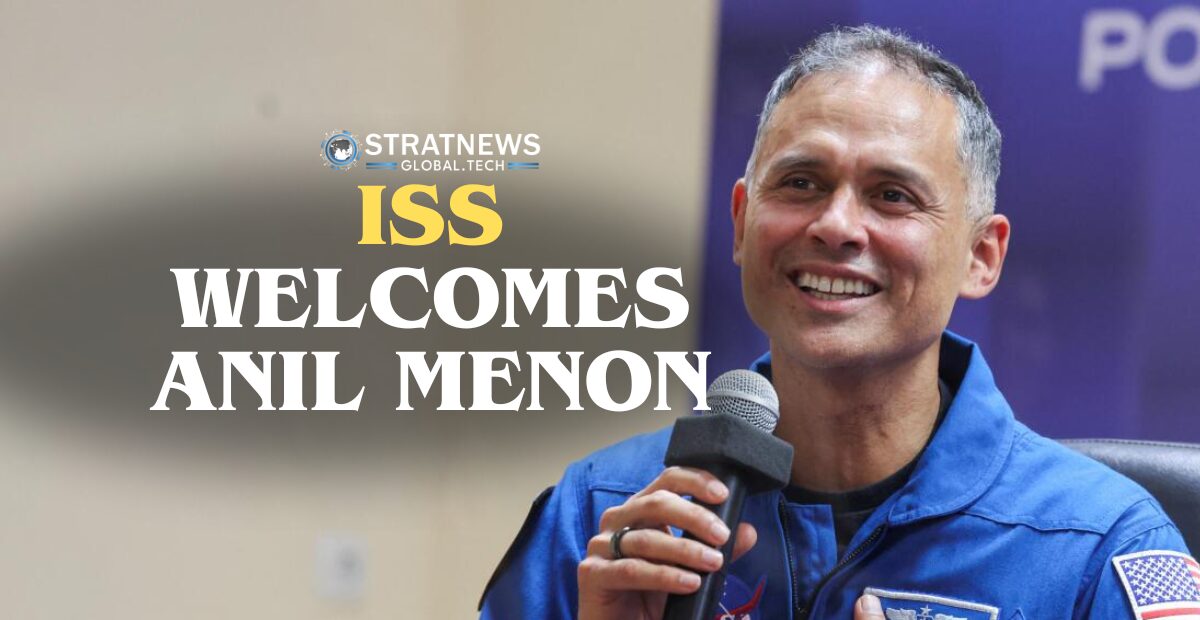
NASA astronaut Anil Menon has begun his first space mission, launching aboard Russia’s Soyuz MS-29 spacecraft to the International Space Station (ISS), underscoring how US-Russia cooperation in space continues despite deep geopolitical tensions.
The Soyuz spacecraft lifted off from the Baikonur Cosmodrome in Kazakhstan carrying Menon and Roscosmos cosmonauts Pyotr Dubrov and Anna Kikina. Around three hours later, it docked with the ISS’s Prichal module, where the trio joined the Expedition 74 crew.
The mission is Menon’s first journey into space, while Dubrov and Kikina are each on their second spaceflight. The crew is expected to spend about eight months aboard the ISS before returning to Earth in April 2027 after completing a series of scientific experiments and technology demonstrations.
Despite relations between Washington and Moscow remaining strained following Russia’s invasion of Ukraine, the ISS continues to be one of the few areas of sustained cooperation between the two countries. Under a long-standing seat-exchange agreement, NASA astronauts fly aboard Russian Soyuz spacecraft while Roscosmos cosmonauts travel on SpaceX Crew Dragon missions, ensuring the station remains continuously staffed.
Soyuz MS-29 is a routine crew rotation mission that replaces part of the station’s existing crew. With the arrival of Menon, Dubrov and Kikina, the ISS temporarily hosts ten astronauts and cosmonauts before three current crew members depart later this month to begin Expedition 75. The station has maintained a continuous human presence since November 2000.
Born in Minneapolis, Menon is the son of K.P. Shankaran Menon, whose family is from Kerala’s Palakkad district, and Elizabeth Menon, a Ukrainian immigrant to the United States. An emergency medicine physician, he is also a colonel in the U.S. Space Force with expertise in aerospace medicine. Before joining NASA’s astronaut corps, he served as a NASA flight surgeon supporting ISS missions. He later joined SpaceX, where he established the company’s medical programme, supported the first crewed Dragon missions and contributed to the Starship programme. Selected as part of NASA’s 2021 astronaut class, he completed two years of astronaut training before receiving his first flight assignment. His wife, Anna Menon, flew on SpaceX’s Polaris Dawn private astronaut mission in 2024.
During the mission, Menon will work on experiments spanning artificial intelligence, semiconductor manufacturing and space medicine. One study will examine semiconductor crystal growth in microgravity, where scientists hope the near-weightless environment will produce higher-quality crystals for advanced chips used in artificial intelligence, high-performance computing and medical equipment.
Another experiment will test AI-assisted ultrasound imaging using augmented reality, allowing astronauts to perform complex medical scans with limited support from doctors on Earth. The technology is expected to play an important role on future missions to the Moon and Mars, where communication delays will make real-time medical guidance difficult.
The crew will also study how prolonged exposure to microgravity affects blood circulation, carry out 3D bioprinting of vascular tissue to support regenerative medicine research, and evaluate systems that can produce intravenous fluids from the station’s potable water supply. The technologies could reduce dependence on cargo missions by allowing astronauts to produce essential medical supplies during long-duration spaceflight while contributing to advances in healthcare on Earth.