


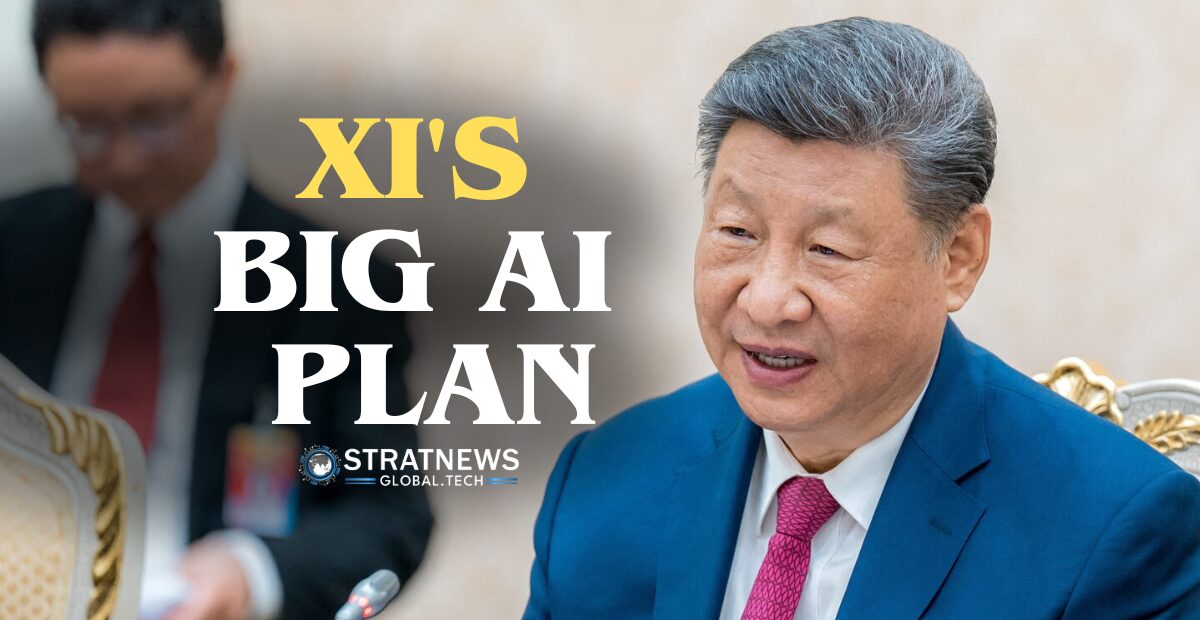
Chinese President Xi Jinping is set to present China’s vision for the future of artificial intelligence and global AI governance at the World Artificial Intelligence Conference (WAIC) in Shanghai on Friday, reinforcing Beijing’s determination to become a global AI leader.
Xi’s keynote address comes just two days after he visited Shanghai on Wednesday, where he inspected urban renewal projects and stressed that “advancing high-quality urban renewal is an important lever for the modernisation of cities.” During the visit, Xi called for fully implementing the concept of a “people’s city”, urging officials to consult residents on their needs, seek public opinion, and measure success through people’s satisfaction while improving residents’ sense of happiness, security and wellbeing.
The conference, running from July 17 to 20, comes at a crucial time as China accelerates efforts to build an independent AI ecosystem amid growing technological rivalry with the United States.
Huawei Unveils Powerful AI Computing Cluster
One of the biggest announcements at the event will be the public debut of Huawei’s Atlas 950 SuperPoD, the company’s most advanced AI computing cluster to date.
The large-scale AI system connects thousands of Huawei’s Ascend AI processors through high-speed interconnects, allowing them to function as a single computing platform capable of training and running advanced artificial intelligence models.
The launch is widely viewed as China’s strongest attempt yet to build a domestic alternative to Nvidia’s most advanced AI chips, many of which remain restricted under U.S. export controls.
Chinese media have also reported that domestic chipmakers Biren and MetaX will unveil their own “supernode” AI computing systems during the conference, highlighting China’s rapid advances in AI hardware.
China Pushes AI Self-Reliance
China has steadily expanded its domestic AI ecosystem over the past two years as Beijing seeks greater technological independence.
A major milestone has been the adaptation of DeepSeek’s latest V4 AI model, which can now run entirely on Huawei’s Ascend chip clusters, reducing dependence on foreign semiconductor technology.
The development reflects Beijing’s broader strategy of achieving self-sufficiency in frontier technologies while positioning AI as a key driver of future economic growth.
AI Governance Takes Centre Stage
Beyond technology launches, WAIC is expected to serve as a major diplomatic platform for AI governance.
The conference comes just ahead of the first government-level AI talks between China and the United States under President Donald Trump’s administration, making the Shanghai gathering an important opportunity for Beijing to present its competing vision for governing artificial intelligence.
At a recent United Nations AI dialogue, Washington argued that excessive regulation could hinder innovation, while China promoted affordable, open-source AI models as a way to reduce global inequality in access to advanced technologies.
George Chen, Chair of Digital Practice at the Asia Group, noted that WAIC has evolved far beyond a technology exhibition.
“WAIC has become more than a technology showcase; it is now a geopolitical stage where Beijing seeks to articulate its vision of AI as both a national priority and a diplomatic instrument.”
China’s Global AI Ambitions
Xi has repeatedly described AI as a transformative force for China’s future. In a speech earlier this year, he called artificial intelligence an “epoch-making, major technological transformation following the steam engine,” underlining its strategic importance for national development.
China has identified AI as a pillar of long-term growth and is accelerating its adoption across manufacturing, healthcare, education and other industries.
Beijing is also expected to provide updates on its proposal to establish a World AI Cooperation Organisation (WAICO), first introduced at last year’s WAIC. The initiative aims to promote international cooperation on AI governance, although no countries have formally announced membership so far.
The conference also coincides with a High-Level Meeting on Global AI Governance, where officials are expected to announce progress on implementing China’s Global AI Governance Initiative.
Promoting Open-Source AI
Chinese officials are expected to position the country’s open-source AI ecosystem as a low-cost alternative to Western AI models.
A commentary published this week in the People’s Daily argued that AI development should avoid technological monopolies and instead focus on expanding global access to advanced AI technologies.
Global Leaders Gather in Shanghai
WAIC will bring together political leaders, technology executives and leading AI researchers from around the world.
Among the international attendees are UN Secretary-General António Guterres, Kazakh President Kassym-Jomart Tokayev, and Thai Prime Minister Anutin Charnvirakul.
The conference will also feature renowned AI researchers and Turing Award winners, including Yoshua Bengio and Richard Sutton, although participation from major U.S. technology companies is expected to be limited.
Alongside Huawei’s announcement, other Chinese firms are expected to unveil new AI-powered products, including AI smartphones from ZTE-owned Nubia and AI startup StepFun, showcasing China’s rapidly expanding domestic AI ecosystem.
Xi’s keynote speech is expected to set the tone for both China’s AI development strategy and its efforts to shape the future rules governing artificial intelligence as global competition in the sector intensifies.

