


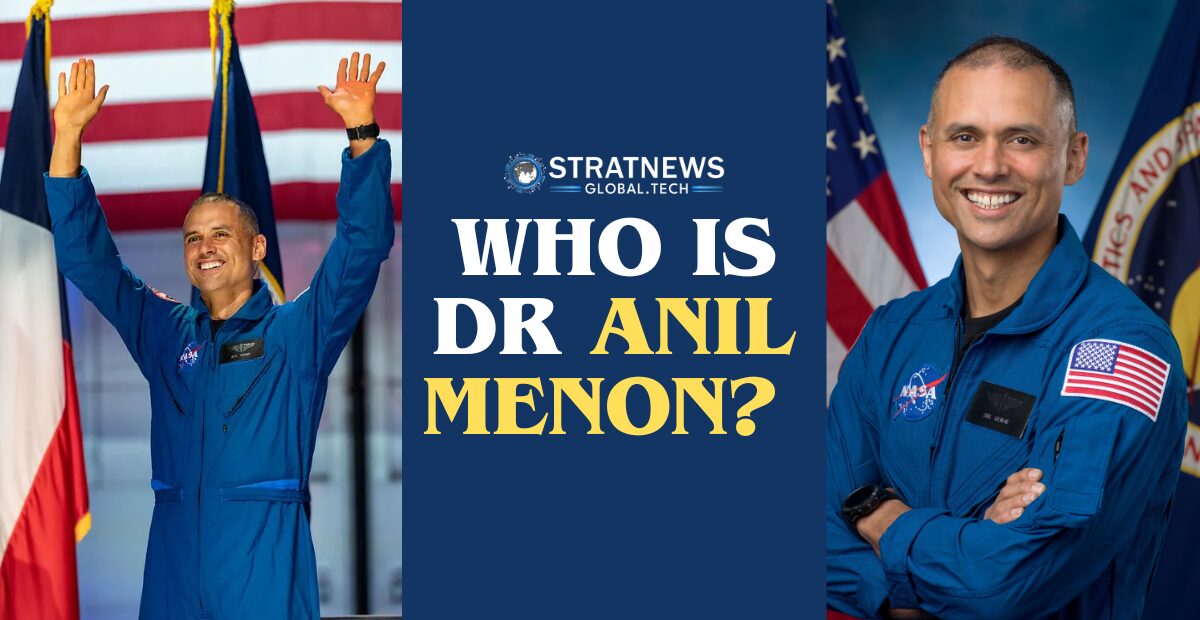
Dr Anil Menon, the Indian-origin astronaut from NASA who recently arrived at the International Space Station (ISS), has made headlines. Not only has his mission garnered widespread attention, but so has his personal journey.
Menon, born to an Indian immigrant father and Ukrainian immigrant mother, is an American citizen. In 1995, he earned degrees in neurobiology, mechanical engineering and public health. He is an actively practising emergency medicine physician and a Colonel in the U.S. Space Force. He has received fellowship training in emergency and aerospace medicine.
He treated climbers on Mount Everest while in the U.S. Air Force, helped earthquake victims in Haiti, and flew search-and-rescue missions in Afghanistan.
In 2021, NASA selected him to join the Astronaut Candidate Class, where he served as the crew flight surgeon for various expeditions on the International Space Station.
He later joined SpaceX as their first flight surgeon, helping to launch its first humans to space during the Demo-2 mission and building a medical organisation to support the human system during future missions.
His arrival at the ISS on the Soyuz spacecraft marked the first time an astronaut of Indian descent had lived and worked aboard the orbital laboratory. The mission carries special significance for the Indian community, given its strong personal and professional roots with the nation. Menon’s father hailed from Ottapalam in Palakkad district in Kerala. Professionally, he also spent a year studying at Jawaharlal Nehru University (JNU) in New Delhi before pursuing his medical and engineering training. He previously also volunteered in remote Indian villages, administering polio vaccines to children as a Rotary Ambassadorial scholar.
At the ISS, Menon, alongside Roscosmos cosmonauts Pyotr Dubrov and Anna Kikina, will conduct scientific research and technology demonstrations aimed at advancing human space exploration that will benefit life on Earth.
He will also continue research to refine the in-space production of semiconductor crystals to enable the large-scale manufacturing of components needed for high-performance computers, artificial intelligence, and improved medical devices.
Other experiments, such as performing an ultrasound using augmented reality and artificial intelligence methods, will also be conducted. If successful, these could eliminate the need for medical support from Earth on future space missions.
He will be a test subject helping researchers understand how blood flow is affected in space to protect future astronauts. He will also conduct microgravity experiments to improve understanding of the ageing process and advance therapeutic developments.
While currently employed with NASA, Menon is also said to maintain his clinical work by practising regularly in local trauma centres, most recently the University of Texas Emergency Department at Texas Medical Centre, Memorial Hermann. His research efforts have led to the publication of over 20 scientific articles on emergency medicine and space medicine.
Before getting the opportunity to fly to the ISS, Menon’s journey
was restricted to being a NASA flight surgeon and preparing astronauts for launch. His astronaut application was rejected four times. However, his fifth attempt, and a successful one, shows that the sky is the limit, literally!

