


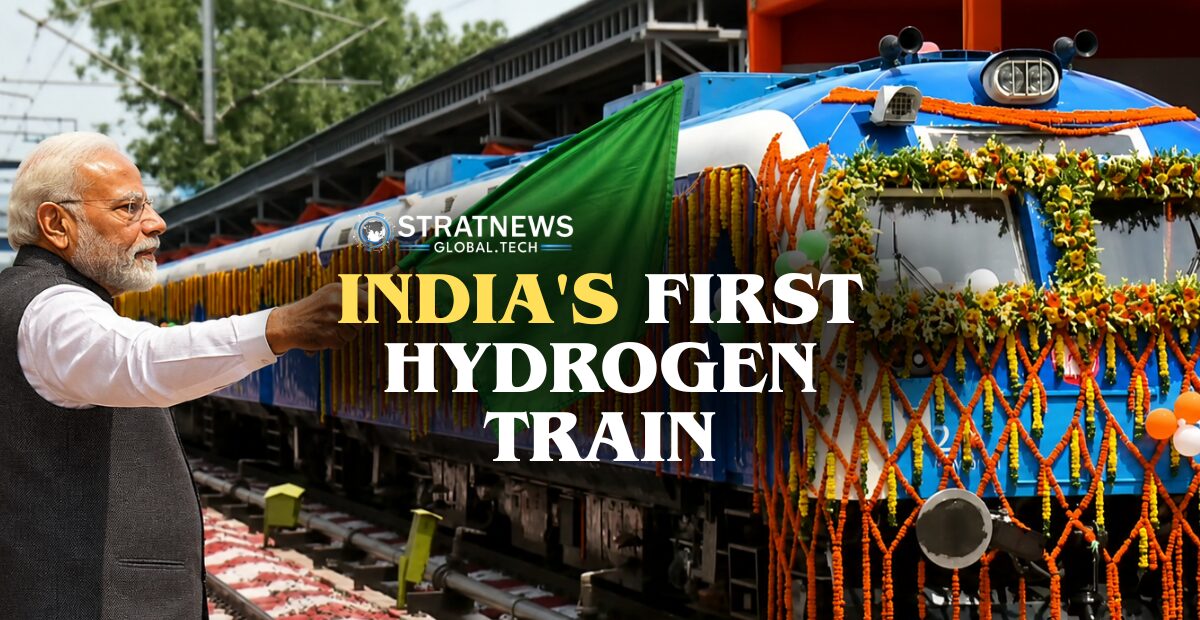
Prime Minister Narendra Modi on Friday flagged off India’s first hydrogen-powered train, marking a significant milestone in the country’s transition towards cleaner and more sustainable rail transport. The train will operate on the 89-kilometre Jind–Sonipat route in Haryana under Northern Railway as part of a pilot project aimed at testing hydrogen fuel-cell technology for future railway operations.
Sharing the announcement on X ahead of the launch, Modi said India had joined a select group of countries operating hydrogen-powered trains, describing the project as an important step in introducing clean technology into the railway sector.
Unlike conventional diesel locomotives, the new train is powered by hydrogen fuel cells that generate electricity through a chemical reaction between hydrogen and oxygen. The only by-product of the process is water vapour, making it a zero-emission alternative that could significantly reduce the environmental impact of rail transport.
The project also includes dedicated hydrogen storage and refuelling infrastructure, creating the foundation for wider adoption of hydrogen-powered trains in the future.
Key Features
The pilot train consists of a 10-coach trainset powered by a 1,200-kilowatt hydrogen fuel-cell propulsion system. It has been approved to operate at a maximum speed of 75 kmph, while its design speed is 110 kmph.
Designed and manufactured in India from the prototype stage, the train can accommodate around 2,600 passengers.
The service will connect Jind Junction, Gohana Junction and Sonipat, stopping at several intermediate stations including Jind City, Pandu Pindara Junction, Bhambhewa, Butana Halt, Khandrai Halt, Lath Halt, Mohana and Sonipat New.
Testing the Future of Green Rail
Officials described the project as a technology demonstration that will help evaluate the performance of hydrogen-powered trains under Indian operating conditions. The findings are expected to guide future deployment of hydrogen-based rail systems across the country as Indian Railways works towards reducing its carbon footprint.
Hydrogen fuel-cell technology is increasingly being viewed as a viable alternative for routes where railway electrification is either difficult or uneconomical.
India Joins a Select Group of Nations
With the launch, India joins a handful of countries experimenting with hydrogen-powered passenger rail systems.
Germany became the first country to introduce hydrogen passenger trains commercially when Alstom’s Coradia iLint entered service in Lower Saxony in 2022. The train demonstrated the technology’s potential by completing a journey of over 1,100 kilometres without refuelling, and Germany continues to expand hydrogen rail operations.
Japan is also advancing hydrogen rail technology, with its Hybari hydrogen hybrid train expected to begin passenger operations by the end of fiscal 2027 on railway lines near Tokyo.
In the United States, California introduced its first hydrogen-powered passenger train, ZEMU (Zero-Emission Multiple Unit), in 2024. The train operates using a combination of hydrogen fuel cells and battery technology while producing only water vapour as emissions.
China has also been developing hydrogen-powered trains as part of its broader clean-energy transport strategy, conducting trial operations on several routes in recent years.
The launch of India’s first hydrogen-powered train represents an important step in the country’s clean-energy ambitions and reinforces its efforts to adopt next-generation technologies across the transport sector while reducing dependence on fossil fuels.

