


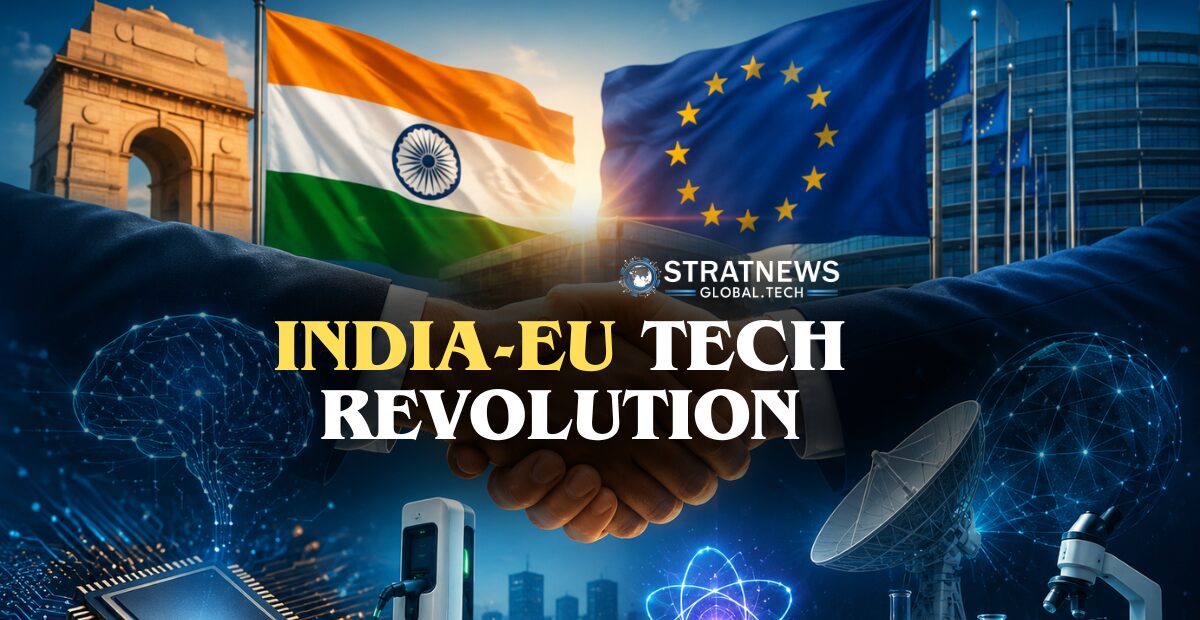
The European Union and India have expanded their technology partnership with new initiatives covering artificial intelligence, semiconductors, quantum technologies, digital infrastructure and startup collaboration, as both sides seek to conclude a long-awaited Free Trade Agreement (FTA) by the end of the year.
At the third meeting of the EU-India Trade and Technology Council (TTC) in Brussels, both sides agreed to shift the council from a policy dialogue into a platform focused on commercial outcomes, industrial partnerships and resilient technology supply chains. The revamped framework is expected to be finalised later this year and will support implementation of the proposed FTA.
The technology agenda reflects a broader effort by New Delhi and Brussels to build trusted supply chains and reduce dependence on a limited number of technology providers while expanding opportunities for businesses, researchers and startups.
One of the biggest announcements was the launch of formal negotiations on India’s association with Horizon Europe, the EU’s flagship research and innovation programme. The goal is to complete the process before the end of 2026, allowing Indian universities, research institutions and startups to participate in one of the world’s largest collaborative research ecosystems from 2027.
The two sides also agreed to establish the first EU-India Innovation Hub focused on electric vehicle charging technologies. The hub will bring together researchers, testing laboratories, standards organisations and startups to accelerate commercialisation and align future technical standards.
Artificial intelligence remains a central pillar of the partnership. Officials agreed to deepen cooperation on AI governance, innovation and applications, including healthcare, while expanding joint research using high-performance computing in areas such as climate science, natural hazards and bioinformatics.
Semiconductors also featured prominently in the discussions. India and the EU committed to strengthening resilient semiconductor supply chains, encouraging investments in electronics manufacturing and expanding collaboration in advanced manufacturing and research. They will also explore closer links between India’s Semiconductor Mission and the EU’s semiconductor pilot lines to support chip innovation and product development.
The technology partnership extends beyond hardware. Building on an agreement signed earlier this year on advanced electronic signatures, both sides will continue work on interoperable digital trust services, including digital identity wallets and secure digital transactions. Cooperation on digital skills, mobility of ICT professionals and global standards for 6G telecommunications will also be expanded.
Technology is increasingly becoming a key pillar of the broader economic relationship. Alongside FTA negotiations, India and the EU agreed to strengthen cooperation across resilient value chains in agri-food, pharmaceuticals and clean energy technologies while addressing regulatory barriers that have complicated bilateral trade. They also reaffirmed support for reform of the World Trade Organization and committed to increasing business-to-business engagement through the upgraded TTC.
If the FTA is concluded this year, many of the initiatives announced under the TTC are expected to provide the institutional framework needed to translate tariff reductions into research partnerships, technology investment and industrial collaboration.
The growing partnership is already creating opportunities for European technology companies. Lithuanian web hosting firm Hostinger, which entered India more than a decade ago, has built its largest global customer base in the country by investing in local infrastructure, integrating UPI and RuPay payments, offering Hindi-language support and pricing services in rupees. The company now serves more than one million customers in India.
“We simply looked at where the internet was growing fastest, where the unmet need was largest, and where our model of affordable services could have the most impact,” said Hostinger CEO Daugirdas Jankus.
“India checked every box. The majority of our Indian customers are first-generation digital adopters—solopreneurs, small business owners and side hustlers who need to get online quickly, without complexity and without paying a lot.”
Lithuania’s startup ecosystem also sees stronger EU-India cooperation creating new opportunities for deep-tech companies.
“The perceived complexity of India has kept many European companies away,” said Gintare Verbickaite, CEO of Unicorns Lithuania. She said innovation ecosystems depend on access to talent, investment and international markets, making deeper links with India increasingly valuable.
The newly announced EU-India Startup Partnership aims to strengthen those links by helping deep-tech startups from both sides access new markets and commercialisation opportunities.
Lithuania is also positioning itself as an entry point for Indian companies expanding into Europe. According to Invest Lithuania strategist Diana Girdenyte, interest from Indian firms continues to grow across information technology, life sciences and advanced manufacturing, while easier visa procedures would further strengthen collaboration.
While negotiations on the FTA continue, the latest meeting of the Trade and Technology Council signals that technology is becoming the defining feature of the EU-India relationship. Cooperation on AI, semiconductors, quantum research, digital infrastructure and startup ecosystems is increasingly shaping the partnership alongside trade, reflecting a shared push to build resilient innovation ecosystems in an increasingly fragmented global technology landscape.