


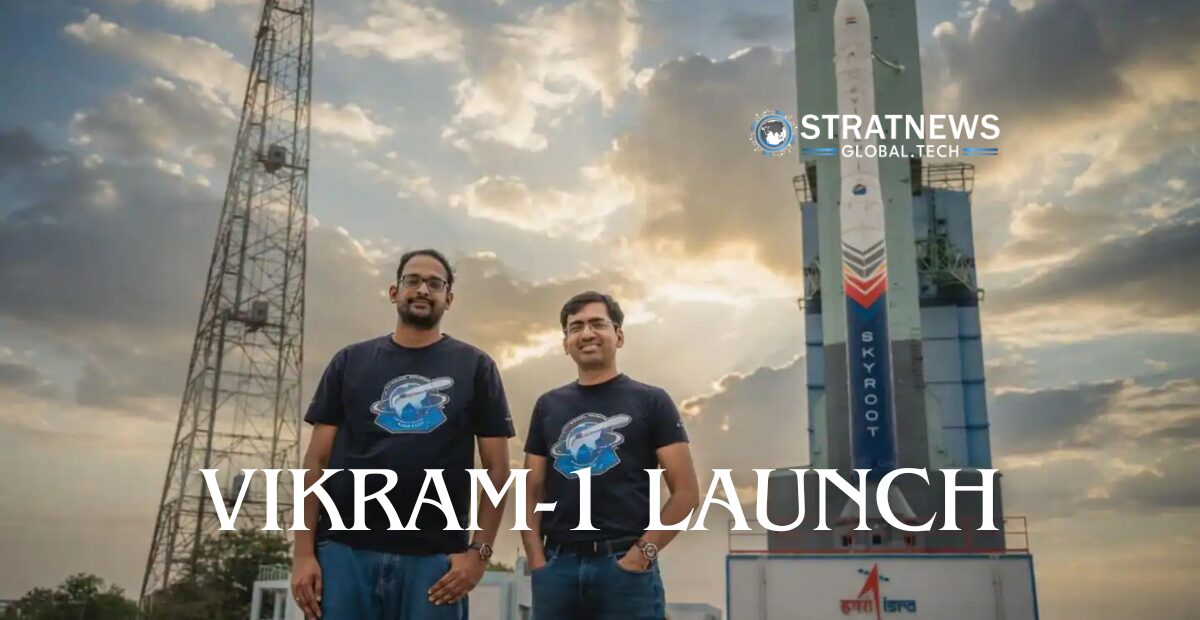
Skyroot’s Vikram-1 Makes History With India’s First Private Orbital Rocket Mission
India’s private space industry achieved a historic milestone as Skyroot Aerospace successfully launched its Vikram-1 rocket into orbit from the Satish Dhawan Space Centre in Sriharikota. The landmark mission, named Aagaman, marked the first attempt by a privately developed Indian rocket to reach orbit and signalled the country’s arrival in the global commercial launch market.
Excitement replaced anxious anticipation on Saturday afternoon after a brief delay to the scheduled launch. Mission controllers placed the rocket on a planned hold shortly before its original lift-off time of 11:30 am. However, the countdown resumed, and Vikram-1 lifted off at 12:05:30 pm.
At 12:21 pm, mission officials confirmed success after the payload was injected into its intended orbit. The announcement, “Hello, space. We have arrived,” marked a defining moment for India’s rapidly expanding private space sector.
A Landmark Achievement for India’s Space Industry
The successful launch secures Vikram-1’s place in the history of India’s space programme. Hyderabad-based Skyroot Aerospace has joined a select group of global companies capable of designing, building and launching orbital rockets.
The Aagaman mission represents the entry of India’s private sector into the international launch services market. It also highlights the country’s growing capabilities in commercial space technology and innovation.
Vikram-1 carried several technology demonstration payloads from Grahaa Space, Cosmoserve, DCubed and Skyroot’s own SCOPE platform. In addition, the mission transported Cosmos Diamonds’ artwork Cosmic Bloom and a micro-art piece featuring micro-sculptures of Sir C. V. Raman, Dr Vikram Sarabhai and Dr A. P. J. Abdul Kalam.
Advanced Rocket Technology
The seven-storey-tall Vikram-1 is a multi-stage orbital launch vehicle built using an all-carbon composite structure. It is powered by propulsion systems developed in-house, including 3D-printed engines and high-thrust solid-fuel boosters.
The rocket is designed to place small satellites weighing up to 350 kilograms into Low Earth Orbit. Its maiden orbital mission targeted a 450-kilometre orbit at a 60-degree inclination.
Ahead of the launch, Skyroot Aerospace revealed that Vikram-1 also carries the signatures of the engineers, technicians and team members who helped build the vehicle, recognising the collective effort behind the mission.
Prime Minister Congratulates the Team
Celebrations erupted at the launch centre following the successful mission. Prime Minister Narendra Modi telephoned Skyroot Aerospace Chief Executive Officer Pawan Kumar Chandana to congratulate the team.
During the conversation, the Prime Minister praised the achievement, saying the team had made India proud.
“You have planted India’s aspirations in space and have also given roots to the dreams of the youth,” he told the Skyroot team.
Chandana noted that the average age of the company’s workforce is just 28 years. The Prime Minister said the achievement demonstrated the capabilities of India’s young innovators and reaffirmed his confidence in the country’s youth.
A Message Travels Beyond Earth
The mission also carried a special message from the Prime Minister. Printed on a commemorative card, the message travelled into space alongside hundreds of cards carrying wishes and aspirations from people around the world.
In his handwritten message, the Prime Minister wrote, “Vande Mataram.” Following the successful launch, Chandana remarked, “Vande Mataram is now in space.”
Named after the father of India’s space programme, Dr Vikram Sarabhai, Vikram-1 represents Skyroot Aerospace’s next major milestone following the successful Vikram-S suborbital mission in November 2022. The successful Aagaman mission marks a significant step in the growth of India’s private space industry and strengthens the country’s position in the global commercial space sector.
With inputs from Reuters