


First Three-Headed Asteroid Discovered in Solar System With Its Own Moon
Astronomers have identified the first known three-lobed asteroid in the solar system, revealing that the unusual space rock also has a tiny moon orbiting it. The discovery offers fresh insight into how asteroids form and evolve, while also shedding light on the early history of the inner solar system.
The asteroid, known as 44 Nysa, has been observed since its discovery in 1857. For decades, it appeared as little more than a faint point of light, and even later observations, including those made by the Hubble Space Telescope, suggested it was likely a two-lobed object. However, new observations have revealed a far more complex structure.
Powerful Telescopes Reveal an Unusual Shape
The discovery was made using joint observations from the Large Binocular Telescope in Arizona and the Very Large Telescope in Chile.
By combining advanced adaptive optics with high-contrast imaging instruments and specialised image-processing techniques, researchers produced the clearest views yet of 44 Nysa.
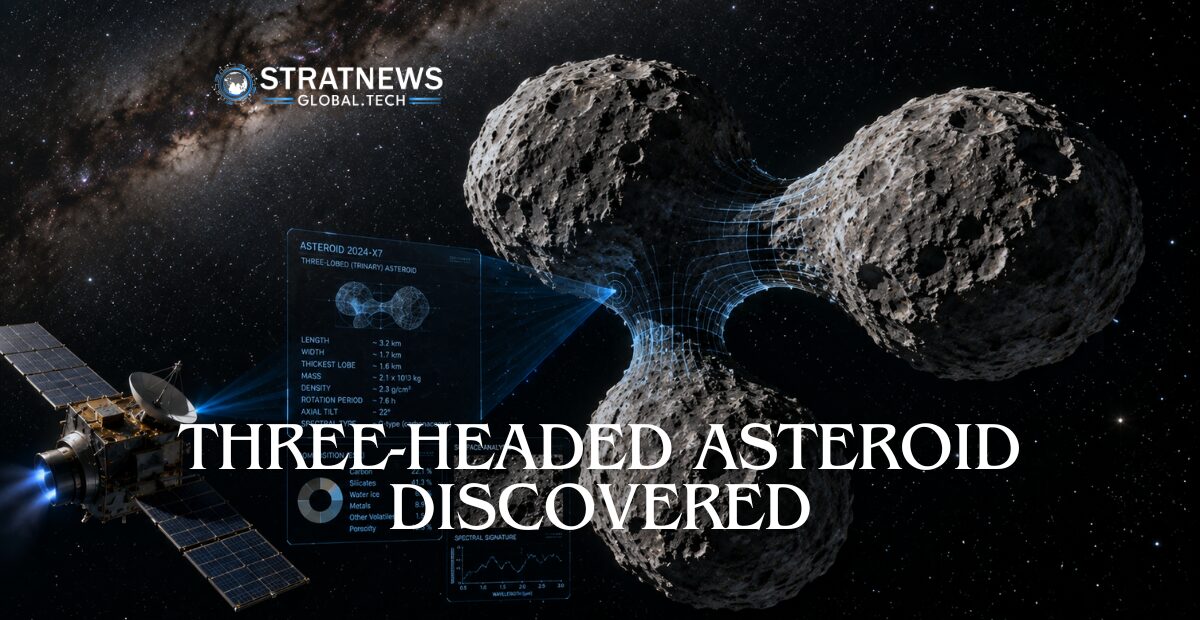
The images show an irregular asteroid measuring around 75 kilometres across at its widest point. More importantly, scientists identified two pronounced valleys that wrap around the asteroid’s surface, indicating that it consists of three connected lobes rather than two.
Lead researcher Kate Minker of Lowell Observatory said the observations revealed a remarkably unusual object. According to the research team, the most likely explanation is that Nysa is either a contact trinary made up of three connected components or an exceptionally irregular single body unlike any previously observed.
Tiny Moon Found Orbiting the Asteroid
The observations also uncovered a small natural satellite measuring about one kilometre across. The moon, currently designated S/2026 (44) 1, orbits at a distance of at least 170 kilometres from Nysa.
Scientists detected the moon during two separate observing campaigns, allowing them to track its movement around the asteroid.
Researchers said high-contrast imaging techniques, originally developed for other areas of astronomy, made it possible to identify the faint moon despite the overwhelming brightness of the asteroid itself.
The discovery of the moon could prove especially valuable because its orbit will help astronomers calculate Nysa’s precise mass and density, providing important clues about the asteroid’s origin.
Two Possible Formation Theories
Researchers believe the most likely explanation is that Nysa is a contact trinary, formed when three asteroid bodies became gravitationally bound and remained attached.
An alternative theory suggests that Nysa was dramatically reshaped after a close encounter with a much larger asteroid. In that scenario, powerful tidal forces could have distorted the asteroid’s outer layers, creating its unusual appearance and potentially breaking it into several fragments.
However, scientists note that such violent events usually produce a family of asteroids with similar compositions. Nysa appears to be isolated, apart from its newly discovered moon, making this explanation less convincing.
Future measurements of the moon’s orbital period and velocity should allow astronomers to determine which formation model best matches the asteroid’s physical properties.
Clues to Earth’s Early Formation
Beyond its unusual appearance, Nysa is also scientifically significant because of its composition.
The asteroid is classified as an E-type asteroid, meaning its surface contains abundant enstatite, an iron-poor silicate mineral that makes it more reflective than many other asteroids. Nysa is the largest and brightest known member of this class.
Scientists believe E-type asteroids formed relatively close to the Sun and may have contributed material that eventually formed the inner planets, including Earth.
As a result, studying Nysa could provide valuable evidence about the conditions that existed in the inner solar system roughly 4.5 billion years ago, helping researchers better understand the origins of our planet.
With inputs from Space.com