


Close Menu
Stratnews GlobalStratnews Global
    Facebook X (Twitter) Instagram
    Trending
    • Three-Headed Asteroid Discovered With Tiny Moon
    • Anthropic Claude Hack Revealed During AI Testing
    • Penguin Guano Helps Satellites Track Antarctic Diets
    • AI Particle Detector Reconstructs Paths From Photons
    • Water System Cyberattacks Prompt US Security Warning
    • Tesla China Separation Report Ahead of SpaceX Merger
    • IIT Madras AI Workshop on Climate and Energy Systems
    • AzaadiSAT 2: 750 Indian Schoolgirls Reach Orbit
    • Support Us
    Stratnews GlobalStratnews Global
    Write for Us
    Friday, July 31
    • Space
    • Science
    • AI and Robotics
    • Industry News
    • Support Us
    Stratnews GlobalStratnews Global
    Home » Three-Headed Asteroid Discovered With Tiny Moon

    Three-Headed Asteroid Discovered With Tiny Moon

    Aditya LenkaBy Aditya LenkaJuly 31, 2026 Space No Comments4 Mins Read
    three-headed asteroid

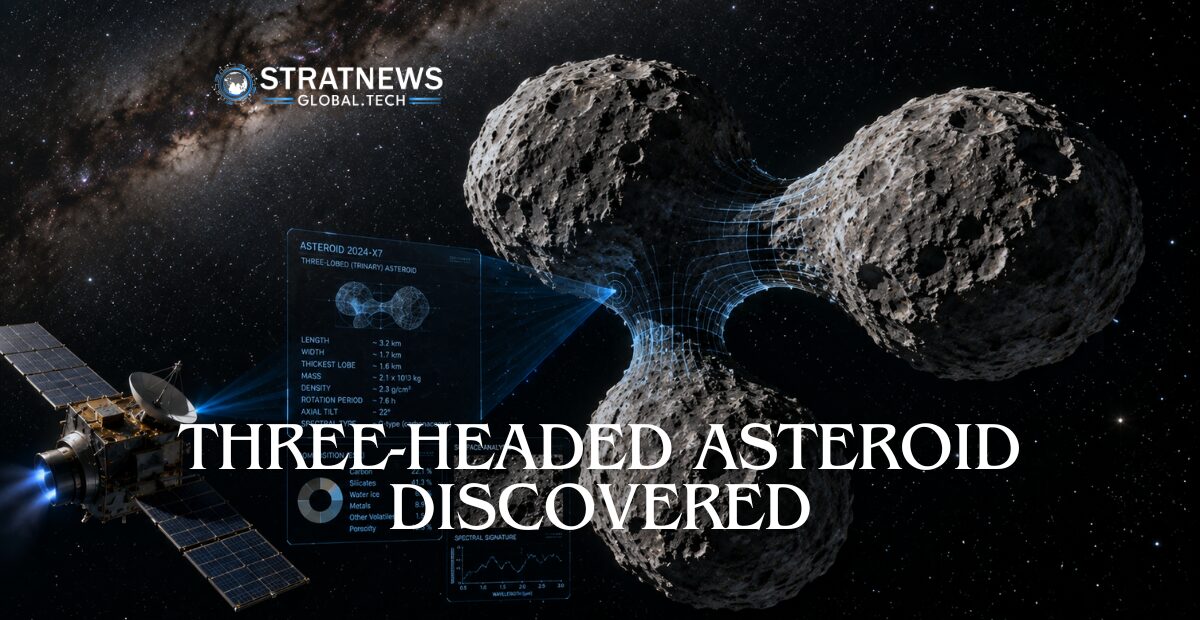
    First Three-Headed Asteroid Discovered in Solar System With Its Own Moon

    Astronomers have identified the first known three-lobed asteroid in the solar system, revealing that the unusual space rock also has a tiny moon orbiting it. The discovery offers fresh insight into how asteroids form and evolve, while also shedding light on the early history of the inner solar system.

    The asteroid, known as 44 Nysa, has been observed since its discovery in 1857. For decades, it appeared as little more than a faint point of light, and even later observations, including those made by the Hubble Space Telescope, suggested it was likely a two-lobed object. However, new observations have revealed a far more complex structure.

    Powerful Telescopes Reveal an Unusual Shape

    The discovery was made using joint observations from the Large Binocular Telescope in Arizona and the Very Large Telescope in Chile.

    By combining advanced adaptive optics with high-contrast imaging instruments and specialised image-processing techniques, researchers produced the clearest views yet of 44 Nysa.

    The images show an irregular asteroid measuring around 75 kilometres across at its widest point. More importantly, scientists identified two pronounced valleys that wrap around the asteroid’s surface, indicating that it consists of three connected lobes rather than two.

    Lead researcher Kate Minker of Lowell Observatory said the observations revealed a remarkably unusual object. According to the research team, the most likely explanation is that Nysa is either a contact trinary made up of three connected components or an exceptionally irregular single body unlike any previously observed.

    Tiny Moon Found Orbiting the Asteroid

    The observations also uncovered a small natural satellite measuring about one kilometre across. The moon, currently designated S/2026 (44) 1, orbits at a distance of at least 170 kilometres from Nysa.

    Scientists detected the moon during two separate observing campaigns, allowing them to track its movement around the asteroid.

    Researchers said high-contrast imaging techniques, originally developed for other areas of astronomy, made it possible to identify the faint moon despite the overwhelming brightness of the asteroid itself.

    The discovery of the moon could prove especially valuable because its orbit will help astronomers calculate Nysa’s precise mass and density, providing important clues about the asteroid’s origin.

    Two Possible Formation Theories

    Researchers believe the most likely explanation is that Nysa is a contact trinary, formed when three asteroid bodies became gravitationally bound and remained attached.

    An alternative theory suggests that Nysa was dramatically reshaped after a close encounter with a much larger asteroid. In that scenario, powerful tidal forces could have distorted the asteroid’s outer layers, creating its unusual appearance and potentially breaking it into several fragments.

    However, scientists note that such violent events usually produce a family of asteroids with similar compositions. Nysa appears to be isolated, apart from its newly discovered moon, making this explanation less convincing.

    Future measurements of the moon’s orbital period and velocity should allow astronomers to determine which formation model best matches the asteroid’s physical properties.

    Clues to Earth’s Early Formation

    Beyond its unusual appearance, Nysa is also scientifically significant because of its composition.

    The asteroid is classified as an E-type asteroid, meaning its surface contains abundant enstatite, an iron-poor silicate mineral that makes it more reflective than many other asteroids. Nysa is the largest and brightest known member of this class.

    Scientists believe E-type asteroids formed relatively close to the Sun and may have contributed material that eventually formed the inner planets, including Earth.

    As a result, studying Nysa could provide valuable evidence about the conditions that existed in the inner solar system roughly 4.5 billion years ago, helping researchers better understand the origins of our planet.

    With inputs from Space.com

    Author

    • Aditya Lenka
      Aditya Lenka

      A multi-faceted professional with a diverse range of skills and experiences. He currently works as a Producer, Digital Marketer, and Journalist for several well-known media outlets, namely StratNewsGlobal, BharatShakti, and Interstellar. With a passion for storytelling and a keen eye for detail, Aditya has covered a wide range of topics and events across India, bringing a unique perspective to his work.

      When he's not busy producing content, Aditya enjoys exploring new places and cuisines, having traveled extensively throughout India. He's also an avid writer and poet, often penning his thoughts and musings in his free time. And when he wants to unwind and relax, Aditya spends time with his two loyal companions, Zorro and Pablo, his beloved dogs.

      Aditya's dynamic personality and varied interests make him a unique individual, always eager to learn and experience new things.

      View all posts
    Featured Global Industry Space
    Share. Facebook Twitter Pinterest LinkedIn Tumblr Email Reddit Telegram WhatsApp
    Aditya Lenka
    Aditya Lenka

      A multi-faceted professional with a diverse range of skills and experiences. He currently works as a Producer, Digital Marketer, and Journalist for several well-known media outlets, namely StratNewsGlobal, BharatShakti, and Interstellar. With a passion for storytelling and a keen eye for detail, Aditya has covered a wide range of topics and events across India, bringing a unique perspective to his work.When he's not busy producing content, Aditya enjoys exploring new places and cuisines, having traveled extensively throughout India. He's also an avid writer and poet, often penning his thoughts and musings in his free time. And when he wants to unwind and relax, Aditya spends time with his two loyal companions, Zorro and Pablo, his beloved dogs.Aditya's dynamic personality and varied interests make him a unique individual, always eager to learn and experience new things.

      Keep Reading

      Anthropic Claude Hack Revealed During AI Testing

      Penguin Guano Helps Satellites Track Antarctic Diets

      AI Particle Detector Reconstructs Paths From Photons

      Water System Cyberattacks Prompt US Security Warning

      Tesla China Separation Report Ahead of SpaceX Merger

      IIT Madras AI Workshop on Climate and Energy Systems

      Add A Comment
      Leave A Reply Cancel Reply

      Anti Drone System (CUAS)
      Latest Posts

      Three-Headed Asteroid Discovered With Tiny Moon

      July 31, 2026

      Anthropic Claude Hack Revealed During AI Testing

      July 31, 2026

      Penguin Guano Helps Satellites Track Antarctic Diets

      July 31, 2026

      AI Particle Detector Reconstructs Paths From Photons

      July 31, 2026

      Water System Cyberattacks Prompt US Security Warning

      July 31, 2026

      Tesla China Separation Report Ahead of SpaceX Merger

      July 31, 2026

      IIT Madras AI Workshop on Climate and Energy Systems

      July 30, 2026

      AzaadiSAT 2: 750 Indian Schoolgirls Reach Orbit

      July 30, 2026

      The New Geopolitics of Capital: Why India Matters More Than Ever

      July 30, 2026

      Uttar Pradesh AI Hub Vision Highlighted at CII Summit

      July 30, 2026

      Subscribe to News

      Get the latest sports news from NewsSite about world, sports and politics.

      • Astronomical Events
      • Space Missions
      • Industry News
      • Science
      StratNewsGlobal Tech
      Facebook X (Twitter) Instagram LinkedIn YouTube
      © 2026 StratNews Global, A unit of BharatShakti Communications LLP
      • About Us
      • Contributors
      • Copyright
      • Contact
      • Write for Us

      Type above and press Enter to search. Press Esc to cancel.