


Close Menu
Stratnews GlobalStratnews Global
    Facebook X (Twitter) Instagram
    Trending
    • IN-SPACe Authorisation Becomes India’s Trust Badge
    • ISRO Heritage Builds Trust for India’s Space Startups
    • Space Startups Drive India’s New Space Economy
    • Ukraine Long-Range Strikes Hit Russian Sites
    • Cl0p Data Theft Claims Target Nearly 50 Companies
    • SMIC Wafer Prices Rise As AI Demand Drives Growth
    • Vikram-1 Launch Cost Advantage & Global Pricing
    • Vikram-1 Orbital Rocket: Specs, Mission And Market Outlook
    • Support Us
    Stratnews GlobalStratnews Global
    Write for Us
    Monday, August 17
    • Space
    • Science
    • AI and Robotics
    • Industry News
    • Support Us
    Stratnews GlobalStratnews Global
    Home » Space Startups Drive India’s New Space Economy

    Space Startups Drive India’s New Space Economy

    Aditya LenkaBy Aditya LenkaAugust 17, 2026 Space No Comments5 Mins Read
    Space Startups

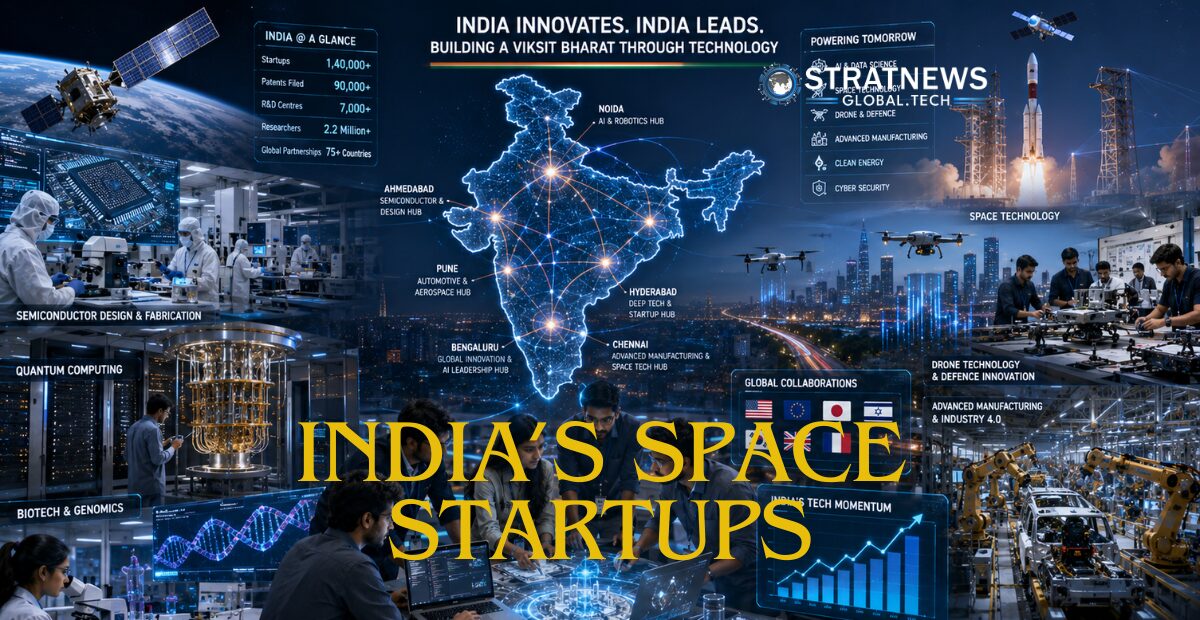
    India’s Space Startup Boom: 440 Firms and $618.5M Drive New Era

    Private investment in India’s space sector crossed $618.5 million by March 31, 2026, up from $100.5 million just five years earlier. The government confirmed the figure in a written reply to the Rajya Sabha, marking a sixfold jump since 2021-22. Roughly $187 million of that total arrived in 2026 alone, and officials point to a shift from early-stage seed checks toward larger growth-stage rounds.

    That shift signals something bigger than a funding number. India’s space program built its reputation through a single government agency, ISRO, for six decades. Private companies now design rockets, build satellites, and sign commercial contracts once reserved for state entities. The country counts 440 registered space startups today, compared with one in 2014.

    That count did not appear by accident. It followed a 2020 Cabinet decision opening the sector to private players, then the Indian Space Policy 2023, which set rules for how private firms can build, launch, and operate space assets alongside ISRO. Startups still draw heavily on ISRO’s infrastructure and decades of flight heritage, using technology-transfer agreements to shorten their own development timelines. NewSpace India Limited (NSIL), ISRO’s commercial arm, manages many of these transfers and brokers launch contracts on behalf of the government. Through NSIL, startups have signed 118 technology-transfer agreements covering 83 ISRO-developed technologies, spanning laser gyros, mini-satellite buses, and radar systems.

    Foreign capital gained a second lever in February 2024, when the Union Cabinet approved 100% FDI under the automatic route for satellite component manufacturing. Satellite manufacturing and operation carry a 74% automatic-route cap, while launch vehicles and spaceports sit at 49%, reflecting their sensitive, dual-use nature. Combined, these thresholds give foreign investors a graduated entry point instead of a single all-or-nothing gate. International funds, not just domestic ones, now factor directly into Indian satellite and component ventures.

    Regulatory clearance runs through the Indian National Space Promotion and Authorisation Centre (IN-SPACe), the nodal body created to authorize and supervise private space activity. IN-SPACe operates a single-window system: one application, one authorizing body, instead of separate approvals scattered across departments. That structure cuts the time a startup spends chasing sign-offs before it can test hardware or fly a payload.

    By mid-2026, IN-SPACe had issued 113 authorisations to 52 non-government entities, with 18 of them startups cleared for satellite operations, payload work, or launch services. Each authorisation functions as a checkpoint against India’s national security and technical standards. For a foreign buyer weighing an unfamiliar vendor, that clearance offers a reference point: the startup has already passed a government technical review before signing its first contract. Officials report that Indian companies have flown nearly 45 payloads and placed over 30 satellites in orbit since the sector opened, activity increasingly cited in the government’s own assessments of private-sector maturity.

    Space startups generally fall into three groups. Upstream firms build the hardware that reaches orbit — rockets, satellite buses, propulsion systems. Downstream firms turn satellite data into products for agriculture, defense, or logistics clients. Ground-segment firms build the antennas, terminals, and software that connect satellites to users on Earth. Most Indian startups sit in the upstream and downstream categories, though ground-segment players are growing as satellite constellations multiply and demand more bandwidth to move data down.

    Launch vehicles show the clearest upstream progress. Skyroot Aerospace’s Vikram-1 lifted off from Sriharikota on July 18, 2026, reaching a roughly 450-kilometer orbit roughly 15 minutes after liftoff. The flight made Skyroot the first private Indian company to reach orbit from Indian soil, and put India alongside the United States and China as the only countries with private orbital launch capability. Agnikul Cosmos, meanwhile, test-fired a cluster of four 3D-printed semi-cryogenic engines in May 2026, a step toward flying its Agnibaan rocket on orbital missions after its 2024 suborbital debut.

    Satellite builders show a parallel story downstream. Pixxel operates six Firefly hyperspectral satellites in orbit, delivering 5-meter-resolution imagery across more than 150 spectral bands to customers spanning agriculture ministries, energy firms, and NASA. The company plans an 18-to-24-satellite constellation by 2027, adding short-wave infrared capability through its upcoming Honeybee satellites. Dhruva Space builds satellite platforms and ground systems, positioning itself in both the upstream hardware and ground-segment layers of the market.

    Startup NameCore SpecializationKey Milestone
    SkyrootLaunch VehiclesVikram-1 reaches orbit, July 2026
    PixxelEarth ObservationSix-satellite Firefly hyperspectral constellation
    Agnikul3D Printed RocketsFour-engine semi-cryogenic cluster test

    India’s space economy could reach $40 billion to $45 billion within a decade, according to recent government and industry estimates, up from roughly $8 billion today. Officials have pointed to a target range of 8% to 10% of the global space economy by 2030, a share that hinges on converting authorised startups into repeat commercial suppliers rather than one-off technology demonstrators. Foreign satellite launches from Indian soil already rose from 35 before 2014 to 399 by January 2026, an early signal of that demand.

    The next test runs through repetition, not announcement. Vikram-1 flew once; Skyroot has said it will fly again later in 2026 before targeting commercial service in 2027. Agnikul must convert cluster tests into a full orbital flight. Pixxel must scale six operational satellites into two dozen. Each step moves the sector from proof of concept toward the recurring contracts that global investors and B2B buyers actually reward.

    Author

    • Aditya Lenka
      Aditya Lenka

      A multi-faceted professional with a diverse range of skills and experiences. He currently works as a Producer, Digital Marketer, and Journalist for several well-known media outlets, namely StratNewsGlobal, BharatShakti, and Interstellar. With a passion for storytelling and a keen eye for detail, Aditya has covered a wide range of topics and events across India, bringing a unique perspective to his work.

      When he's not busy producing content, Aditya enjoys exploring new places and cuisines, having traveled extensively throughout India. He's also an avid writer and poet, often penning his thoughts and musings in his free time. And when he wants to unwind and relax, Aditya spends time with his two loyal companions, Zorro and Pablo, his beloved dogs.

      Aditya's dynamic personality and varied interests make him a unique individual, always eager to learn and experience new things.

      View all posts
    Featured India Industry Space
    Share. Facebook Twitter Pinterest LinkedIn Tumblr Email Reddit Telegram WhatsApp
    Aditya Lenka
    Aditya Lenka

      A multi-faceted professional with a diverse range of skills and experiences. He currently works as a Producer, Digital Marketer, and Journalist for several well-known media outlets, namely StratNewsGlobal, BharatShakti, and Interstellar. With a passion for storytelling and a keen eye for detail, Aditya has covered a wide range of topics and events across India, bringing a unique perspective to his work.When he's not busy producing content, Aditya enjoys exploring new places and cuisines, having traveled extensively throughout India. He's also an avid writer and poet, often penning his thoughts and musings in his free time. And when he wants to unwind and relax, Aditya spends time with his two loyal companions, Zorro and Pablo, his beloved dogs.Aditya's dynamic personality and varied interests make him a unique individual, always eager to learn and experience new things.

      Keep Reading

      IN-SPACe Authorisation Becomes India’s Trust Badge

      ISRO Heritage Builds Trust for India’s Space Startups

      Ukraine Long-Range Strikes Hit Russian Sites

      Cl0p Data Theft Claims Target Nearly 50 Companies

      SMIC Wafer Prices Rise As AI Demand Drives Growth

      Vikram-1 Launch Cost Advantage & Global Pricing

      Add A Comment
      Leave A Reply Cancel Reply

      Anti Drone System (CUAS)
      Latest Posts

      IN-SPACe Authorisation Becomes India’s Trust Badge

      August 17, 2026

      ISRO Heritage Builds Trust for India’s Space Startups

      August 17, 2026

      Space Startups Drive India’s New Space Economy

      August 17, 2026

      Ukraine Long-Range Strikes Hit Russian Sites

      August 17, 2026

      Cl0p Data Theft Claims Target Nearly 50 Companies

      August 14, 2026

      SMIC Wafer Prices Rise As AI Demand Drives Growth

      August 14, 2026

      Vikram-1 Launch Cost Advantage & Global Pricing

      August 14, 2026

      Vikram-1 Orbital Rocket: Specs, Mission And Market Outlook

      August 14, 2026

      Vikram-1 Cost Per Kilogram Vs Global Launch Rivals

      August 14, 2026

      Apple China AI Model Developed With Alibaba Support

      August 14, 2026

      Subscribe to News

      Get the latest sports news from NewsSite about world, sports and politics.

      • Astronomical Events
      • Space Missions
      • Industry News
      • Science
      StratNewsGlobal Tech
      Facebook X (Twitter) Instagram LinkedIn YouTube
      © 2026 StratNews Global, A unit of BharatShakti Communications LLP
      • About Us
      • Contributors
      • Copyright
      • Contact
      • Write for Us

      Type above and press Enter to search. Press Esc to cancel.