


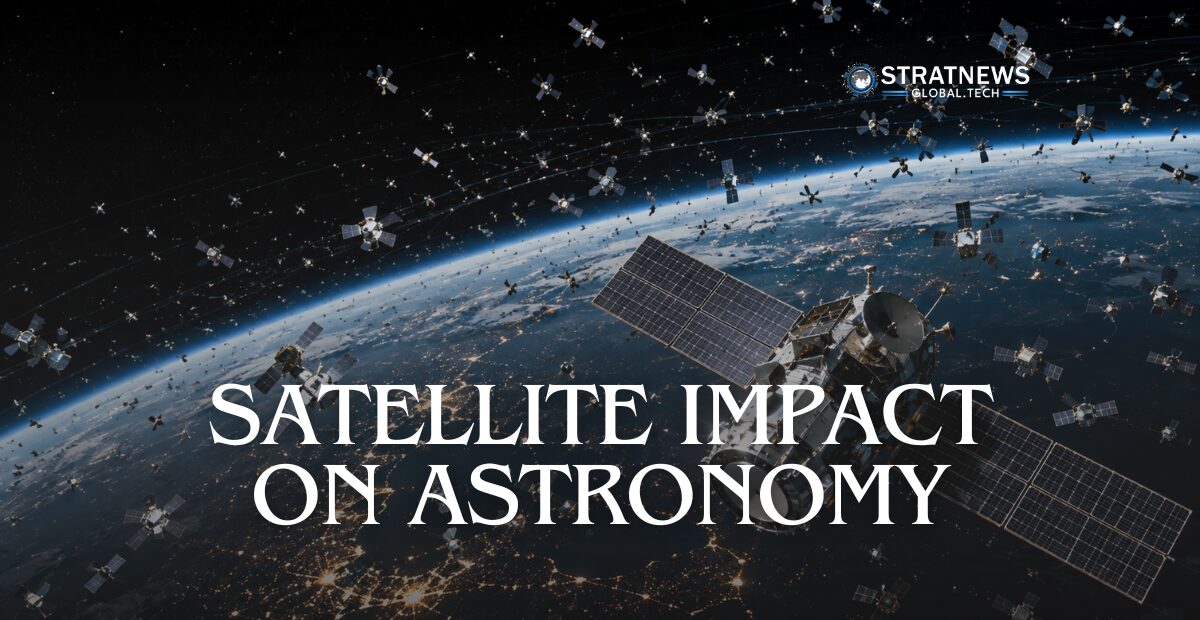
Satellites Threaten To Complicate Astronomical Observations
As more satellites move into orbit, astronomers could face growing challenges in observing the cosmos. A study by the European Southern Observatory (ESO), which operates telescopes in northern Chile, warns that large satellite constellations could significantly affect astronomical research.
The ESO study found that proposals to launch more than 1.7 million satellites into orbit could substantially degrade observations. Some of the planned satellites could also be particularly bright. By comparison, roughly 15,000 satellites currently orbit Earth.
Bright satellite streaks can cross telescope images and interfere with observations. They can also reduce the quality of night-sky photography, creating a growing problem for observatories as the number of objects in orbit increases.
Bright Streaks Create Growing Problems
“Each of these satellites, when it crosses a telescope’s field of view, leaves a bright line,” said ESO astronomer Olivier Hainaut, the study’s author.
A single streak may cause only a minor disruption. However, the effect can become significant when thousands of satellites appear in the sky. Each streak removes a small section of a telescope’s view of space, Hainaut said.
The satellite industry has expanded dramatically since 2019. Internet services such as Elon Musk’s Starlink and Amazon’s Leo have contributed to that growth, increasing the number of satellites operating in low Earth orbit.
Simulations Show Potential Impact
Researchers based their findings on simulations conducted at the Paranal Observatory in Chile’s Atacama Desert. One model examined a constellation containing up to one million satellites.
The simulations showed that thousands of illuminated objects could be visible above the ESO’s Very Large Telescope in the Atacama shortly after sunset. Consequently, the growing number of satellites could make some observations increasingly difficult.
Hainaut said the impact would depend on both the number of satellites and their brightness. The combination of those factors could determine how severely astronomical observations are affected.
“If there are 100,000, that is a level of pain that is bearable,” Hainaut said.
However, the situation could become much more serious at higher numbers. If 300,000 satellites were in orbit, some telescopes could lose most of their data, Hainaut added.
Balancing Technology And Science
Despite the concerns, researchers said the benefits of satellite internet services should not be minimised. Instead, they said the challenge is to balance technological advances with scientific discovery.
The study highlights the growing tension between expanding satellite networks and the need to preserve clear views of the night sky. As a result, astronomers may face increasing pressure to protect observations while satellite operators continue expanding their networks.
“The problem is that this kind of research takes time, but the satellites are already being launched,” Hainaut added.
With inputs from Reuters