


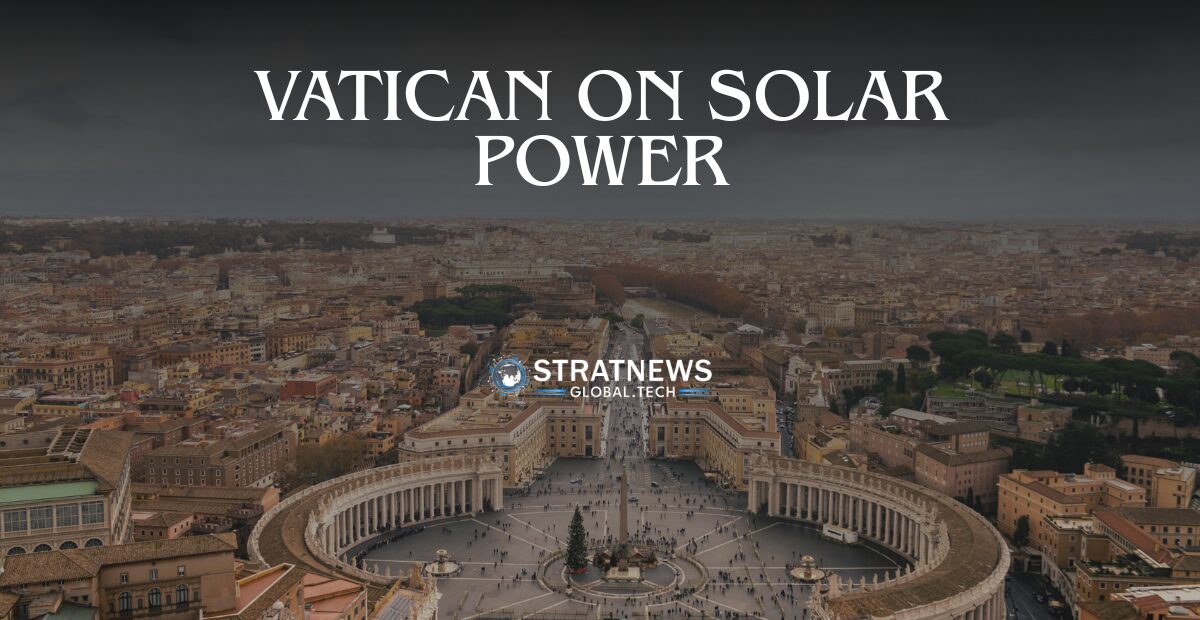
Vatican Plans €100 Million Agrivoltaic Plant To Power Holy See
The Vatican is preparing to build a renewable energy plant worth roughly €100 million ($117 million), with the project designed to make the Holy See energy self-sufficient within two years.
The plant will combine solar power with agriculture at the Vatican-owned Santa Maria di Galeria estate on the northwestern outskirts of Rome. Sources involved in discussions about the project said the facility could have a capacity of 80 to 90 megawatts, potentially making it one of Italy’s largest agrivoltaic installations.
Solar Power And Agriculture Combined
Agrivoltaic plants place solar panels several metres above the ground, allowing crops to grow underneath them. The panels can provide shade, which helps reduce evaporation and protects crops from extreme weather.
A joint Italian-Vatican commission met earlier this month to launch the project at the Santa Maria di Galeria estate. The meeting followed Italy’s ratification this year of a 2025 bilateral agreement covering development of the site.
However, officials did not disclose the project’s cost, capacity or expected completion date after the meeting. According to sources involved in the discussions, construction could take between 18 and 24 months, including the necessary permitting and administrative procedures.
The Vatican did not immediately respond to a request for comment.
Vatican City is the world’s smallest country. It covers 108 acres and has fewer than 900 residents. It is also the headquarters of the global Catholic Church and the location of St. Peter’s Basilica.
The much larger Santa Maria di Galeria estate covers roughly 450 hectares. Vatican Radio has operated transmission facilities there since the 1950s.
Surplus Electricity Could Go To Italy
The proposed plant is intended to supply electricity to Vatican Radio’s transmission station and help Vatican City State become fully energy self-sufficient.
The electricity could also serve properties linked to the Holy See, including Rome’s Bambino Gesù hospital, according to the sources.
However, the Vatican will not receive the financial incentives available to Italian households and businesses that install solar power systems. Instead, any electricity produced beyond the Vatican’s needs would be made available to Italy.
One of the sources said tracking solar panels would cover about 200 hectares of the Santa Maria di Galeria estate. That would represent nearly half of the site’s total area.
Project Backed By Pope Francis And Pope Leo XIV
The renewable energy project was a priority for the late Pope Francis, who was the first pontiff to accept the scientific consensus on climate change. Pope Leo XIV has also endorsed the project.
Meanwhile, the bilateral agreement between Italy and Vatican City extends to the agrivoltaic project the special status already granted to Vatican Radio facilities. That status includes exemptions from Italian taxes and public charges.
Italy’s ratification law states that implementing the agreement must not create any new or additional burden on public finances.
Contracts for the work are expected to be put out to tender in the coming weeks.
The Vatican has previously installed solar technology. In 2008, during the pontificate of German-born Pope Benedict XVI, German companies SolarWorld and SMA Solar Technology donated 2,400 photovoltaic panels and related equipment.
The equipment was installed on the roof of the Nervi Hall, where papal audiences and concerts are held.
With inputs from Reuters