


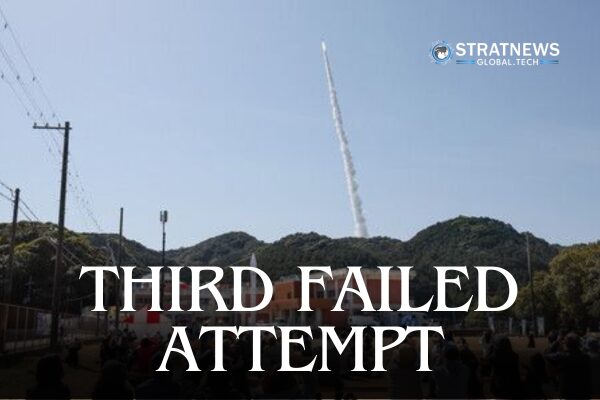
Japan’s commercial space ambitions suffered another setback after the Kairos small rocket from Space One destroyed itself shortly after launch on Thursday. The mission aimed to complete the country’s first fully commercial satellite launch. However, the rocket failed for the third consecutive attempt.
The rocket lifted off successfully at first. Yet the flight ended only 69 seconds after launch when the system triggered an automatic self destruction. The vehicle was carrying five experimental satellites for several organisations.
Kairos mission ends shortly after lift off
The Kairos rocket stands 18 metres tall and uses solid propellant. It carried experimental satellites including payloads from Tokyo based ArkEdge Space and the Taiwan Space Agency.
However, the rocket ended its flight automatically at an altitude of about 29 kilometres above the Pacific Ocean. Officials confirmed that the onboard system triggered the termination sequence.
Meanwhile, Space One Vice President Nobuhiro Sekino spoke at a press conference after the failure. He said engineers had not detected any significant abnormalities in the rocket or its onboard equipment before the termination.
Therefore, investigators believe the autonomous flight termination system may have malfunctioned. That system normally destroys the rocket if it deviates from a safe trajectory.
Live broadcast footage showed the vehicle flying on an unstable path soon after lift off. Within two minutes the rocket appeared to wobble during its ascent from the private launch site at the tip of the Kii peninsula in western Japan.
Space One operates as a joint venture backed by several Japanese companies. These include optical electronics maker Canon, aerospace manufacturer IHI, and construction firm Shimizu. However, the company had already failed during two earlier Kairos launch attempts in 2024.
Japan struggles to build domestic launch capacity
Japan currently has very few domestically built launch vehicles. Yet demand continues to rise because of defence requirements and the expanding satellite market.
The country managed only three rocket launches in 2025. However, national plans aim to reach a yearly launch pace of 30 missions in the early 2030s.
Another setback occurred in December when the sixth flight of the state funded H3 rocket failed. Mitsubishi Heavy Industries developed that vehicle. Consequently, the disruption created further delays in Japan’s satellite launch pipeline.
Because of these challenges, satellite companies often choose overseas launch providers. Many firms use ride sharing options from SpaceX in the United States. Others rely on Rocket Lab, which launches rockets from New Zealand.
Government support and industry push
Meanwhile, the Japanese government has tried to ease the shortage of launch capacity. Authorities have provided subsidies worth millions of dollars to Space One and other emerging rocket developers.
In addition, the defence ministry has signed large contracts with several startups. These agreements aim to deploy dozens of national security satellites into orbit.
However, no Japanese company has yet achieved a satellite launch using a fully commercial rocket built in the country.
At the same time, car manufacturers have begun investing in rocket development. They hope to adapt expertise from combustion engine engineering during the transition to electric vehicles.
Toyota invested in Interstellar Technologies last year. That company became the first Japanese firm to reach outer space in 2019. Meanwhile, Honda carried out a surprise reusable rocket experiment.
Commercial rockets outside the United States and China still remain at an early stage of development. Startups in Germany, Australia, and South Korea tested rockets similar in size to Kairos last year. However, none successfully reached space.
Researchers say launch reliability will decide future competition. Building a strong launch record quickly therefore remains essential for companies hoping to challenge established global providers.
With inputs from Reuters