


China’s Robotic Dogs Revolutionising Industry and Technology
China’s robotic dogs have evolved from a niche innovation to a multi-billion-dollar sector, highlighting the nation’s rapid advancements in artificial intelligence and industrial robotics. These sophisticated machines, developed by companies like DEEP Robotics, are now being deployed in real-world applications, demonstrating their potential across multiple industries.
AI-Powered Robotic Dogs with Advanced Capabilities
Unlike traditional lab experiments, modern robotic dogs are equipped with cutting-edge AI, enabling them to move with remarkable agility. DEEP Robotics has developed a controller using reinforcement learning and neural networks, allowing these machines to replicate the natural gait of real dogs.
“They can perform highly bionic and natural movements, entirely based on their environment,” said Xiong Junjie, director of overseas business at DEEP Robotics.
The robotic dogs can even execute complex manoeuvres such as backflips—something beyond the capability of real dogs. They can also jump up to 80 centimetres, demonstrating superior physical abilities. By continuously improving their hardware, manufacturers are expanding the range of potential applications.
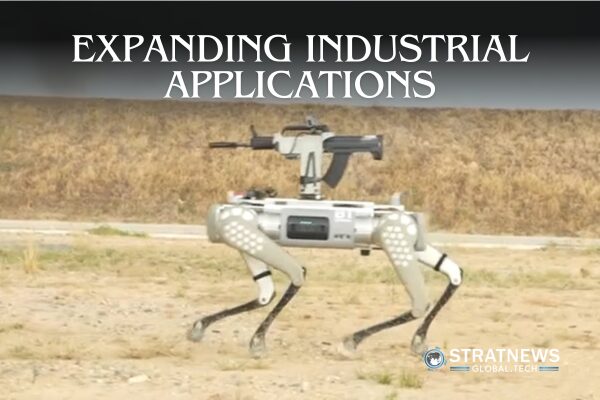
Expanding Industrial Applications
These robotic dogs are designed for more than just mobility. Equipped with 12 motors that mimic canine muscles, they serve critical roles in industrial settings. Their advanced sensors and AI-driven functions enable them to detect gas leaks, map collapsed tunnels, and identify faults in power grids.
In Singapore, robotic dogs from China have already been deployed to patrol and inspect the country’s six-kilometre-long electric cable tunnels. Their ability to operate in hazardous environments makes them invaluable for tasks where human workers face significant risks.
One of the key advantages of these robotic dogs is their cost-effectiveness. Over 95% of their components, including chips, are sourced domestically, allowing Chinese manufacturers to maintain competitive pricing while ensuring rapid product iterations.
A Growing Market with Global Potential
The demand for robotic dogs is surging, with their industrial applications making them more widely used than humanoid robots. The global market for robotic dogs reached $1.2 billion in 2023, and projections suggest this figure could quadruple by 2031. By then, over 560,000 intelligent robotic dogs are expected to be in circulation, solidifying their role in various industries.
Zhong Jianguo, CEO of Roborack, believes China’s robotics industry is well-positioned for global expansion. “China’s robots are superior to some competitive foreign products in terms of iteration speed, maturity, and cost. Their advantages will become more apparent over time,” he said.
As technology continues to advance, China’s robotic dogs are set to become an integral part of industrial automation, emergency response, and infrastructure maintenance, marking a new era in robotics.
With inputs from Reuters

