


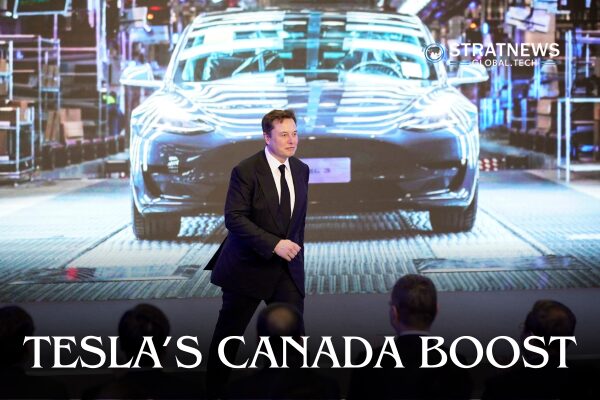
Tesla is positioned to be one of the main beneficiaries of Canada’s decision to remove 100% tariffs on Chinese-made electric vehicles (EVs). Experts say the U.S. automaker’s early move to ship cars from its Shanghai factory and its established sales network across Canada provide it with a significant advantage over its rivals.
Under the new trade agreement announced last Friday, Canada will allow up to 49,000 vehicles to be imported annually from China, subject to a 6.1% tariff under most-favoured-nation terms. Canadian Prime Minister Mark Carney stated that this quota could increase to 70,000 vehicles within five years. However, half of the quota will be reserved for cars priced below 35,000 Canadian dollars (about USD 25,189), a category Tesla models do not fall into.
Tesla’s Shanghai Operations and Market Flexibility
Tesla’s Shanghai plant, its largest and most cost-efficient globally, already produces a Canada-specific version of the Model Y. The company began shipping these cars to Canada in 2023, which led to a 460% year-on-year surge in automobile imports from China to Vancouver, totalling 44,356 units that year.
Shipments from China ceased in 2024 when Ottawa imposed 100% tariffs to counter what it described as China’s state-directed policy of overcapacity. Since then, Tesla has supplied Canada with Model Y units from its Berlin plant, while its more affordable Model 3 remains primarily produced in Shanghai.
Industry experts believe the new agreement could restore Tesla’s previous export arrangements swiftly. “This new agreement could allow resumption of those exports rather quickly,” said Sam Fiorani, vice president at AutoForecast Solutions.
Competitive Edge and Market Presence
Tesla already operates 39 stores across Canada, giving it an established retail and service network. In contrast, Chinese automakers such as BYD and Nio have yet to set up a sales presence in the country. This readiness allows Tesla to move quickly with marketing and distribution plans.
“Tesla indeed has an advantage with its offering of a few models, versions and simple production lines so that it can be flexible to sell cars produced in any country in any markets to achieve the best cost efficiency,” explained Yale Zhang, managing director of AutoForesight in Shanghai.
The company’s focused product range and streamlined production give it agility in responding to shifting trade policies and supply dynamics. Tesla declined to comment on the recent developments.
Opportunities for Chinese EV Brands
While Tesla stands to benefit, the pricing clause in the new trade deal favours Chinese EV makers targeting the lower end of the market. Fiorani noted that the real beneficiaries could be Chinese automakers and Canadian consumers seeking affordable entry-level EVs.
John Zeng, head of market forecasting for China at GlobalData, added that the quota presents an opening for Chinese brands to test demand in Canada, especially given the country’s large Chinese-Canadian population.
According to a report by the Canadian Broadcasting Corporation (CBC), Canada also aims to explore joint ventures with Chinese firms within three years to manufacture a locally assembled EV using Chinese expertise. BYD, China’s leading EV producer, already operates an electric bus assembly facility in Ontario.
Other brands previously exporting from China to Canada, including Volvo and Polestar—both owned by China’s Geely Group—did not comment on the new arrangement.
Broader Trade Implications
Canada’s policy shift contrasts sharply with the approach taken by the former Biden administration, which quadrupled tariffs on Chinese-made EVs to 100% in 2024, effectively halting such imports to the United States. Critics in Washington, including former Trump officials, have condemned Canada’s move, arguing it could undermine North American trade alignment on clean energy manufacturing.
Despite this, Canada’s policy signals a pragmatic approach, balancing protectionism with market access to meet growing domestic EV demand. For Tesla, the shift could reopen a profitable export route from Shanghai while giving Canada’s consumers a wider choice of electric models.
with inputs from Reuters

