


Close Menu
Stratnews GlobalStratnews Global
    Facebook X (Twitter) Instagram
    Trending
    • Commercial Space Strategy Faces Concentration Risks
    • AI in Space Technology could Transform Satellite Operations
    • Semiconductor Training Expands Through India’s C2S Initiative
    • Digital Divide Narrows Through India’s Digital Transformation
    • X launches grok-racist-posts-investigation after offensive chatbot responses surface
    • G Spider AI robot canal cleaning in Thiruvananthapuram boosts sanitation safety
    • Data Is The New Oil: Iran’s Strikes on Amazon, Microsoft Centres Redefine Warfare
    • Pentagon blocks Anthropic AI military use after Anthropic supply chain risk designation
    • Support Us
    Stratnews GlobalStratnews Global
    Write for Us
    Monday, March 9
    • Space
    • Science
    • AI and Robotics
    • Industry News
    • Support Us
    Stratnews GlobalStratnews Global
    Home » India-US NISAR Satellite To Launch On 30 July: A New Era In Earth Observation

    India-US NISAR Satellite To Launch On 30 July: A New Era In Earth Observation

    Kanika SharmaBy Kanika SharmaJuly 22, 2025 India in Space No Comments2 Mins Read

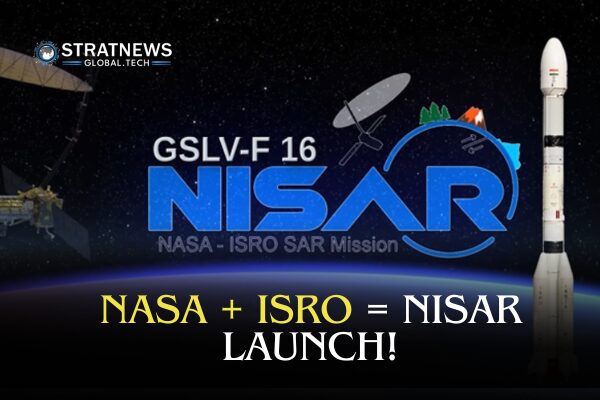
    India’s space agency ISRO has announced that the NASA-ISRO Synthetic Aperture Radar (NISAR) satellite will be launched on 30 July 2025 at 17:40 IST from the Satish Dhawan Space Centre (SDSC SHAR) in Sriharikota. The announcement, shared by ISRO on 22 July 2025 through its official channels, marks a significant moment in international space collaboration as this satellite represents the first joint Earth observation mission between ISRO and NASA.

    The satellite will be launched aboard ISRO’s GSLV-F16 rocket, which will inject it into a Sun-synchronous orbit at an altitude of 743 kilometres, with an inclination of 98.40 degrees.

    NISAR is a state-of-the-art Earth observation satellite weighing 2,392 kilograms. What makes it particularly unique is its combination of dual-frequency Synthetic Aperture Radar systems: NASA’s L-band radar and ISRO’s S-band radar, both mounted onto NASA’s sophisticated 12-metre unfurlable mesh reflector antenna.

    This assembly is integrated onto ISRO’s modified I3K satellite bus. Using SweepSAR technology for the first time, NISAR will survey the Earth with a swath width of 242 kilometres while offering high spatial resolution imagery.

    The satellite is designed to provide comprehensive, all-weather and day-night monitoring of the Earth’s surface. It will revisit and scan the entire planet every 12 days, delivering data that is critical for a wide range of scientific and practical applications. Capable of detecting even subtle changes in the Earth’s surface, NISAR will track ground deformations, glacier and ice sheet movements, and shifts in vegetation patterns.

    Beyond these, it will support applications such as sea ice classification, ship detection, shoreline monitoring, storm tracking, monitoring soil moisture variations, surface water mapping, and providing vital data for disaster management and emergency response.

    This mission is the result of over a decade of collaborative effort between technical teams from ISRO and NASA’s Jet Propulsion Laboratory (JPL).

    According to ISRO’s statement, the NISAR satellite represents a technological milestone and symbolises deepening ties between India and the United States in the field of space exploration. The data gathered by NISAR will play a critical role in resource management, climate change studies, and enhancing global disaster preparedness in the years to come.

    Author

    • Kanika Sharma
      Kanika Sharma

      View all posts
    Dont miss Featured India in Space ISRO Just In NASA-ISRO Synthetic Aperture Radar (NISAR)
    Share. Facebook Twitter Pinterest LinkedIn Tumblr Email Reddit Telegram WhatsApp
    Kanika Sharma
    Kanika Sharma

      Keep Reading

      Commercial Space Strategy Faces Concentration Risks

      AI in Space Technology could Transform Satellite Operations

      Semiconductor Training Expands Through India’s C2S Initiative

      Digital Divide Narrows Through India’s Digital Transformation

      X launches grok-racist-posts-investigation after offensive chatbot responses surface

      G Spider AI robot canal cleaning in Thiruvananthapuram boosts sanitation safety

      Add A Comment
      Leave A Reply Cancel Reply

      Anti Drone System (CUAS)
      Latest Posts

      Commercial Space Strategy Faces Concentration Risks

      March 9, 2026

      AI in Space Technology could Transform Satellite Operations

      March 9, 2026

      Semiconductor Training Expands Through India’s C2S Initiative

      March 9, 2026

      Digital Divide Narrows Through India’s Digital Transformation

      March 9, 2026

      X launches grok-racist-posts-investigation after offensive chatbot responses surface

      March 9, 2026

      G Spider AI robot canal cleaning in Thiruvananthapuram boosts sanitation safety

      March 6, 2026

      Data Is The New Oil: Iran’s Strikes on Amazon, Microsoft Centres Redefine Warfare

      March 6, 2026

      Pentagon blocks Anthropic AI military use after Anthropic supply chain risk designation

      March 6, 2026

      Sierra Space valuation rises as Sierra Space Series C funding reaches $8 billion

      March 6, 2026

      India Digital Public Infrastructure model sets global benchmark for population scale systems

      March 6, 2026

      Subscribe to News

      Get the latest sports news from NewsSite about world, sports and politics.

      • Astronomical Events
      • Space Missions
      • Industry News
      • Science
      StratNewsGlobal Tech
      Facebook X (Twitter) Instagram LinkedIn YouTube
      © 2026 StratNews Global, A unit of BharatShakti Communications LLP
      • About Us
      • Contributors
      • Copyright
      • Contact
      • Write for Us

      Type above and press Enter to search. Press Esc to cancel.