


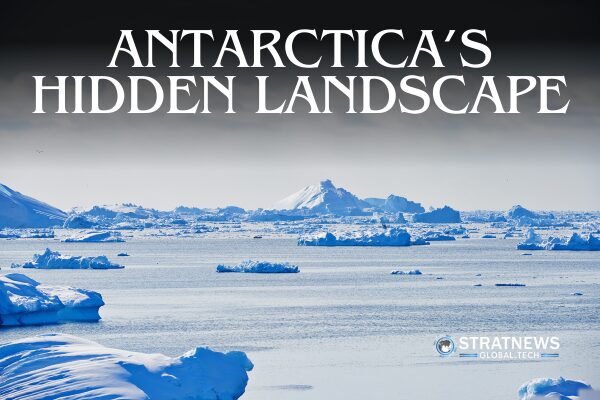
Scientists Unveil the Most Detailed Map of Antarctica’s Hidden Landscape
Scientists have created the most detailed map ever of the terrain concealed beneath Antarctica’s vast ice sheet, revealing a dramatic landscape of mountains, valleys, canyons and plains. Using advanced satellite data and a new analytical method, the team uncovered tens of thousands of previously unknown hills and features beneath the frozen continent.
A Revolutionary View Beneath the Ice
The research, published this week in Science, marks a major step forward in understanding Antarctica’s subglacial world. By combining high-resolution satellite imagery with a technique called ice-flow perturbation analysis, scientists were able to estimate the shape and conditions of the bedrock below the ice. The new map covers the entire continent, including regions that had never been charted before.
Glaciologist Robert Bingham of the University of Edinburgh, one of the study’s lead authors, said accurate mapping of the continent’s bedrock is vital for predicting how quickly the ice sheet could melt and raise global sea levels. “The shape of the bed is an important control on friction acting against ice flow,” he explained. “That friction directly influences how fast ice moves toward the ocean and contributes to sea-level rise.”
The map identifies more than 30,000 previously uncharted hills, each at least 50 metres high. It provides a new view of Antarctica as a complex and diverse landmass—one that, in Bingham’s words, is “anything but boring.”
Hidden History of a Changing Continent
Antarctica, which is about 40% larger than Europe and roughly half the size of Africa, was not always covered in ice. The continent’s subglacial terrain was first shaped more than 34 million years ago, before ice began to form. Since then, shifting glaciers have continued to carve and remodel the surface. Antarctica was once connected to South America before tectonic movements caused the continents to drift apart.
The Antarctic Ice Sheet remains the largest body of ice on Earth, containing around 70% of the planet’s freshwater. Its average thickness is about 2.1 kilometres, with some areas reaching nearly 4.8 kilometres.
Bingham noted that many of the features revealed by the new map resemble landscapes in regions such as Scotland, Scandinavia and Greenland, featuring deep glacier valleys dissecting high plateaus. “The similarity of the Antarctic landscape to those regions gives us great confidence in our results,” he said.
Mapping What Lies Beneath
Until recently, the surface of Mars was mapped in greater detail than the terrain under Antarctica’s ice. Traditional radar surveys—mounted on aircraft or pulled by snowmobiles—left gaps of up to 150 kilometres between measurements.
Lead author Helen Ockenden of the Institut des Géosciences de l’Environnement in France said the new approach bridges those gaps. “Our method combines mathematical models of ice flow with high-resolution satellite data, allowing us to infer what the landscape must look like even in places where radar data is missing,” she explained. “This gives us the first truly complete picture of how Antarctica’s hidden landscape connects together.”
Implications for Climate Research
The scientists hope the map will improve predictions of how Antarctica’s ice will respond to global warming and contribute to rising sea levels. It could also help guide future field surveys and inform projections used by the Intergovernmental Panel on Climate Change (IPCC).
“We can now identify where detailed field surveys are most needed—and where we already have sufficient understanding,” Bingham added.
The new map, the researchers say, represents a major leap in understanding one of Earth’s least explored frontiers and could play a critical role in shaping future climate policy.
with inputs from Reuters