


As New Delhi prepares to host the two days BRICS Summit on September 12 -13, Space cooperation is expected to feature prominently in discussions among BRICS leaders. This reflects the bloc’s growing ambition to expand collaboration beyond traditional areas such as trade, finance and development into one of the world’s fastest-evolving strategic domains.
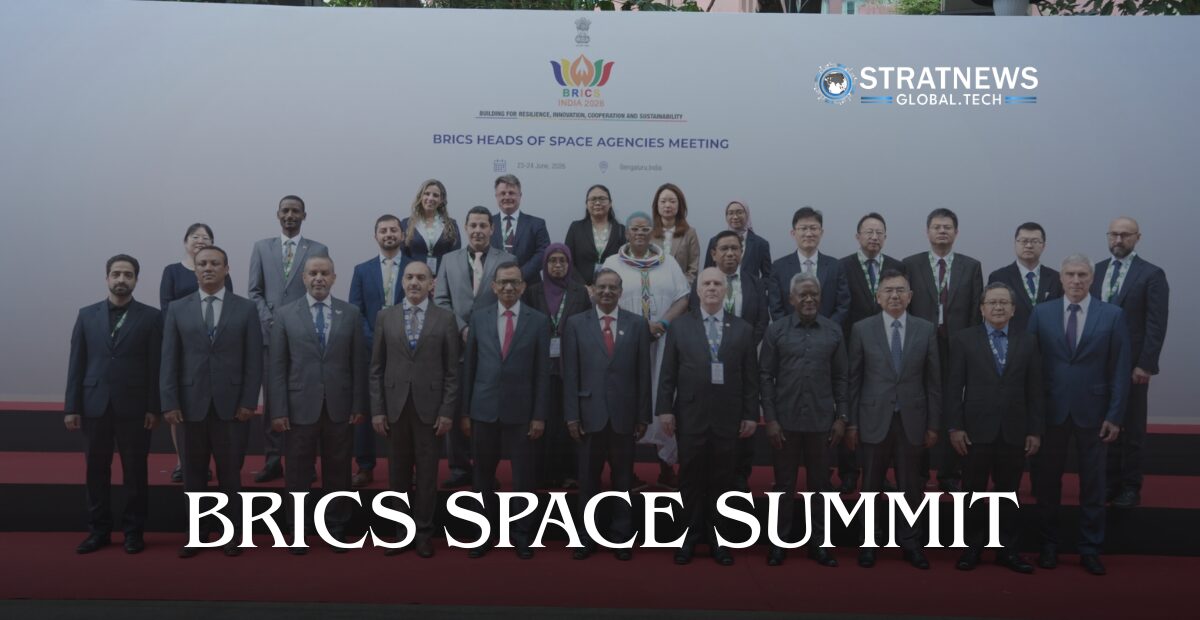
The timing is important. With Chinese President Xi Jinping and Russian President Vladimir Putin among other leaders expected to travel to India for the summit, according to sources, the meeting offers an opportunity for leaders to build on the momentum generated at the BRICS Heads of Space Agencies (HOSA) meeting held in Bengaluru recently.
In this meeting member countries moved beyond routine exchanges to discuss creating permanent institutional mechanisms that could shape the future of BRICS cooperation in space.
Hosted by the Indian Space Research Organisation (ISRO) under India’s BRICS Chairship, the Bengaluru meeting brought together space agency chiefs from all ten BRICS nations including Brazil, China, Egypt, Ethiopia, India, Indonesia, Iran, Russia, South Africa and the United Arab Emirates. It reflected the changing nature of the grouping itself. The expanded BRICS is no longer looking at space simply as a scientific endeavour but more and more as a strategic, economic and developmental asset. One of the biggest outcomes of the meeting was the decision to advance discussions on amending the BRICS Remote Sensing Satellite Constellation Agreement so that the bloc’s new members can become part of the framework.
There were detailed discussions on the Terms of Reference for a proposed BRICS Space Council, an institutional mechanism that could provide continuity to cooperation and help coordinate joint initiatives across member states.
The discussions focused on using space technology to deal with some of the world’s most pressing challenges, including climate change, disaster management, environmental monitoring and sustainable development. Views were exchanged on space sustainability, responsible behaviour in orbit and the growing challenge posed by space debris as the number of satellites continues to rise rapidly.
The implication of these discussions lies in the changing nature of the global space sector itself.
Space is no longer just a place to explore. Today, satellite systems are the backbone of communication networks, navigation, financial transactions, weather forecasting, agriculture, disaster response, border surveillance and military operations. The race for technological superiority is increasingly taking place in orbit and space infrastructure is an essential component of national security and economic stability.
Recognising this shift, Union Minister for Space Dr. Jitendra Singh called for the creation of a “BRICS Space Economy,” arguing that member countries possess the scientific expertise, technological capability and industrial scale needed to emerge as a major force in the rapidly expanding global space sector.
“The future of the space economy will not be shaped by nations working in isolation. It will be shaped by partnerships, shared innovation and collective ambition,” he said while urging BRICS nations to move beyond consultation towards co-development, co-innovation and co-creation.
That vision is expected to receive political attention when leaders meet in Delhi.
India enters these discussions from a position of considerable strength. Over the past few years, its space programme has undergone a remarkable transformation. Landmark achievements such as Chandrayaan-3, the Aditya-L1 solar mission and continuing preparations for the Gaganyaan human spaceflight programme have elevated India’s standing among major spacefaring nations. At the same time, policy reforms have opened the sector to private industry, creating one of the world’s fastest-growing commercial space ecosystems.
Indian space startups, private aerospace companies and industry leaders, met with the delegated an indication towards India’s intention to position itself not only as a launch provider but also as a technology partner capable of contributing across the entire value chain of the global space economy.
India’s expanding bilateral partnerships also provide a strong foundation for wider BRICS cooperation.
Among them, Russia remains India’s closest and longest-standing partner in space. In a previous conversation with StratNewsGlobal, Russian Ambassador Denis Alipov described the relationship as one that stretches from the Soviet launch of Aryabhata, India’s first satellite, in 1975 to today’s collaboration on Gaganyaan and future deep-space missions.“Currently, Roscosmos and ISRO are actively collaborating on the Gaganyaan mission. This includes astronaut training, support in the development of the crewed spacecraft, provision of life-support and crew-escape systems, flight suits, and capacity building in space medicine,” Ambassador Alipov said.
He noted that cooperation now extends into sophisticated areas such as propulsion technologies, satellite navigation through GLONASS and NavIC, ground infrastructure and other advanced technologies that remain confidential.
Looking ahead, he pointed to an even more ambitious possibility.
“One promising frontier may be the collaboration in development of nuclear power sources for deep space exploration,” he said.
Ambassador Alipov also underlined the growing importance of BRICS itself as a platform for multilateral space cooperation.
“Space is increasingly becoming a strategic pillar of BRICS cooperation,” he observed, referring to ongoing work on satellite data sharing, sustainable space connectivity, the proposed BRICS Space Council and collaborative climate-monitoring initiatives.
India’s partnerships with other BRICS members reinforce this broader trajectory.
Cooperation with Brazil has steadily expanded over the past two decades.
Brazilian ground stations have tracked and supported several Indian missions, including Chandrayaan and ASTROSAT, as well as Brazil’s Amazonia-1 Earth observation satellite, which ISRO successfully launched in 2021.Both countries are active participants in the BRICS Remote Sensing Satellite Constellation, making their bilateral experience a natural building block for broader multilateral cooperation.
Similarly, India’s relationship with the United Arab Emirates has entered a new phase. Earlier this year, IN-SPACe and the UAE Space Agency signed a landmark Letter of Intent that moves cooperation beyond launch services into joint commercial infrastructure, private-sector collaboration, technology development and talent creation through a proposed space academy. These initiatives reflect the growing role of industry and startups in international space partnerships, an approach that India is keen to replicate within the BRICS framework.The potential expansion of the Remote Sensing Satellite Constellation could be especially important. By combining the satellite capabilities of all 10 BRICS members, the network would offer broader geographic coverage and greater access to Earth observation data for agriculture, disaster management, climate monitoring, water management and environmental protection.At a time when climate-related disasters are becoming more frequent, such cooperation carries direct developmental benefits for countries across Asia, Africa, Latin America and the Middle East.
Equally important is the focus on space sustainability.As commercial satellite constellations are deployed rapidly, there are concerns about orbital congestion and the issue of space debris and the long-term sustainability of outer space is prominent in international discussions.
BRICS members increasingly see themselves as stakeholders in shaping responsible norms for the peaceful use of outer space while ensuring that developing countries retain equitable access to space technologies.